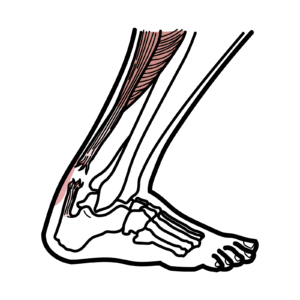
0:00 Hello, in this video we're going to talk about Achilles tendonopathy, or tendon 0:10 itis, 0:10 as well as Achilles tendon rupture. 0:15 The Achilles tendon is the largest tendon in the body. 0:18 The gastrocnemus and soleus muscles, which are highly important for walking, 0:22 running, 0:22 and impact activities, fuse to form the Achilles tendon. 0:27 The tendon needs to withstand up to eight times the bodyweight in force when 0:31 undertaking 0:31 sporting activities, and injuries to the Achilles tendon are common. 0:39 Achilles tendonopathy or tendonitis is an overuse injury from excessive stress 0:44 on the 0:45 tendon. 0:46 Acute rupture of the Achilles tendon can also occur, either in intense sporting 0:51 activities 0:52 or in the elderly, following chronic tendon pain. 1:01 The Achilles tendon has a capacity to resist large, tensile forces, and is the 1:07 largest 1:07 tendon in the body. 1:08 It stems from the distal joining of the gastrocnemus and soleus muscle, and 1:14 inserts at the bottom 1:15 of the capineus, which is a bone. 1:23 Contraction of the gastrocnemus, soleus, and then subsequently, the Achilles 1:29 tendon 1:30 is involved, along with the actions of the tibialis posterior and perineus long 1:34 us and 1:35 brevis, causes the foot to plant aflex. 1:39 So the Achilles tendon has a role in plant aflexion. 1:43 A peritoneous sheath of connective tissue allows the tendon to slide relative 1:50 to the 1:50 surrounding tissue. 1:57 Mechanism of Achilles tendonopathy or tendonitis. 2:02 Acute Achilles tendon pain generally develops when athletes abruptly increase 2:08 their activity, 2:08 causing microtrauma to the tendon itself. 2:14 Without adequate healing time, tendonopathy progresses with recurrent microtra 2:19 uma and degeneration 2:20 of the Achilles tendon, and at which stage, the tendonopathy is chronic. 2:26 Damage tendon becomes calcified, thickened, inelastic and fibrotic. 2:33 Other risk factors of Achilles tendinopathy include cold weather, foot misal 2:39 ignment, poor 2:40 running mechanics, inappropriate footwear, weakness in plant aflexion, and leg- 2:47 length 2:47 discrepancy. 2:51 Acute rupture of the Achilles tendon occurs when a sudden shear stress is 2:56 applied to an 2:57 already weakened or degenerative tendon. 3:05 Achilles tendonopathy usually occurs in athletes who increases their training 3:10 beyond their 3:11 tendin's ability to heal the microtrauma from repetitive stress. 3:16 Typically, they complain of pain or stiffness two to six centimeters above the 3:21 posterior 3:21 calcanius. The pain is usually described as burning, the pain is worse with 3:26 activity 3:27 and may be relieved after a short period of rest. 3:32 Patients with tendinopathy typically have localized tendinitis, again, two to 3:36 six centimeters 3:37 above the posterior calcanius. 3:42 Chronic Achilles tendinopathy, there may be thickening of the actual tendon 3:49 itself. 3:50 An acute Achilles tendon rupture can occur with the following risk factors. 3:59 If they have pre-existing Achilles tendinopathy, they use medications such as 4:04 fluoroquinolones 4:05 or glucocorticoids, and they have autoimmune disorders such as psoriasis and an 4:09 kylosing 4:10 spondylitis. Acute tendon rupture occurs when sudden forces 4:16 are exerted upon the Achilles tendon, during strenuous physical activities that 4:21 involve 4:21 sudden pivoting on the foot or rapid acceleration, typically when a patient is 4:26 pushing off with 4:27 their feet, such as stop-and-go sports like tennis, basketball, or softball. 4:37 People with acute Achilles rupture feel as if they were struck violently in the 4:41 back 4:42 of the ankle, some hear a pop, and experience severe acute pain, although the 4:47 absence of 4:48 pain does not rule out a rupture. 4:52 Most pain-intended ruptures occur where the blood supply of the gastrocnemisol 4:56 ius muscle 4:57 complex is porous, which again is that area, two to six centimeters above the 5:03 insertion 5:04 point. 5:10 The clinical examination of an acute Achilles tendon rupture. 5:14 First, there is loss of tendon definition, and in the acute setting, there 5:18 might be bruising 5:19 and swelling of the area. 5:22 The calf squeeze or Thompson test provides an accurate means for detecting 5:26 complete Achilles 5:27 tendon rupture. 5:30 The test is performed with the patient either lying prone with their feet 5:35 hanging off the 5:36 end of the examination table, or if they kneel on a chair. 5:41 The clinician squeezes the gastrocnemis muscle belly while watching for plantar 5:47 flexion. 5:48 The absence of plantar flexion when squeezing the gastrocnemis muscle marks a 5:53 positive test, 5:55 indicative of rupture. 5:59 Remember, this is because the Achilles tendon plays a role in plantar flexion. 6:08 The differential diagnosis of an Achilles tendonopathy or Achilles tendon 6:14 rupture include ankle 6:15 sprain. 6:16 Ankle sprains occur with landing, whereas acute Achilles problem occurs when 6:22 taking off typically. 6:27 Calcanial brusitis and calcaneal apothecitis. 6:36 Diagnosis of Achilles tendonopathy is based on history and examination. 6:40 Imaging is generally not necessary except to run other conditions such as a 6:44 fracture or 6:45 to confirm Achilles tendon rupture with an ultrasound. 6:51 Treatment. 6:55 In acute tendonopathy, it's important to avoid aggravating activities, apply 7:00 ice when symptomatic, 7:02 non-steroidal anti-inflammatory drugs, support the Achilles tendon with a heel 7:07 lift, approximately 7:08 12mm rise, and also using elastic bandages or taping as needed. 7:14 It's important to slowly return to exercise or rehabilitation. 7:24 In chronic tendonopathy, injection therapies might be used such as glucocortic 7:29 oid injection, 7:30 platelet-rich plasma injection, and autologous blood injections. 7:36 Other treatments for chronic tendonopathy include extra-corporial shockwave 7:40 therapy, dry-meadling, 7:43 and taping and heel support. 7:50 Treatment of acute tendon rupture of the Achilles tendon is either surgical or 7:56 non-surgical, 7:58 and the area is controversial. 8:01 Typically, surgery is used for athletes, whereas non-surgical approaches are 8:07 for inactive patients 8:08 such as the elderly. 8:10 And other treatment is really resting and possibility of injection (tratherapy, 8:20 as mentioned). 8:22 Complications of Achilles tendon rupture is typically re-injury, whether it's 8:26 tendon 8:26 opathy or Achilles tendon rupture, as well as thromboembolism. 8:38 So in summary, the Achilles tendon is the largest tendon in the body, and is a 8:41 common 8:41 side of injury. 8:42 The two important injuries are Achilles tendonopathy, tendonitis, from overuse 8:48 injury, and Achilles 8:49 tendon rupture. 8:51 Thank you for watching. 9:08 You