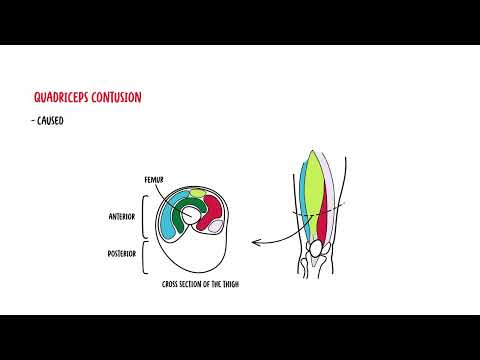
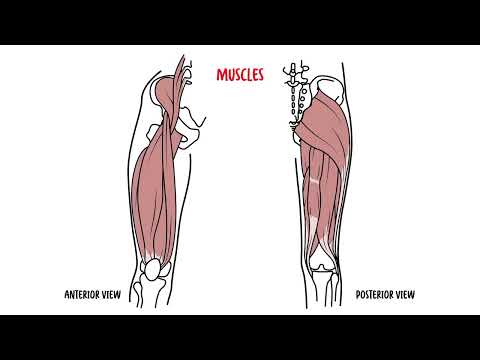
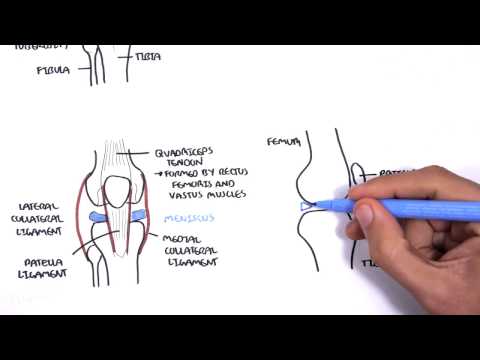
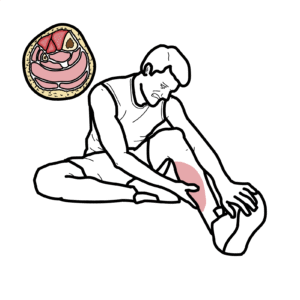
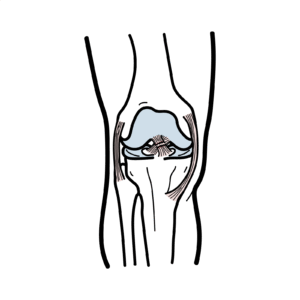
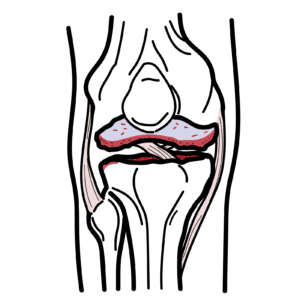
0:00 The quadriceps comes from the Latin quadri, which means containing four, and se 0:15 ps, pertaining 0:16 to the head. 0:18 Therefore, quadriceps consist of four individual muscles, the rectus femoris, v 0:25 astus lateralis, 0:27 vastus medialis, and vastus intermedius. 0:32 These muscles make up the anterior compartment of the thigh, together with sart 0:36 orius and 0:37 the pectinius. 0:39 In addition to these, the end of the iliosois muscle passes into the anterior 0:45 compartment. 0:47 The quadriceps muscles have different origins, but converge an insert onto the 0:53 patella as 0:54 the common quadriceps tendon. 0:57 This tendon then envelopes the patella, and inserts onto the tibial tuberosity. 1:03 The portion of the tendon that extends inferior to the patella is generally 1:07 referred to as 1:08 the patella tendon. 1:16 The combined action of the quadriceps muscles is knee extension. 1:25 Let's look at each of these four quadriceps muscles in a bit more detail. 1:30 The rectus femoris is the only muscle of the four that passes two joints, the 1:35 hip and knee 1:36 joint. 1:37 The rectus femoris also helps perform hip flexion, because it originates at the 1:43 anterior 1:44 inferior ilioxbine and ilium, superior to the acetabulum, and then attaches all 1:50 the 1:50 way down to form the quadriceps tendon. 2:00 The vastus lateralis has the largest volume of all the quadriceps. 2:05 It originates at the greater trochanter and the lateral lip of the linear asper 2:10 of the 2:11 fema, and again attaches to form the quadriceps tendon. 2:16 It also has some aponeuroses that actually attach to the patella itself. 2:24 The vastus lateralis contributes to knee extension, but also pulls the patella 2:33 laterally. 2:35 The vastus medialis is the smallest of the quadriceps and originates at the 2:42 medial fema 2:44 near the intertrochanteric line and the medial lip of the linear asper of the 2:51 fema. 2:52 The vastus medialis then forms the quadriceps tendon, but again, part of the ap 2:56 oneuroses 2:57 also attaches onto the patella. 3:00 The vastus medialis counteracts the vastus lateralis by pulling the patella med 3:07 ially. 3:08 Finally, the vastus intermedius is behind the rectus femoris. 3:18 It originates from the anterior and lateral surfaces of the femoral shaft and 3:26 forms the 3:28 quadriceps tendon as well. 3:31 The quadriceps muscle join and form the quadriceps tendon, which again envelop 3:36 es the patella, 3:37 a cesamoid bone in front of the knee joint. 3:40 The quadriceps tendon envelopes the patella and inserts onto the tubule tuber 3:45 osity as 3:46 the patella tendon. 3:53 The innervation of all these muscles are by the femoral nerve, which arises 3:57 from the nerve 3:58 roots at the second and fourth lumbar vertebrae. 4:06 The blood supply of these muscles is from the femoral artery, the medial and 4:12 lateral 4:13 circumflex artery, and the profunda femoris artery, which are your deep femoral 4:22 branches. 4:23 The function of the quadriceps muscle is to extend the knee, and as we have 4:28 learned, 4:29 the rectus femoris helps with hip flexion as well. 4:37 Now there are many pathologies that can involve the quadriceps as well as the p 4:42 atella tendon. 4:45 This includes the quadriceps muscle strain, where you have a tear of the quad 4:50 riceps muscle. 4:51 Quadriceps muscle contusion, which is where you have direct trauma to the 4:57 muscle. 4:58 Quadriceps tendonitis, which is inflammation or irritation of the quadriceps 5:03 tendon. 5:04 Quadriceps tendon tear or rupture, where you have tear or complete tear of the 5:09 quadriceps 5:09 tendon, patella tendonitis, which is inflammation of the patella tendon, or p 5:17 atella tendon tear 5:18 or rupture, which is where you have a tearing or complete tear rupture of the p 5:25 atella tendon. 5:27 Other pathologies include Oschgood Schlatter disease, which is where you have t 5:32 ibial tuberosity 5:33 A-vulsion, and sending lassen Johansson disease, where you have inferior patell 5:42 a apophysis 5:44 of vulsion. 5:49 Pain that can mimic quadriceps or patella tendon pain include Moralgea Parast 5:55 hetica, where 5:56 you have nerve entrapment of the lateral femoral cutaneous nerve. 6:01 This could be from things such as acides. 6:04 Femoral nerve injury, where the nerve that innervates the quadriceps muscle 6:08 gets compressed, 6:10 for example, causing pain around the thigh. 6:15 Femoral or patella fracture, knee bursitis, which is inflammation of the bursa, 6:23 which 6:23 are fluid-filled sacs around the knee. 6:27 That pad syndrome, where fat behind the patella becomes impinged, causing pain, 6:34 click a syndrome, 6:36 which is essentially where you have an interarticular band that is thickened 6:41 and fibrosed, and 6:42 this may cause pain around the knee region. 6:48 Patellofemoral pain syndrome, also known as runner's knee, which is essentially 6:51 a diagnosis 6:52 of exclusion common in athletes. 6:56 There will be a video that will look into some of these conditions in more 7:00 detail, as 7:01 well as their treatment. 7:10 So in summary, we talked about the anatomy of the quadriceps, which consists of 7:15 four muscles, 7:17 the rectus femoris, vastus lateralis, vastus medialis, and vastus intermedius. 7:25 We talked about the different pathologies that can arise, such as quadriceps 7:30 strain and 7:30 quadriceps tendon tear. 7:33 Thank you for watching.