

Bipolar Disorder
Overview
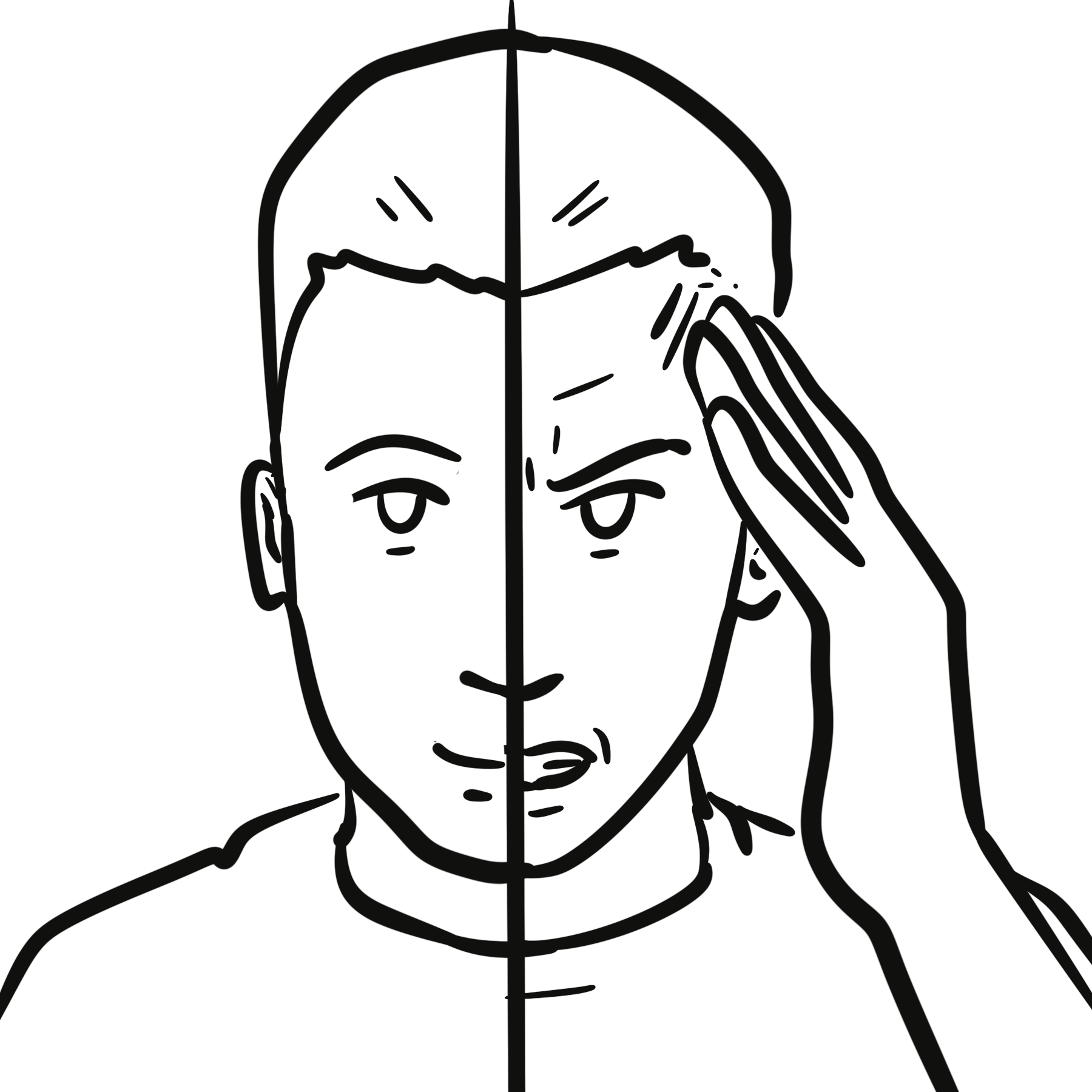
Bipolar disorder, previously termed manic depression, is a psychiatric diagnosis characterised by abnormally elevated or irritable mood episode(s) accompanied by disruptive symptoms of distractibility, indiscretions, grandiosity, flight of ideas, hyperactivity, decreased need for sleep, and talkativeness. It is well known that bipolar disorder carries with it high mortality and morbidity rates. The lifetime risk for suicide for people with bipolar disorder is 15%. Early recognition and treatment of bipolar disorders improve outcomes.
Definition
Bipolar disorder type I: A syndrome with complete manic symptoms occurring during the course of the disorder.
Bipolar disorder type II: Hypomania, characterized by depression and episodes of mania that do not meet the full criteria for manic syndrome.
Hypomonia: Symptoms are similar to those of mania, although they do not reach the same level of severity or cause the same degree of social impairment.
Rapid-cycling bipolar disorder: Occurrence of at least four episodes— both retarded depression and hypomania/mania—in a year.
Labile: A mood and/or affect that switches rapidly from one extreme to another. For example, a patient can be laughing and euphoric one minute, followed by a display of intense anger and then extreme sadness in the following minutes of an interview.
Classification
Type I Bipolar
- Manic episode
- Between manic episodes depression
Type II Bipolar
- Less severe
- Hypomania
- Between manic episodes depression
Bipolar disorder is characterised by recurrent episodes of elevated mood and depression, together with changes in activity levels. Elevated mood is severe and sustained (mania) in bipolar I disorder and less severe (hypomania) in bipolar II disorder.
Risk Factors
- Family history
- Stressful life events
- Previous history of depression
- Substance abuse
- Age <25yo
- Presence of an anxiety disorder
- Obesity
- Cardiovascular disease
Children of parents with bipolar disorders have a 4 to 15 percent risk of also being affected, compared with a 0 to 2 percent risk in children of parents without bipolar disorders.
Clinical Manifestation
Bipolar disorders often are first diagnosed in adolescence or early adulthood after several years of symptoms. Patients with bipolar disorders often present for treatment with depression or in a mixed state. The clinical course of bipolar disorders varies. Patients rarely experience a single episode, with relapse rates reported at more than 70 percent over five years.
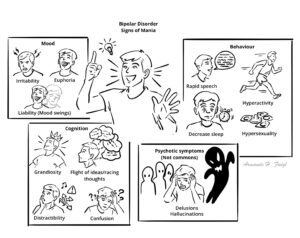
Signs of Mania
Mood
- Irritability
- Euopharia
- Liability
Cognition
- Grandiosity
- Flight of ideas/racing thoughts
- Distractibility/ poor concentration
- Confusion
Behaviour
- Rapid Speech
- Hyperactivity
- Decrease sleep
- Hypersexuality
Psychotic symptoms (Not common)
- Delusions
- Hallucinations
Patients in the midst of an episode of mania are often quite irritable and have very little insight into their own disease, making compliance with treatment difficult.
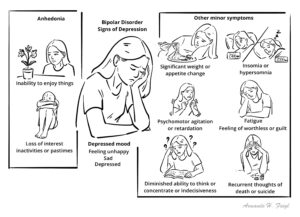
Signs of Depression
Depressed mood
- Feeling unhappy
- Sad
- Depressed
Anhedonia
- Inability to enjoy things
- Loss of interest inactivities or pastimes
Other minor symptoms
- Significant weight or appetite change
- Insomnia or hypersomnia
- Psychomotor agitation or retardation
- Fatigue or loss of energy
- Feelings of worthlessness or guilt
- Diminished ability to think or concentrate or indecisiveness
- Recurrent thoughts of death or suicide
Patients in the midst of an episode of mania are often quite irritable and have very little insight into their own disease, making compliance with treatment difficult.
Depression is usually more common and longer lasting than elevated mood, and—together with inter-episode milder symptoms—contributes most to overall morbidity.
Investigations
- Serum drug screening
- Opiates
- Amephatines
- Cocaine
- FBC – anaemia
- Thyroid function test – to rule out hyperthyroidism
- Serum Vitamin D – as a cause of mood symptoms
- Lipid studies – usually abnormal in patients with bipolar disorder
- Serum Glucose – rules out diabetes
- Urinalysis – to rule out infection in elderly
Diagnosis
DSM V criteria for a manic episodes (DIGFAST)
- Distractibility
- Insomnia, Irritability, Impulsivitiy
- Grandiosity
- Flight of ideas
- Activity increased
- Agitation
- Speech, Sleep and Apetitite
- Thoughtlessness
Factors that support Diagnosis
- Family History
- Personal history
- Substance abuse
Treatment
Early diagnosis and treatment of acute mood episodes improve prognosis by reducing the risk of relapse and doubling the rate of response to medications. Treatment should continue indefinitely because of the risk of relapse. In the maintenance phase, patients with bipolar disorders should receive regular clinical examinations that focus on depressive, manic, and sleep symptoms; suicide risk; comorbid conditions and general medical health; and substance abuse
Maintenance Non- pharmacological methods
- Cognitive behavioral therapy
- Caregiver support
- Psychoeducation regading the early warning signs of mood replase
Maintenance Pharmacological (Prophylaxis) – Mood stabilizers
- Lithium carbonate
- Valproic acid
- Second line – Carbamazepine or oxcarbazepine
Pharmacology
Lithium is a mood stabilizer. Side effects (LITHIUM CV): Leukocytes Increased Tremors Increased Urine Mother-teratogenic Coma Vision problems.
During the course of an episode of acute mania, patients almost always require an antipsychotic in addition to a mood stabilizer, at least for the short term.
Emergency Acute Mania Patients with acute mania need to be hospitalized because they could harm themselves or others.
- Lithium OR
- Olazapine OR
- Sodium Valproate
- +/- antipsyhotics
Emergency Acute Depression Patients with acute depression should be assessed for suicidal or homicidal ideation and the need for inpatient treatment
- Lithium OR
- Lamotrigine OR
- Antipsychotic
| Scheduling (must assess patient within 24hrs of admission) |
| Mentally ill or disorder |
| Facility and treatment available |
| Risk to themselves or others |
| Least restrictive method |
| They wont admit voluntarily |
Complications & Prognosis
Complications
Mental disorder
- Cognitive dysfunction
- Suicide
- Disability
Medication
- Weight gain
- lithium nephrotoxicity
- lithium hypothyroidism
- lithium intoxication
- lithium neurotoxicitiy
- lamotrigine induced rash
- valproate induced hyperammonaemic encephalopathy
Other psychiatric disorders, such as anxiety disorder and alcohol and drug misuse, are common.
Prognosis
- Likelihood of recurrence is almost certain, as the vast majority of patients have more than 1 lifetime episode.
- Manic episodes typically have an abrupt onset, developing over a few days, while depressive episodes usually develop more gradually. With treatment, episodes of mania, depression, or mixed states last for approximately 3 months.
- Mortality is higher among patients with bipolar disorder when compared with the general population.
References
- Anderson IM, Haddad PM, Scott J. Bipolar disorder. BMJ. 2012;345:e8508. doi:10.1136/bmj.e8508.
- Price AL, Marzani-Nissen GR. Bipolar disorders: a review. Am Fam Physician. 2012;85(5):483-93.
- American Psychiatric Association. Diagnostic and statistical manual of mental disorders. 5th ed., text rev. Washington (DC): American Psychiatric Association Publishing; 2022. doi:10.1176/appi.books.9780890425787.
- Yatham LN, Kennedy SH, Parikh SV, Schaffer A, Bond DJ, Frey BN, et al. Canadian Network for Mood and Anxiety Treatments (CANMAT) and International Society for Bipolar Disorders (ISBD) 2018 guidelines for the management of patients with bipolar disorder. Bipolar Disord. 2018;20(2):97-170. doi:10.1111/bdi.12609.
- Keramatian K, Chithra NK, Yatham LN. The CANMAT and ISBD guidelines for the treatment of bipolar disorder: summary and a 2023 update of evidence. Focus (Am Psychiatr Publ). 2023;21(4):344-53. doi:10.1176/appi.focus.20230009.
- McKnight RF, Adida M, Budge K, Stockton S, Goodwin GM, Geddes JR. Lithium toxicity profile: a systematic review and meta-analysis. Lancet. 2012;379(9817):721-8. doi:10.1016/S0140-6736(11)61516-X.





Members only discussions coming soon…