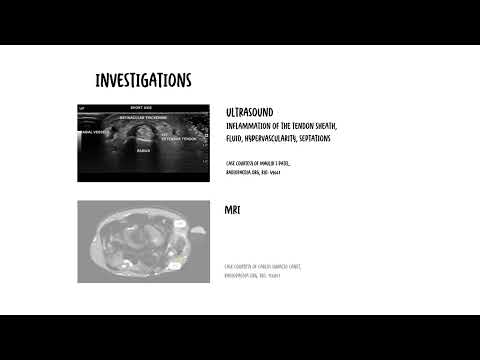
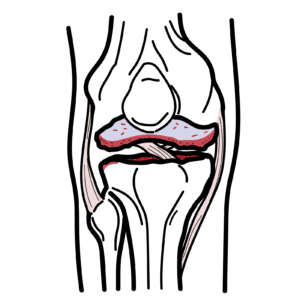
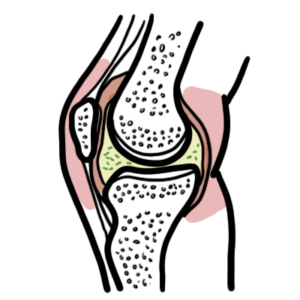
0:00 Hello, in this video we're going to talk about bacon cysts. 0:10 Bacon cysts, also known as popliteal cysts, are one of the most common 0:14 disorders in the 0:17 knee. 0:18 These fluid-filled cysts form at the back of the knee in the area called the 0:21 popliteal 0:22 fossa. 0:23 It is actually enlargement of a bursa that sits between the gastrocnemus muscle 0:29 , called 0:30 the gastrocnemus semi-membranosis bursa. 0:35 Bacon cysts forms in adults as a result of degeneration of the knee joint. 0:41 Bacon cysts is often not a problem, but may cause stiffness and discomfort. 0:52 The knee joint is made up of the lower ends of the femur, upper end of the t 0:56 ibia, and 0:56 the patella. 0:58 The articular cartilage covers and protects the ends of the bone, where they 1:01 meet to 1:02 form a joint. 1:04 The knee joint is filled with a clear fluid called synovial fluid that acts as 1:09 a lubricant 1:10 to help reduce friction between the joint. 1:13 Small fluid-filled sacs, called bursa, cushion the joint and the area, and help 1:19 reduce friction 1:20 between the muscles and the surrounding structures. 1:27 Bacon cysts was first described by Dr. William Morand Baker. 1:34 Most cysts are asymptomatic, so they don't have symptoms, and are detected 1:40 incidentally 1:40 by an imaging study performed for some other reason. 1:44 The cysts is actually an enlarged gastrocnemus semi-membranosis bursa, located 1:52 between the 1:52 gastrocnemus muscle. 1:55 The bursa, or cysts, can be either communicating with the synovial fluid or not 2:02 . 2:02 So in children, there is no communication, and the bacon cysts arise strictly 2:08 from the 2:09 bursa. 2:10 In adults and older people, which is more common, bacon cysts arises secondary 2:16 to degenerative 2:18 or inflammatory joint diseases or joint injuries. 2:21 They usually communicate with the adjacent knee joint space. 2:28 As a result, the bacon cysts normally contain synovial fluid. 2:33 The most common joint disorders causing bacon cysts in adults and the elderly 2:38 include osteoarthritis, 2:40 rheumatoid arthritis, and meniscal tears. 2:49 Clinical presentation The clinical features of a popliteal cyst, 2:53 or bacon cysts, are influenced by the size of the cyst. 2:57 Bacon cysts is typically identified incidentally on imaging for some other 3:04 reason. 3:05 These are normally asymptomatic, however, one can develop posterior knee pain, 3:11 knee stiffness, 3:12 and swelling, or notice a mass behind the knee, especially if the knee is 3:19 extended. 3:21 Patients frequently report discomfort with prolonged standing and with hyperf 3:25 lection of 3:26 the knee. 3:31 On physical examination, there can be a medial popliteal mass that is most 3:36 prominent with 3:37 the patient standing with the knee fully extended. 3:42 For sure sign is where you have swelling that softens or disappears when the 3:48 knee is flexed 3:50 to 45 degrees. 3:57 Diagnosis of bacon cysts If it enlarges, it can compress adjacent 4:01 structures such as the vein, causing lower leg and ankle swelling due to venous 4:07 obstruction. 4:08 Other complications could include dissection or rupturing of the actual cyst, 4:12 and this 4:12 can cause erythema and swelling around the area, which could be misdiagnosed as 4:18 a deep 4:19 vein thrombosis. 4:25 Diagnosis of bacon cysts is based on histrion examination. 4:31 If uncertain, an ultrasound or an x-ray of the area could be used. 4:36 An MRI scan can also be used of the knee. 4:44 Management of bacon cysts If symptomatic, treat the underlying joint pathology, 4:52 such as osteo 4:53 trimatolathritis or the miniscule tear. 4:56 With adult patients who have symptoms, ultrasound guided direct aspiration of 5:01 the popliteal cyst 5:03 can be used, followed by injection of glucocorticoids to help reduce pain and 5:09 inflammation. 5:10 Finally, surgical excision of the bacon cysts could also be done. 5:20 In summary, bacon cysts are fluid filled cysts that form at the back of the 5:24 knee. 5:25 Bacon cysts forms in adults as a result of a degeneration of the knee joint. 5:31 Bacon cysts is often not a problem but may cause stiffness and discomfort. 5:36 Treatment is only done if the patient is symptomatic. 5:39 Thank you for watching. 5:50 [BLANK_AUDIO]