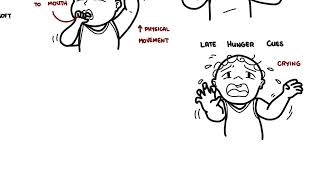
0:00 Is my baby eating enough? 0:07 You've just hit upon one of the most common worries for a new parent, and it's 0:13 perfectly 0:13 normal to feel concerned about whether your little one is getting enough to eat 0:16 . 0:17 It's a question almost every parent asks, especially because babies can't tell 0:21 us directly 0:23 what they need. 0:25 The good news is, your baby's bodies gives us lots of clear signals, and by 0:30 observing 0:30 a few key things, you can feel more confident that they're getting all the nour 0:35 ishment they 0:36 need to grow and thrive. 0:40 One of the most important things to watch is your baby's diaper output. 0:45 Think of it as a direct report from their tummy. 0:49 In the first few days after birth, it's normal for diapers to be a bit space, 0:54 and the poop 0:55 to be dark and sticky. 0:58 This is called maconium, normal, but by the time your baby is about five to 1:04 seven days 1:05 old, you should be seeing at least six to eight wet diapers in a 24-hour period 1:13 . 1:13 For breastfed babies, you'll also typically notice about three to five, or even 1:18 more, 1:18 yellow, CD, poops each day in those early weeks. 1:26 If your baby is formula fed, their poop is a bit different. 1:29 There might be a little less frequent, but should still be soft. 1:36 Plenty of wet and dirty diapers are a fantastic sign that your little one is 1:40 well hydrated, 1:41 and taking in enough milk or formula. 1:47 Beyond diaper checks, pay close attention to your baby's weight gain and their 1:51 overall 1:51 behavior. 1:53 After small, normal, initial weight loss in the first few days after birth, 1:57 your baby 1:58 should start steadily gaining weight by about two weeks of age. 2:03 Your doctor will keep a close eye on this at every checkup, making sure they're 2:09 following 2:10 a healthy growth curve. 2:12 A baby who is getting enough to eat will generally seem happy and content after 2:17 feeds. 2:17 They will be alert and engaged when they're awake and will show consistent 2:22 progress with 2:22 their early developmental milestones, like lifting their head or focusing on 2:31 your face. 2:32 In terms of how often newborns feed, it's helpful to understand that they 2:37 typically 2:38 eat on demand, meaning whenever they show signs of hunger rather than on a 2:43 strict schedule. 2:44 This is especially true for breastfed babies whose mothers' bodies produce milk 2:49 based on 2:50 supply and demand. 2:53 In the first month, a newborn can breastfeed anywhere from 8 to 12 times in a 2:58 24 hour period, 3:00 which often works out to every 1 to 3 hours. 3:05 This milk is very easily digested so babies get hungry more frequently. 3:11 Formula-fed babies might go a little longer between feeds, perhaps every 2 to 4 3:16 hours, 3:16 as formula takes a bit more time to digest. 3:20 It's not uncommon for these feeding sessions to last anywhere between 15 to 40 3:25 minutes, 3:25 and sometimes even longer, especially in the very early days as both you and 3:31 baby are learning. 3:36 You'll notice your baby giving you hunger cues, which can be divided into three 3:40 stages. 3:41 And again, the hunger and feeding is very frequent in the early stages, in the 3:49 early 3:49 months. 3:51 But these hunger cues and these three stages include the early hunger cues, the 3:56 active 3:57 hunger cues, or the later signs of hunger. 4:01 Early hunger cues include things like rooting, turning their head towards your 4:06 hand or breast, 4:08 lip smacking, and sticking out their tongue. 4:11 Active hunger cues are really when they're very hungry, and these include 4:16 increasing 4:16 physical movement and bringing their hands to their mouth. 4:20 Late signs of hunger is when they're really absolutely starving, and they will 4:26 increase 4:26 movement with crying, so trying to feed them before they get to this point can 4:32 make for 4:33 a comma feeding experience. 4:35 Of course, there are also some signs that your baby might just not be getting 4:43 enough. 4:43 And if you notice any of these, or you are concerned, you should definitely 4:46 reach out 4:47 to your doctor. 4:48 These things can include fewer wet or dirty diapers than expected, very little 4:52 or no weight 4:53 gain, or continued significant weight loss, a baby who seems unusually sleepy 4:58 and hard 4:58 to wake up for feeds, or one who is constantly fussy and seems unsatisfied even 5:03 after trying 5:04 to feed them. 5:05 If breastfeeding is consistently painful for you, or if your baby seems to be 5:11 feeding 5:11 for a very long time without much actual swallowing, those are also good 5:15 reasons to seek professional 5:17 guidance. 5:18 Most your instincts, but always feel empowered to reach out to your healthcare 5:22 provider for 5:23 reassurance and support. 5:25 They're there to help you navigate these precious early months. 5:48 You