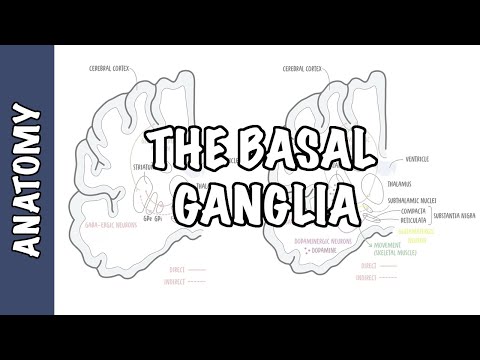
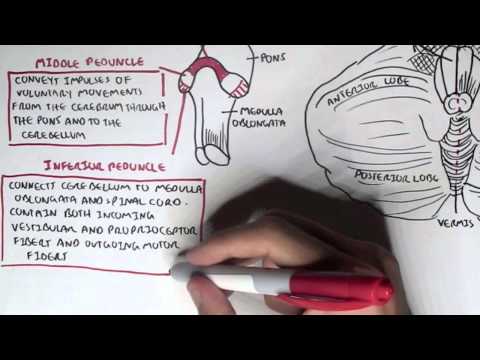
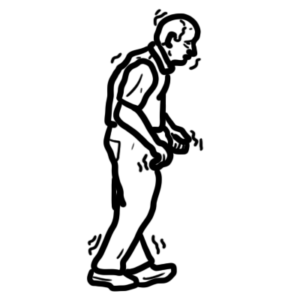
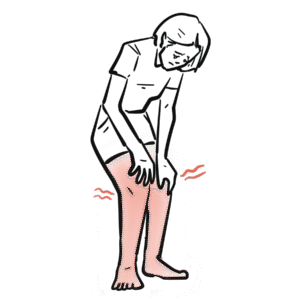
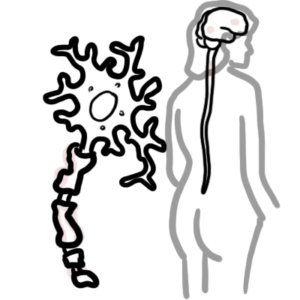
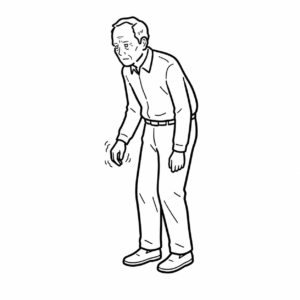
0:00 Hello, in this video, we're going to talk about cerebral palsy, cerebral 0:09 pertaining 0:10 to the brain and palsy as in paralysis. 0:13 Now, cerebral palsy is an umbrella term that refers to a group of disorders 0:18 affecting 0:18 a person's ability to move. 0:20 It is due to damage to the developing brain, either during the pregnancy or 0:25 shortly just 0:25 off the birth. 0:26 There's three important parts of the brain, which is important to know when 0:31 dealing with 0:32 cerebral palsy. 0:33 And these three areas are the cortex, which is essentially the brain itself, 0:37 the basal 0:38 ganglia within the brain, and then the cerebellum. 0:42 Cerebral palsy is a problem in one or more of these areas, causing abnormal 0:47 muscle tone, 0:48 posture, and movement. 0:50 The clinical presentation Again, cerebral palsy is a disorder that manifests 0:55 shortly off the birth. 0:58 Early signs of cerebral palsy include nocytility and irritability, poor feeding 1:05 , abnormal reflexes, 1:08 abnormal muscle tone, asymmetrical movement patterns. 1:15 But of course, these signs can be missed and thought of as normal until the 1:20 baby has grown. 1:22 And that is why it is important to monitor for delays in motor milestones. 1:28 It is also important to know of the misconception that cerebral palsy gets 1:34 worse as we age, 1:36 when actually cerebral palsy is a static disorder and is non-progressive. 1:43 Signs of cerebral palsy in childhood or cerebral palsy in general can be 1:49 classified into three. 1:52 Like syndrome, dyskinetic syndrome, or a toxic syndrome, not a kinetic. 1:58 A kinetic means no movement. 2:01 What's interesting is that these syndromes correlate to the brain areas we 2:05 talked about 2:06 at the beginning of the video, the cerebrum or cortex, the basal ganglia and 2:13 the cerebellum. 2:15 Now, for spastic syndrome, this includes signs and symptoms such as tremors, 2:22 hypertonicity, 2:24 scissor-gate and limb weakness. 2:28 The dyskinetic syndrome include abnormally slow movement, writhing movement. 2:34 And this movement is exacerbated during stress or when there's no sleep. 2:40 The a-taxic syndrome involves the cerebellum and so problems here causes a wide 2:46 -based 2:47 gate and also intentional tremor. 2:52 Cerebral palsy is not only about movement and motor problems, there are a lot 2:56 of other 2:57 complications associated with it and these include pain, intellectual 3:04 disability, speech 3:06 and language disorders, epilepsy, seizures, visual impairment, bladder problems 3:13 , sleep 3:14 disorders, hearing impairment, hip displacement and also behavioral problems. 3:25 The diagnosis of cerebral palsy is clinical. 3:29 However, an MRI of the brain can be performed. 3:33 If the cause of the signs and symptoms is unknown. 3:40 The management of cerebral palsy involves a multidisciplinary team because 3:46 there are 3:46 a lot of complications as we talked about. 3:50 The team involves a physiotherapy to help reduce impairment and optimize 3:54 function, occupational 3:56 therapists for self-care skills and to increase independence. 4:02 A speech therapist is here to assess for dysphagia and also to improve 4:09 communication. 4:10 Orthopedic specialists is important to help with the motor problems, with scol 4:15 iosis of 4:16 the spine which is common and to help with the use of various braces to help 4:21 with movement. 4:23 A neurologist as well as a psychologist is important for mental health. 4:29 The general practitioner or family physician is probably the person who 4:32 coordinates the 4:33 whole thing. 4:34 Then there's also the pediatrician, a neurologist as well as a pediatric nurse 4:40 if and when necessary. 4:44 Let's talk about the mechanism of disease. 4:47 So it's important to recap a little bit about neurology or neuroanatomy. 4:52 So zooming into the brain here, here we have the cerebrum, the big matter of 4:58 the brain. 4:59 It connects to the brainstem which then connects with the spinal cord. 5:04 The cerebellum is an important structure that sits below the brain or cerebrum 5:09 at the back. 5:10 Let's now cut a cross-section of the brain and we are looking at it from the 5:17 front. 5:18 So straight at it. 5:19 In this brain section we are looking at the motor cortex. 5:24 The area of the cerebrum which helps initiate movement, specifically voluntary 5:31 movement. 5:32 So here is the right motor cortex and here is the left motor cortex. 5:37 Neurons which arise from the right will travel down the spinal cord and send 5:44 motor information 5:46 to the left side of the body. 5:48 Similarly, neurons arising from the left motor cortex will go down and cross 5:54 over supplying 5:55 the right side of the body. 5:59 Let us now zoom into the left motor cortex. 6:02 Here is the left motor cortex and we can also see the left cerebellum at the 6:07 bottom here. 6:09 Now the motor cortex has designated areas of our body. 6:15 So for example, this area correlates with the lower limbs, this area of the 6:19 upper limbs 6:19 and here the facial area. 6:22 So if a neuron is arising from the upper limb area here on the left motor 6:27 cortex, which 6:29 is the area of the hand, it means that the neuron will supply motor to the hand 6:35 on the 6:35 right side because remember it is supplying the opposite side of the body. 6:43 This area is called the cortex, the brain cortex, it is more specifically the 6:48 motor cortex of 6:49 course. 6:50 And it is also part of the pyramidal group. 6:52 It is part of the pyramidal group because neurons that are involved here are 6:57 voluntary. 6:57 It is under conscious control. 7:01 Here we have the basal ganglia and cerebellum which actually communicates with 7:06 the voluntary 7:06 neurons to help send coordinated learned movement patterns. 7:12 The basal ganglia and cerebellum is your extra pyramidal because they are not 7:17 under conscious 7:18 control. 7:20 The types of cerebral palsy can be separated as we mentioned into areas 7:24 affecting one or 7:25 more of these regions. 7:27 So for example, problems in the cortex causes spastic cerebral palsy. 7:34 Problems in the basal ganglia causes dyskinetic cerebral palsy. 7:39 Other problems causes a toxic cerebral palsy. 7:43 And there is also mixed cerebral palsy which is a mixture of one or more. 7:49 Spastic cerebral palsy causes stiffness with difficulty moving the limbs. 7:55 Spastic cerebral palsy is the most common type. 7:59 This kinetic cerebral palsy affects the basal ganglia producing involuntary and 8:05 uncontrolled 8:06 movement patterns. 8:08 Which makes sense if you think about Parkinson's disease which also affects the 8:13 basal ganglia. 8:14 A toxic cerebral palsy affects the cerebellum and causes disturbance in the 8:20 sense of balance. 8:22 And this is why patients who have a toxic cerebral palsy have a wide gait. 8:27 Then finally there is the mixed cerebral palsy. 8:31 While the cortex is part of the pyramidal group, the basal ganglia and cerebell 8:35 um as I mentioned 8:36 is not part of conscious control and so it is the extra pyramidal group. 8:45 Paramidal cerebral palsy involves voluntary motor neurons. 8:49 Extra pyramidal cerebral palsy involves involuntary motor neurons. 8:56 Now problems in the cerebral cortex causes spastic cerebral palsy and it is 9:02 part of the 9:03 pyramidal voluntary group. 9:06 Whereas extra pyramidal cerebral palsy affects the cerebellum and/or basal gang 9:11 lia and is 9:11 called a toxic or diskinetic or athenoid cerebral palsy. 9:18 Let us focus on spastic cerebral palsy first which affects the cerebral cortex. 9:25 Now cerebral palsy is not only categorized as to the area of the brain affected 9:30 but also 9:31 how much of the body is affected. 9:35 So for example, here the affected regions of the motor cortex is the left upper 9:41 limb 9:41 and the lower limb regions which means that the right upper limb and the right 9:48 lower limb 9:49 are affected. 9:50 Therefore, this person will have stiff limbs on the right side and there is 9:55 also increased 9:56 tone here as well. 10:00 Because half of the body on one side is affected, this is called hemiplegia. 10:05 Similarly, in this example the affected area is bilaterally the lower limbs of 10:13 the motor 10:13 cortex which means that the lower limbs of the person will be stiff and also 10:20 have increased 10:21 tone. 10:24 When the muscles in the lower limb are stiff, increased tone, different muscles 10:27 work more 10:28 than others and a characteristic feature of spastic cerebral palsy is the sciss 10:34 or gate. 10:35 Because the lower half of the body is affected, this is also called paraplegia 10:42 or diplegia. 10:43 Other parts of the limbs can also be partially affected in spastic cerebral 10:48 palsy. 10:49 Finally, there is quadriplegia. 10:54 This is bilateral upper and lower limb motor cortex involvement. 10:59 There is also scissor stance with all limbs stiff. 11:06 So that was pyramidal cerebral palsy, also known as spastic cerebral palsy 11:12 which affects 11:13 the cerebral cortex. 11:18 Now let's focus on the extra pyramidal cerebral palsy. 11:22 And here, all the body is affected. 11:25 There is no hemiplegia, there's no diplegia, there's no quadriplegia, 11:28 everything is affected. 11:30 In a toxic cerebral palsy, the cerebellum is the problem. 11:35 The cerebellum is a very important structure in the brain for balance and 11:42 coordination. 11:42 And so if this is affected, there is balance and coordination difficulty. 11:47 As a result, the person will have a wide gate. 11:51 In this kinetic cerebral palsy, the basal ganglia is involved creating 11:56 uncontrolled movement 11:59 and dystonia. 12:02 So what causes cerebral palsy? 12:04 Well there is no exact cause but there is thoughts that a number of things can 12:08 or could 12:09 have a relationship to cerebral palsy. 12:12 And these include perinatal hypoxic ischemic injury, prematurity which is seen 12:17 in the majority 12:18 of cerebral palsy patients, antipodum hemorrhage during pregnancy and intrauter 12:24 ine infections 12:25 as well, intracranial hemorrhage in the fetus or fetal stroke. 12:32 A risk is if a mother has multiple pregnancies and there is also possibly 12:39 genetic susceptibility. 12:41 It's interesting to note that the majority, 80% of cerebral palsy are due to 12:47 perinatal 12:48 or anti-natal factors and only less than 20 are actually quiet after the neon 12:55 atal period. 12:56 So that was for me but check out a great video on cerebral palsy by the osmosis 13:03 team. 13:04 They go into a bit more detail on the pathophysiology behind cerebral palsy as 13:09 well as the causes. 13:18 [BLANK_AUDIO]