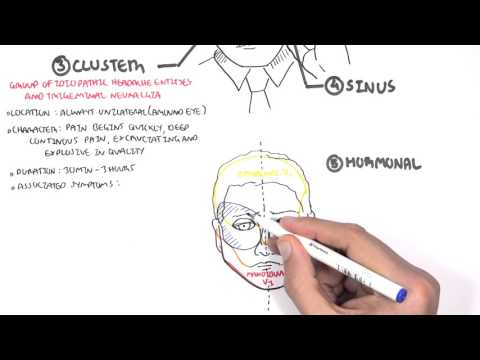
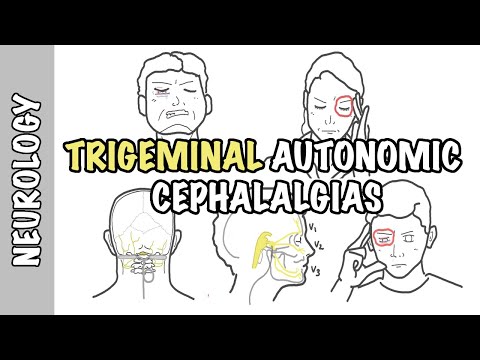
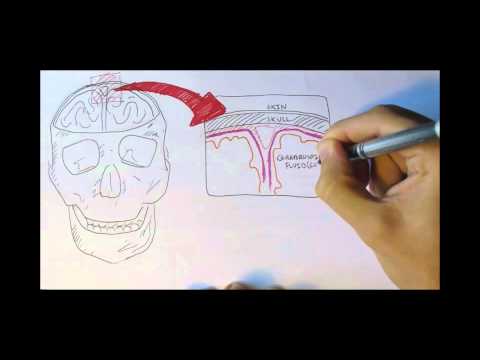
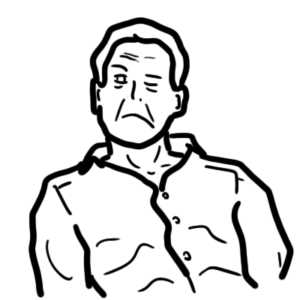
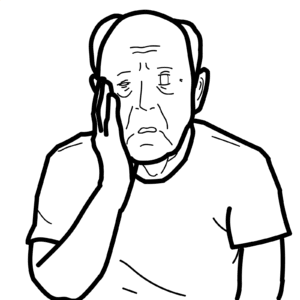
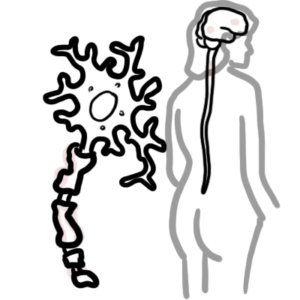
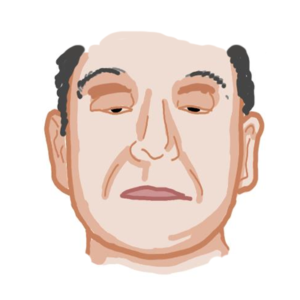
0:00 Clostohedic is a neurological disorder that presents with an intense and severe 0:11 , strictly 0:12 unilateral headache, typically in the superorbital, retroorbital, temporal 0:19 regions, and arising 0:20 from deep within. 0:24 The headache is described as "the person's worst headache ever", using 0:29 comparisons 0:30 such as childbirth, fractures, and renal stones. 0:34 Headaches are so severe it is known as a suicide headache. 0:38 The pain ramps up quite quickly once it starts and typically remains for 15 to 0:44 180 minutes 0:45 when untreated. 0:47 During this time, patients are agitated and restless, preferring to rock in a 0:51 sitting 0:52 position, pace, fidget, and push their hands into the area of most pain. 0:57 Clostohedic's attacks can occur once every other day in the start of a bout and 1:02 increase 1:02 to up to 8 times a day. 1:05 The attacks can have a circadian pattern with a nocturnal preference. 1:11 They are usually associated with prominent cranial autonomic symptoms such as 1:16 lacrimation, 1:17 angunctival injection, rhinorrhea, oral fullness, periorbital swelling, ptosis, 1:23 or meiosis, 1:25 which again are all ipsilateral to the pain. 1:31 Clostohedics have bouts of attacks. 1:34 Clostohedics are more common in men and can be triggered by alcohol, foods 1:38 containing nitrates, 1:40 and strong odors. 1:43 The pathophysiology of clostohedics are poorly understood but involves the trig 1:47 eminal nerve, 1:48 the nerve which is responsible for sensation of our face. 1:53 Clostohedics are actually part of a bigger group of headaches called trigeminal 1:56 autonomic 1:57 effalges because of the involvement of the trigeminal nerve as well as the 2:02 autonomic 2:02 features associated with all these headaches. 2:06 It is believed that activation of the trigeminal autonomic reflex plays a 2:11 central role in the 2:13 pathophysiology of clostohedics. 2:21 The thought is that stimulation of trigeminal afferents here can result in cran 2:28 ial autonomic 2:30 outflow. 2:32 Pain from the cranium travels to the nucleus of the trigeminal nerve. 2:37 From here it sends pain information to the higher brain centers where we 2:44 perceive pain. 2:46 The ipsilateral autonomic features of clostohedics suggest cranial parasymp 2:53 athetic activation. 2:55 This includes lacrimation, rhinorrhea, nasal congestion, and eyelid edema. 3:03 As well as sympathetic hypofunction, so inhibition of the sympathetic system. 3:12 So inhibition of the sympathetic nerve around here resulting in ptosis and me 3:20 iosis. 3:21 These cranial autonomic symptoms are thought to result in part from activation 3:26 of the trigeminal 3:28 autonomic reflex. 3:31 The activation of the trigeminal autonomic reflex is thought to be a result of 3:36 activation 3:37 of the hypothalamus. 3:41 This makes up the trigeminal hypothalamic pathway which is thought to be the 3:47 cornerstone 3:47 of the pathophys of clostohedics. 3:51 The posterior hypothalamic region plays an important role in the pathophys 3:55 iology because 3:56 these headaches display the following characteristics. 4:02 Relapsing and remitting cores, seasonal variation, and a clockwise regularity 4:09 of a single attack. 4:11 And this all implies involvement of a biological clock, namely the hypothalamus 4:16 , in the origin 4:17 of the illness. 4:18 Pet scan imaging have also demonstrated activation of these areas during 4:22 cluster attacks and not 4:24 with other headaches such as migraines. 4:27 Another theory is the vascular theory. 4:29 Clinical symptoms of clostohedics are caused by neurogenic inflammation of the 4:34 walls of 4:34 the cavernous sinus where the sympathetic nerve and the trigeminal nerve run 4:44 through. 4:46 The differential diagnosis of clostohedics are really other trigeminal autonom 4:51 ic pathologies. 4:52 The clostohedics itself shares many features with other trigeminal autonomic 4:57 pathologies 4:58 differing in duration and frequency. 5:06 Clostohedics here typically run a 15-to-180-minute duration with a frequency of 5:12 up to 8 times 5:12 a day. 5:14 Paroxysmal hemichrania have a shorter duration but higher frequency. 5:20 And then you have synced and soona, which are terrible headaches lasting very 5:25 short duration 5:26 but extremely frequent up to 100 times a day. 5:30 And then hemichrania continua, which is a constant headache that can last days. 5:35 Other differential diagnosis separate to a trigeminal autonomic pathologies 5:39 include 5:40 migraines and trigeminal neuralgia. 5:47 Clostohedics to order include an MRI brain. 5:52 Treatment for a cluster headache can be divided into three parts. 5:58 Treating an acute attack, an interim treatment or bridging treatment, and once 6:03 subsided a 6:04 preventative treatment. 6:06 For acute treatment, if someone has a acute onset cluster headache using high 6:11 flow oxygen 6:12 via Hudson mask for example for 20 minutes, also in addition sumatriptan, sub 6:18 cutaneous 6:18 or intranasal. 6:21 Intern treatment can be used as an adjunct, including steroids or an occipital 6:26 nerve block. 6:28 Once pain has settled, preventative strategies such as verapamil or something 6:34 new called 6:34 castitonin gene-related peptide monoclonal antibodies. 6:40 In summary, castohedics are a severe intense headache that is unilateral with 6:46 associated 6:47 autonomic features. 6:49 The pathophysiology is thought to involve the trigeminal autonomic reflex in 6:54 addition to 6:56 hypothalamic activation. 6:59 Treatment includes using high flow oxygen for acute attacks and preventative 7:04 strategies 7:05 using verapamil.