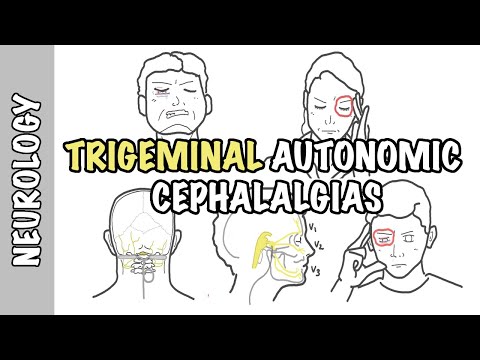
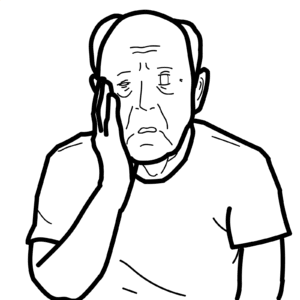
0:00 Hello, in this video, we're going to look at headaches, the main types of 0:07 headaches, 0:08 and then treatment as well. 0:10 So headaches can be divided into two main types. 0:13 We have primary headaches, and we have secondary headaches. 0:18 Secondary headaches are pretty bad, so these are your red flag headaches, and 0:26 we'll talk 0:28 about secondary headaches towards the end of this video, but we will firstly 0:31 look at primary 0:32 headaches. 0:33 And primary headaches are the main, the most common types of headaches that are 0:38 encountered 0:39 by the general population. 0:41 So here I'm drawing this person with a headache, and there are many types of 0:46 primary headaches. 0:48 A very common type is one that affects one side of the face, so unilateral and 0:55 sort 0:55 of upper half, and these are your, and this is known as the migraine headache. 1:01 Then you have tension headache, which sort of feels like a tightness around 1:05 your forehead. 1:07 You have the cluster headache, which is sort of around your eye orbit area, and 1:12 then you 1:12 have sinus headache, which is related when you have sinusitis, or irritation of 1:17 your 1:17 sinus, and then you have hormonal headache, which is a result of sort of your 1:22 hormonal 1:23 levels changing. 1:25 So let's talk about each of these types of headaches in a bit more detail, 1:29 beginning 1:30 with migraine. 1:32 So migraine is a disorder of recurrent attack, so it comes and goes. 1:36 The location of migraine is mostly unilateral, 70%. 1:41 The characteristic of the headache, it's gradual onset. 1:45 Resignedo-paten, which is basically increasing in intensity, sort of, and 1:52 frequency, with 1:53 moderate to severe intensity, so the pain. 1:58 Duration of the headache is between 40, 72 hours roughly. 2:02 Associated symptoms include nausea, vomiting, photophobia, phonophobia, and 2:08 also aura. 2:09 Aura is sort of the feeling of something about to happen, which is the intense 2:16 headache. 2:17 Then you have the tension headache. 2:18 Now, tension headache, you can think of it as being more muscular. 2:22 So it's the most ubiquitous headache, and is the most common reason why over- 2:29 the-counter 2:30 analgesics are actually bought. 2:34 So these are the most common, this is the most common headache, essentially. 2:45 The location of tension headaches are usually bilateral and around the forehead 2:51 area. 2:52 The characteristic, it's pressure or tightness, like a band, which waxes and w 2:58 anes. 2:58 The duration is variable, and associated symptoms, usually none. 3:05 Then you have the cluster headache. 3:08 Now cluster headaches are pretty painful. 3:12 Cluster headaches are a group of idiopathic headaches, that is associated also 3:16 with trigeminal 3:17 neuralgia. 3:18 Now trigeminal, what I mean by that is trigeminal is a nerve, trigeminal nerve, 3:24 and it's a very 3:25 important cranial nerve that does many things around your face, essentially. 3:30 Now the location of the cluster headaches is always unilateral, and it's 3:34 usually around 3:35 the eye, so it's one-sided around the eye. 3:39 The characteristic of a cluster headache, the pain begins quickly. 3:43 It's deep, continuous pain, excruciating and explosive in quality. 3:51 The duration, it's pretty quick in respect to the other headaches we talked 3:55 about, 30 3:56 to 3 hours, and the associated symptoms are essentially the symptoms of the 4:03 trigeminal 4:04 nerve problem, as well as some other nerve problems. 4:07 So just drawing it out, here I'm drawing a face. 4:11 Now we have to quickly just understand what the trigeminal nerve does in order 4:16 to understand 4:17 the symptoms associated with the cluster headache. 4:20 So the trigeminal nerve, it's important for sensation around your face. 4:25 It senses an area around your forehead, which is supplied by the ophthalmic 4:29 branch of the 4:30 trigeminal. 4:31 Then you have the maxillary branch of the trigeminal V2, which applies sort of 4:35 the nose area, and 4:37 then you have the mandibular branch, which is V3, which supplies sort of the 4:41 bottom area 4:42 of your face. 4:43 So that's the trigeminal nerve, it's responsible for sensation around your face 4:50 . 4:51 And these are its branches, three branches. 4:54 So in cluster headache, you have pain in this area in blue here around the eye. 5:01 And the associated symptoms include hornus syndrome, which you have ptosis and 5:08 meiosis. 5:10 The ptosis is drooping of the eyelid and meiosis is a constriction, so you're 5:13 unable to dilate 5:15 your pupils. 5:16 You can also have lacrimation and also nasal discharge. 5:21 So essentially what I'm trying to portray here is that the cluster headache, 5:25 you can 5:25 have some associated symptoms involving the trigeminal nerve and sort of other 5:33 nerve problems 5:34 there in your algeal problems. 5:37 Hope that made sense. 5:39 Then you have sinus headaches, which is associated with sinusitis. 5:42 Then you have hormonal headaches as well, and hormonal headaches, essentially 5:46 it's when 5:47 the changes of your hormone levels causes the headache. 5:50 So it can be associated with low estrogen concentration, for example at the 5:54 beginning 5:55 of the menstrual cycle, or withdrawal of hormone therapy. 6:00 So all of a sudden you have estrogen one minute and then you take away the 6:04 hormonal therapy, 6:05 estrogen levels drop, you get this headache. 6:10 So those were the five types of headaches, primary headaches, migraine, tension 6:16 , cluster, 6:17 sinus, and hormonal. 6:19 Now let us look at the drugs used, the common or main drugs used to treat each 6:24 of these 6:24 headaches, beginning with the migraine. 6:29 So for migraines, which is recurrent, insides or aspirin, plus anti-emetics and 6:36 hydration 6:37 is important. 6:38 So anti-emetics are drugs that stop vomiting. 6:42 For tension headaches, simple analgesics, so this is paracetamol, and again it 6:47 's the 6:48 most common tension headache is the most common reason I guess why people, one 6:52 of the common 6:52 reasons why people buy over the counter-paracetamol. 6:56 For cluster headaches, subcutaneous sumo-tryptam or oxygen can be given, and 7:02 this is to prevent 7:03 vomiting in general. 7:05 Tryptans, which include sumo-tryptam, are actually contraindicated in certain 7:11 patients 7:11 with coronary artery disease, peripheral vascular disease, or cerebrovascular 7:18 disease. 7:19 For sinus headaches, supportive therapy is important, analgesics, anti-emetics, 7:25 and also 7:26 you can prescribe, or you can give, antibiotics depending on the cause of the 7:32 sinusitis. 7:33 So I hope that was clear, the different types of primary headaches, as well as 7:38 just the 7:39 general management. 7:41 Now let's look at secondary headaches, which, as I mentioned earlier, are 7:46 serious and dangerous. 7:48 Secondary headaches are a result of serious underlying diseases or other 7:52 conditions. 7:53 So we have some warning signs and symptoms for secondary headaches, and we can 7:57 remember 7:57 this by the acronym SNOOP. 8:01 S stands for systemic symptoms, illness, or condition, such as cancer. 8:07 N is for neurological symptoms, or abnormal signs, O is for oncents, which is 8:14 new, age 8:15 greater than 40, or it's sudden, such as when you have a thunderclap sort of 8:20 feeling, which 8:20 is a subarachnod hemorrhage, essentially. 8:23 The other O is for other associated conditions or features. 8:26 P is for previous headache history with headache progression or change in 8:32 attack character. 8:36 So essentially what SNOOP is trying to say is that, you know, the headache that 8:41 the person 8:42 presents with is very abnormal, and it's got all these signs and symptoms which 8:46 will 8:47 tell you, hang on a second, this is not normal, this is a more serious problem, 8:52 this is more 8:53 serious than a tension headache or a migraine. 8:57 So let's look at some examples. 8:58 So here I am drawing a person who has a very serious headache. 9:04 So examples of secondary headaches include intracranial hemorrhage, and this 9:10 can include 9:11 subjural, epidural, or subarachnoid hemorrhage. 9:18 And of course these people, they can present with some neurological problems, 9:23 as well as 9:25 some, you know, some complaining of thunderclap, essentially, that the onset 9:31 was thunderclap. 9:33 Then you can have another example is giant cell arthritis, which also is known 9:39 as temporal 9:40 arthritis, which is essentially the temporal artery that is inflamed on the 9:44 side of your 9:45 head. 9:47 The final example of a secondary headache is an internal quadratic dissection. 9:53 So in summary, we looked at headaches, which can be primary or secondary. 9:59 Primary include migraine, tension, cluster, sinus, and hormonal, and secondary 10:04 are your 10:04 dangerous ones, and it's a result of an underlying condition that is more 10:15 serious. 10:17 And we can pick this up with the acronym SNUP, which helps us sort of identify 10:22 if it's more 10:23 serious or not. 10:26 And yeah, so I hope you enjoyed this video. 10:27 Thank you for watching. 10:28 Bye.