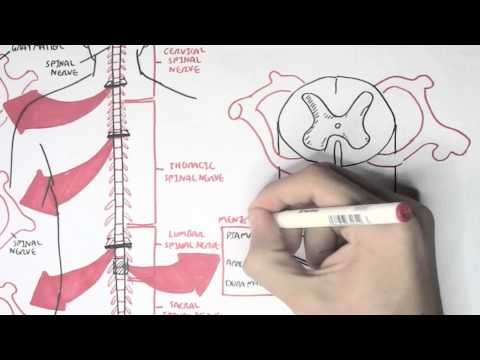
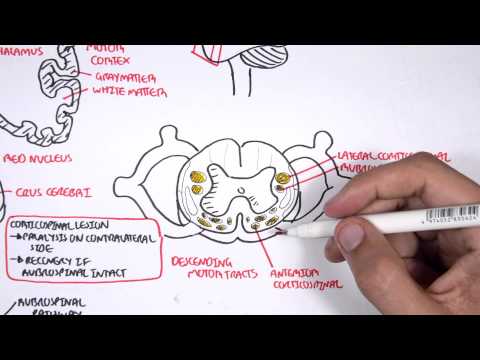
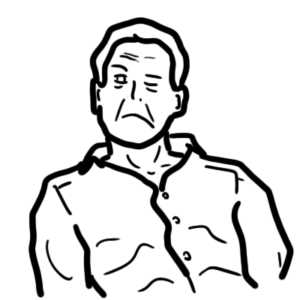
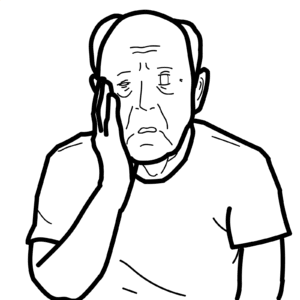
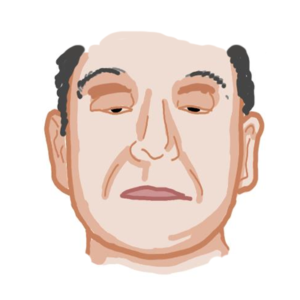
0:00 Horner syndrome is a classic neurologic syndrome with three distinct clinical 0:10 signs on one 0:11 side of the face. 0:13 These are ptosis, which is drooping of the eyelid, meiosis, constriction of the 0:20 pupil, 0:20 and anhydrosis. 0:22 No sweating on the affected side. 0:27 Horner syndrome is caused by a lesion anywhere along the sympathetic pathway 0:31 that supplies 0:32 the head, neck, and the eye. 0:37 You have sympathetic nerves which supply the face, and the sympathetic nerves 0:41 forms what's 0:42 called the sympathetic pathway, and again, a lesion anywhere along this path 0:47 can result 0:48 in Horner syndrome. 0:51 Here you have the brain, contains the hypothalamus, pituitary gland. 0:56 The brain connects the spinal cord via the brain stem made up of the midbrain, 1:01 the palms 1:01 and the medulla, which are written here. 1:04 The sympathetic pathway involved in Horner syndrome include three nerves, 1:10 basically, neurons. 1:13 The first neuron arises from the hypothalamus. 1:17 It descends down to the cervical spinal cord section, about level C8-T1-T2. 1:24 This area is also called the ciliospinal center of budge, and synapses with the 1:30 second neuron 1:31 here. 1:40 The second sympathetic order neuron in ocean blue here travels from the 1:48 sympathetic trunk 1:50 through the brachial plexus over the lung apex. 1:55 It then ascends to the superior cervical ganglion located near the angle of the 2:01 mandible and 2:02 the, roughly, around the bifurcation of the common carotid artery. 2:09 The bifurcation of the common carotid artery is to the external and internal 2:14 carotid arteries. 2:16 The second order neuron synapses with the third order neuron at the superior 2:22 cervical 2:22 ganglion, which is, again, the sympathetic chain, this whole area here. 2:29 The third order neuron then ascends within the adventicia of the internal carot 2:35 id artery. 2:36 The neuron, now termed the oculosympathetic fiber, innovates a few things in 2:42 the eye. 2:43 Firstly, the iris dilator muscle, as well as the mala's muscle, which is a 2:50 small smooth 2:50 muscle in the eyelid responsible for eyelid elevation. 2:56 There are fibers which branch from the superior cervical ganglion traveling 3:01 along the external 3:02 carotid artery, and its branches innovates the sweat glands and are responsible 3:08 for facial 3:09 sweating and vasodilation. 3:14 Let's focus now on the third order neuron, also called the oculosympathetic 3:20 neuron you 3:20 can say. 3:21 Remember, this neuron ascends along the internal carotid artery through the 3:27 cavernous sinus, 3:28 which is a venous plexus, which drains blood from the eye. 3:34 The third order neuron, nerve fibers, the oculosympathetic fibers, they innerv 3:40 ate mala's muscle, which 3:42 is a small smooth muscle in the eyelid responsible for a minor portion of upper 3:49 eyelid elevation. 3:51 The sympathetic nerve also innervates the iris dilator muscle, which causes 3:57 pupils to dilate 3:58 because in a sympathetic response, you are in a phytophyll response. 4:04 And of course, these fibers also supply the sweat glands, because you sweat 4:10 typically 4:10 when you're in a phytophyll response, a sympathetic response. 4:16 Horror syndrome can result from a lesion anywhere along the three neuron 4:22 sympathetic pathway 4:22 that originates in the hypothalamus, the first, the second, or third order 4:28 neurons. 4:28 This means that everything downstream would not occur, so you don't have eyelid 4:35 elevation 4:36 and you don't get pupil dilation because the iris dilator muscle is not innerv 4:42 ated properly 4:42 and you don't sweat. 4:45 As a result, you get the clinical features of horror syndrome, ptosis, meiosis, 4:53 and anhydrosis. 4:55 The cause or etiology of horror syndrome in adults relates to where the lesion 5:00 is located. 5:02 So 40% of cases of horror syndrome, you don't actually know what causes it. 5:08 Majority is caused by lesions in the second or third order neurons. 5:13 So let's take a look at some of the causes, step by step, beginning with 5:17 lesions in the 5:17 first order neuron. 5:20 Those of first order neuron lesion include hypothalamic strokes or tumas. 5:27 Brainstem strokes, such as seen in Wallenberg syndrome, brainstem tumas, brain 5:34 stem demyelination. 5:36 Because the first order neuron travels along the cervical spinal cord. 5:40 Spinal cord tumas, myelitis, demyelination of the spinal cord and seringomyelia 5:47 can also 5:48 cause first order neuron lesions too. 5:55 Lesions to the second order neuron can be a cause of horror syndrome too. 5:59 The causes are much different and include apical lung lesions, the classic we 6:05 learn 6:05 at medical school, the pankos tumour. 6:07 However, subclavian artery aneurysms and any media stinal masses can also cause 6:13 compression 6:14 of the second order neuron and so can cause horror syndrome. 6:19 Thyroid tumas, especially anaplastic carcinomas, which can rapidly grow and 6:25 compress the surrounding 6:26 structures, including compressing the second order sympathetic neuron we just 6:33 learned. 6:34 Lesions to the third order neuron can cause horror syndrome, but may so with or 6:38 without 6:38 anti-drosis because remember, the nerve fibres that supply most of the sweat 6:44 glands come 6:44 from the superior cervical ganglion and travels along the external corded 6:50 artery. 6:51 It doesn't actually go through the cavernous sinus. 6:53 And so if you think about it, lesions of the third order neuron distal from the 6:59 internal 6:59 corded artery won't really affect sweating that much. 7:04 Those of third order neuron include the cavernous sinus issues, having the sin 7:11 us tumas, thrombosis 7:13 in the veins, internal corded artery aneurysms and pituitary tumas. 7:20 The cavernous sinus is actually super important. 7:24 It's a venous plexus which drains blood from the eye and surrounding structures 7:29 . 7:29 The cavernous sinus houses many cranial nerves, number three, number four, 7:34 number five and 7:35 number six. 7:37 The internal corded artery passes through the cavernous sinus as well. 7:43 Now the pituitary gland is superior and close by. 7:47 Remember the third order sympathetic neuron we learned about ascends along the 7:53 internal 7:53 corded artery and passes through the cavernous sinus and so if there's a 7:58 whopping pituitary 7:59 tumour that can compress, injure the third order neuron or if there's thromb 8:06 osis in the 8:07 cavernous sinus from infection or pro-quagulant state that can cause a demi and 8:13 injury to 8:14 the third order neuron you can cause hornet syndrome. 8:20 Due to the internal corded artery such as an internal corded artery dissection, 8:25 aneurysm 8:25 or thrombosis can also result in hornet syndrome. 8:30 Finally, there's also superior cervical ganglion lesions for whatever cause can 8:36 cause a lesion 8:38 in third order neuron causing hornet syndrome. 8:44 So those are the main causes of hornet syndrome classified into the different 8:48 lesions that 8:48 can occur anywhere along the sympathetic pathway. 8:54 Something to remember, painful hornet syndrome, you have to think about 9:00 specific causes such 9:01 as crotted artery dissection and cavernous sinus thrombosis. 9:06 This typically occurs with a headache or neck pain in young adults. 9:11 When someone presents with hornet syndrome after taking history and performing 9:16 a thorough 9:16 neurological examination because your consultant tells you to do so, you need 9:23 to evaluate and 9:24 form a potential diagnosis. 9:26 And so an investigation that can be done is something called the pharmacology 9:30 test using 9:30 cocaine or a pryclonidine to help confirm hornet syndrome. 9:38 This is where essentially you use eye drops, these substances and you're giving 9:44 it to the 9:45 person to induce pupil dilation in both eyes. 9:49 Of course, if the affected side doesn't dilate, then you are suspicious or 9:56 confident that 9:57 it's hornet syndrome. 9:59 Then you do the hydroxy amphetamine eye drop test, which helps identify 10:02 localization of 10:03 the lesion. 10:04 It actually helps distinguish third order neuron from first or second order 10:07 neuron lesions 10:08 only. 10:09 Finally, you need to do some imaging. 10:13 So MRI brain, neck or CT angiogram can be used to identify any tumours, any 10:20 crowded 10:21 auditory dissections or anything else that could be causing this manifestation 10:27 or lesions 10:28 along the sympathetic pathway. 10:31 Treatment of hornets will obviously depend on the cause. 10:43 [BLANK_AUDIO]