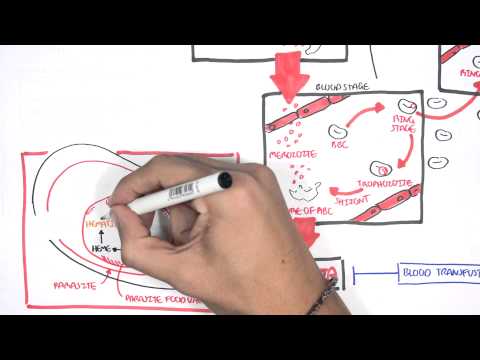
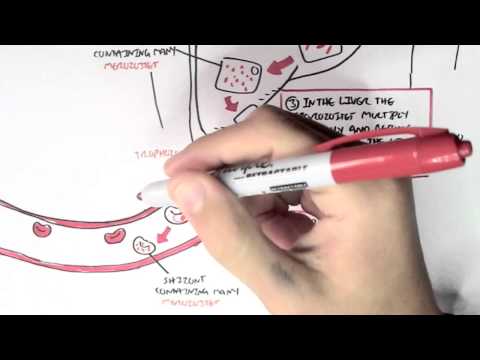
0:00 In this video, we will look at the pathophysiology of malaria. 0:09 We begin by recapping the life cycle of the parasite responsible for malaria. 0:14 So here we have a susceptible human who possibly lives in a tropical area. 0:20 The parasite responsible for malaria are the plasmodium species. 0:25 The plasmodium parasites are actually carried by two types of creatures. 0:30 One human, the other mosquitoes, anopheles. 0:34 So an adult female, anopheles mosquito, carries the parasite and can bite this 0:42 susceptible 0:42 human. 0:44 It bites it because the mosquito normally feeds off blood. 0:49 And while feeding, it will simultaneously inject the deadly parasite into the 0:54 human circulation. 0:55 Let us look inside this infected mosquito to see where this actual parasite 1:02 lives. 1:03 So the mosquito carries the infective form of the parasite in the salivary 1:08 glands. 1:09 The infective form of the parasite in the salivary glands are known as sporozo 1:15 ites. 1:16 During mosquito feeding, the sporozoites are also injected into circulation of 1:21 the 1:21 human. 1:22 The sporozoites then travels to the liver, to the cells of the liver known as 1:28 hepatocytes. 1:30 The sporozoites replicate within the hepatocytes to form a schizion, which 1:37 eventually ruptures 1:39 are releasing many merozoites. 1:43 The merozoites are still the parasite, but in a different form. 1:49 A particular type of plasmodium parasite called plasmodium vivax, or plasmodium 1:55 ovalet, can 1:56 actually infect the hepatocyte and basically become dormant, meaning that they 2:03 don't replicate. 2:04 They just stay in the hepatocyte for a year or two. 2:08 Now this dormant form of plasmodium vivax or ovalet are known as hypnozoites. 2:18 And when the plasmodium vivax or ovalet are ready or want to replicate, they 2:24 enter the 2:25 cycle. 2:26 So they replicate and they rupture the hepatocyte, releasing many merozoites. 2:32 The merozoites then will enter the circulation and begin infecting red blood 2:38 cells. 2:39 So it actually hides within these red blood cells because red blood cells are 2:44 our own 2:44 cells and so the immune system cannot really attack it. 2:48 But not only that, the merozoites actually feed off hemoglobin in the red blood 2:55 cells. 2:56 The merozoites will enter what's called the ring stage during replication and 3:01 then become 3:02 a trophazoid, which matures into schizont, and then rupture again, releasing 3:08 many merozoites. 3:10 It releases many merozoites into circulation and the same cycle continues. 3:15 So the merozoites will infect other red blood cells and et cetera, et cetera, 3:21 et cetera. 3:22 This cycle of the parasite is the asexual blood cycle and is responsible for 3:27 the clinical 3:28 manifestations of the disease, which is fever, chills, sweating. 3:34 Anyways, from the ring stage, some parasites will differentiate into sexual 3:40 stages. 3:41 So some of these parasites will become gametosites, either male gametosites or 3:49 female gametosites. 3:52 And when another enough fleas mosquito comes along, this other enough fleas 3:57 mosquito is 3:58 not infected, by the way. 4:01 And when this uninfected enough fleas mosquito bites the human for feeding, it 4:06 will suck up 4:06 at the same time the gametosites, the male and female parasitic gametosites. 4:12 The gametosites will enter the mosquito's stomach and will enter what's called 4:16 the sporogenic, 4:18 spirogonic cycle, I think I pronounced that right. 4:21 And this is where essentially the male gametosite and female gametosite will 4:25 form a zygote. 4:26 The zygote, in turn, becomes a motile and elongated eucanite, eucanite, eucan 4:33 ite, which 4:34 develops into an oocyte. 4:36 The oocyte grows and then it will rupture releasing sporozoites, which will 4:44 make their 4:45 way to the mosquito's saliva glands, inoculation of the sporozoite into a new 4:51 human host perpetuates 4:53 the malaria life cycle. 4:55 So you can see how this cycle can become very vicious, repetitive and can 5:02 easily spread. 5:04 Now that we know a little about the life cycle, let us concentrate on the path 5:07 ogenesis, so 5:08 what we see in the human in terms of clinical signs. 5:14 So, the spleen of the human is responsible for killing damage to red blood 5:18 cells, amongst 5:19 many other things. 5:21 So we can have normal red blood cells and we can also have the infected red 5:24 blood cells, 5:26 infected by the merozoites, in the asexual cycle, remember. 5:30 The splenic macrophages have a central role in sensing and phagocytizing these 5:35 infected 5:35 red blood cells, and they are exposed to high numbers of parasites in the 5:41 process. 5:42 As a consequence, these macrophages kill many red blood cells, which can 5:48 eventually lead 5:49 to anemia, but also it will lead to the production of large amounts of pro- 5:55 inflammatory cytokines, 5:58 such as TNF alpha and interleukin B. 6:01 So there are two ways that the pro-inflammatory cytokines are released, one, 6:07 when these macrophages 6:09 are exposed to the actual parasites in circulation, or two, when the macroph 6:15 ages in the spleen 6:17 just engulfs the damage to red blood cells, which then will consequently result 6:24 in the 6:24 production and release of pro-inflammatory cytokines. 6:30 These pro-inflammatory cytokines are released in a cyclic manner. 6:34 These cytokines cause the fever they are pyrexic, which is associated with 6:40 signs of malarial 6:41 illness, such as chills, rigor, low blood pressure, headache, excessive pers 6:47 piration, 6:48 sweating basically, and hyperprexia. 6:52 These pyrexic cytokines also cause impaired erythropoasis, which contribute to 6:58 the anemia 6:59 we see in malaria. 7:01 So that was one event that occurs in the pathophysiology of malaria, which was 7:09 the release 7:10 of cytokines. 7:18 So the macrophages and monocytes release TNF alpha and interleukin B, but also 7:25 they release 7:26 interferon gamma, which takes us to the next pathological event that occurs in 7:33 a malarial 7:34 infection. 7:36 This next event, this next pathological event, actually affects the blood 7:41 vessels, small 7:42 capillaries within organs, such as the brains, lungs, placenta, and the kidneys 7:50 . 7:51 So it's important to know that the parasite, when it infects red blood cells, 7:54 it actually 7:55 causes the red blood cells to express a surface protein. 8:00 The TNF alpha and interferon gamma, released by monocytes or macrophages, 8:05 actually increases 8:06 the expression of adhesion molecules by endothelial cells for these surface 8:13 proteins. 8:14 So these adhesion molecules on endothelial cells include CD36 and ICAM1, 8:20 amongst many 8:20 others. 8:22 The cytokines released by monocytes and macrophages also increase vascular 8:26 permeability in organs. 8:30 Depending on the location of the organ, the adhesion molecules expressed by the 8:35 endothelial 8:35 cells are different. 8:37 So for example, in the brain, it is CD36 and ICAM1 that are expressed on endot 8:42 helial cells. 8:46 So what happens is that if an infected red blood cell does not bind to an ad 8:52 hesion molecule 8:53 on an endothelial cell, it will be cleared up by the splenic macrophages. 8:59 However, if an infected red blood cell can adhere to an adhesion molecule on an 9:06 endothelial 9:07 cell, it will trigger coagulation by activating thrombin. 9:13 So essentially, it will create a clot. 9:16 It will form what's known as a rosette, which are essentially red blood cells, 9:21 coagulating 9:21 with one another, like forming a clot. 9:24 And this can lead to inflammation, so we can get tissue inflammation. 9:30 There in tissue inflammation, we get disruption of endothelial barrier 9:36 integrity and a favor 9:37 of local tissue inflammation, we can get leukocyte infiltration into the tissue 9:45 . 9:45 So to summarize, in the brain, if we have obstruction of the vessels and local 9:51 inflammation 9:52 here, this can lead to what's called cerebral malaria, which is fatal. 10:01 In the lungs, the obstruction of vessels and local inflammation contribute to 10:07 acute respiratory 10:08 distress. 10:14 In the placenta, if it is a pregnant lady, the obstruction of vessel and local 10:19 inflammation 10:20 can contribute to placenta malaria, which is fatal as well. 10:26 Finally, the kidneys, kidney problems can be caused by anemia and the tissue 10:33 inflammation 10:34 and coagulation process. 10:37 And this will lead to renal impairment and metabolic acidosis. 10:43 And this can all cause hypoxia and hyperventilation due to the increase in acid 10:51 ity. 10:52 Okay, so that was somewhat a detailed overview of what occurs in malaria. 10:59 We had a release of pro-inflammatory cytokines. 11:03 We had adherence of plasmodium-infected red blood cells, as well as we had the 11:09 rupture 11:10 and removal of parasites and altered red blood cells by splenic macrophages. 11:17 Let us now look into more detail how the pro-inflammatory cytokines actually 11:21 get triggered, get released. 11:24 Remember the pro-inflammatory cytokines are thought to be responsible for the 11:27 signs and 11:28 symptoms of malaria, which is the chills, the fever and the rigor. 11:33 Let us just say here is the outer membrane of a macrophage, and here is the 11:38 nucleus of 11:38 the macrophage where we can find the DNA. 11:42 Okay, now let me introduce things called pamps, which are pathogen-associated 11:48 molecular 11:49 patterns, and these are just structures that can be detected by immune cells. 11:55 The red blood cell can be ingested by the macrophage in a spleen, right? 12:01 And as a consequence of phagocytosis, the genetic material of the parasite is 12:06 released. 12:07 The genetic material is a pathogen-associated molecular pattern, and can be 12:12 detected by 12:13 tall-like receptors, which are important receptors in the innate immune system. 12:21 GPI, which is another structure found in plasmodium parasites, can be released 12:27 when the parasite 12:29 infects red blood cells. 12:31 GPI is properly called glycosylphosphatidylenosetol, and are recognized also by 12:37 tall-like 12:38 receptors on the plasma membranes of immune cells. 12:43 When the tall-like receptor recognizes GPI, it triggers an intracellular 12:49 cascade leading 12:50 to the activation of transcription factor nucleofactor Kappa B, NFKB. 12:57 NFKB moves to the nucleus where it activates the transcription of pro- 13:01 inflammatory cytokines 13:02 that are the protein of alpha and pro-interleukin-1B. 13:09 Pro-inflammatory cytokines means that they are not active, essentially, so they 13:13 need to 13:13 be activated, and we will actually see how this happens. 13:19 Another pathogen-associated molecular pattern is hemozion, which is a product 13:25 of parasite 13:26 metabolism of heme within red blood cells. 13:30 Hemozion are released, which can be taken up by macrophages. 13:35 Hemozion, through several processes, can lead to the activation of CasPase-1. 13:41 CasPase-1 is a molecule complex responsible for activating the pro-inflammatory 13:48 cytokines, 13:49 so it will convert the pro-inflammatory cytokines to cytokines. 13:55 I hope that makes sense, so it converts the pro-interleukin-1B to the active 14:00 interleukin-1B. 14:04 So that was talking about pamps. 14:06 There's also another thing called damps, which are damage-associated molecular 14:12 patterns. 14:12 Damps are endogenous components released from stressed, damaged, or dying cells 14:18 that can 14:18 activate tall-like receptors on immune cells. 14:22 We have three main damps. 14:25 These are associated with malaria. 14:28 These are urate, heme, and microvessels. 14:33 Urate can be endostized, causing activation of CasPase-1, and we know what CasP 14:42 ase-1 does. 14:46 Heme can be recognized by plasma membrane, tall-like receptors. 14:50 The microvessels and tall-like receptor can lead to the activation of the 14:55 nuclear factor 14:57 Kappa-B, which, as we know, is a transcription factor activating the 15:01 transcription of pro-inflammatory 15:02 cytokines, TNF-alpha, and interleukin-1B, which subsequently gets activated by 15:11 CasPase-1. 15:12 So that was a really brief overview of the different pamps and damps that 15:18 activate or 15:19 trigger the release of pro-inflammatory cytokines, which will result in the 15:24 clinical manifestations 15:26 of malaria, which is the fever, rigor. 15:31 To make things a bit more confusing, the macrophage is also an antigen-present 15:36 ing cell, and thus 15:37 can activate T cells through MHC-1 or MHC-2, depending on what T cell it is. 15:44 This can amplify or enhance the release of interferon gamma, which, as we know, 15:52 sort 15:52 of stimulates the expression of adhesion molecules on endothelial cells, and 15:57 thus the formation 15:59 of rosette, the clot, the coagulation, and thus trigger inflammation as well. 16:08 So I hope you enjoyed this video on the pathophysiology of malaria. 16:11 Thank you for watching. 16:12 Bye. 16:14 You