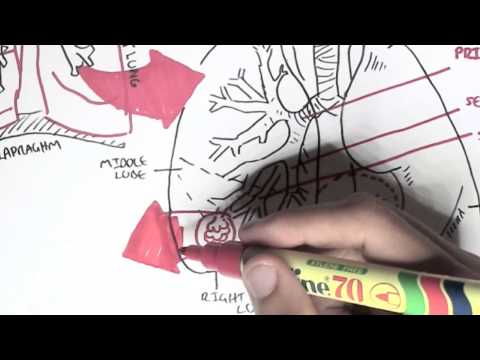
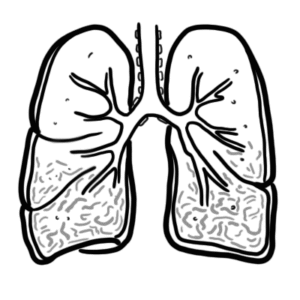
0:00 In this video, we're going to look at the mechanism of breathing. 0:13 Before we start, it is very important to understand the concept of gases and 0:18 pressure. 0:19 The rule to know is that gases travel from an area of high pressure to an area 0:23 of low 0:24 pressure, so it's similar like diffusion. 0:29 It has moved from an area of high pressure to an area of low pressure. 0:32 Anyways, what is the mechanism behind breathing? 0:35 Well here I'm drawing a guy with his respiratory tract, the nose, the mouth, 0:40 the larynx, the 0:40 trachea, the bronchi, and the lungs. 0:43 Here are the lungs. 0:45 Surrounding the lungs, we have visceral pleura, which is a type of serous 0:51 membrane. 0:52 Then we have another pleura around it called the parietal pleura. 0:57 The parietal and visceral pleura are actually part of the same serous membrane. 1:04 It just folds on itself, but we don't have to really understand that for this 1:11 video. 1:12 In between the visceral and parietal pleura, we have what's called the pleural 1:16 cavity, 1:17 and it's important to know just the names of these three when dealing with the 1:22 lungs. 1:23 Now these things I'm drawing around the right lung here partially are the ribs. 1:33 Connecting in between the ribs, connecting the ribs, we have muscles known as 1:38 intercostal 1:38 muscles, and we have three intercostal muscles. 1:43 These intercostal muscles are muscles used for respiration. 1:49 We also have another important muscle used in respiration, the one you probably 1:53 all know 1:53 about called the diaphragm. 1:56 So the two important muscles for respiration are the diaphragm and the inter 2:02 costal muscles. 2:03 Now that we know the muscles, let's learn about the pressures. 2:08 Now outside our body, there is atmospheric pressure, which we measure to be 760 2:14 mm mercury. 2:17 In our lungs, our actual lungs, there is pressure that we call intra pulmonary 2:24 pressure, which 2:25 complements the atmospheric pressure, so it's balanced at 760 mm mercury. 2:33 We also have this other pressure called the intra pleural pressure, which is 2:37 the pressure 2:38 in the pleural cavity. 2:41 Now to make this video really simple, we will focus only on the atmospheric 2:46 pressure and 2:47 the intra pulmonary pressure, which we'll try to balance out. 2:55 And remember the rule that gases, air, travels from an area of higher pressure 3:02 to an area 3:03 of lower pressure. 3:05 So the air, the gas here for example outside, will only travel into the lungs 3:11 when the 3:12 intra pulmonary pressure drops. 3:17 So how does the intra pulmonary pressure in our lungs decrease drops? 3:24 Let's have a look. 3:26 So again, just quickly here, here are the ribs surrounding the lungs. 3:32 And here are the intercostal muscles that run between the ribs. 3:37 Then you have the diaphragm here. 3:39 The intercostal muscles and the diaphragm are the two important muscles in 3:46 normal respiration. 3:48 Then you have the two important pressures, the atmospheric pressure, which is 3:52 760, and 3:52 the intra pulmonary pressure, which in this case is also 760. 3:58 So the atmospheric pressure and the intra pulmonary pressure are balanced. 4:02 There is a difference of 0 millimeters of mercury in respect to the atmospheric 4:09 pressure. 4:11 One more thing to know is the intra pulmonary volume, which is basically the 4:14 volume within 4:15 the lungs. 4:17 Now, if the intra pulmonary volume changes, this would mean that the intra 4:22 pulmonary pressure 4:24 will change as well, right? 4:27 Because there is a relationship between pressure and volume. 4:30 And this is also important to understand. 4:36 Now before we continue, the ribs I have drawn here are a bit misleading because 4:42 most of 4:43 the ribs actually wrap around the lungs, correct? 4:47 So if we were to look at this diagram from a superior view, it can look 4:51 something like 4:52 this. 4:53 So here is the back, the vertebrae, and then the ribs, which actually circulate 4:58 around 4:59 the whole lungs and connects to a bone in the center known as a sternum with 5:06 college. 5:07 And then in between the ribs, running in between the ribs, we have the inter 5:11 costal muscles. 5:13 And of course in the center, which I have not drawn, we have the lungs. 5:19 So let's look at inspiration, the mechanism of inspiration. 5:26 So here again, we have the lungs and the pleura, and then we have the diaphragm 5:30 below the lungs. 5:33 What happens in inspiration is that the volume within the lungs will actually 5:39 increase. 5:40 So here, this is due to the constriction of the two important muscles, the 5:45 intercostal 5:45 muscles and the diaphragm. 5:49 During inspiration, the diaphragm contracts and moves down. 5:53 This will allow the interpulmonary volume to increase. 6:00 Because the interpulmonary volume increases, the interpulmonary pressure will 6:04 decrease 6:05 to about 759 millimeters mercury. 6:09 So in respect to the atmospheric pressure, there is a difference of negative 1 6:14 millimeters 6:15 mercury. 6:17 And the interpulmonary pressure is 1 below the atmospheric pressure. 6:24 And because we know the rule of gases, the air, the gas, oxygen will flow into 6:29 the lungs 6:30 down its pressure gradient from an area of high pressure to an area of lower 6:36 pressure. 6:37 And so after inspiration, we have automatically expiration when we breathe out 6:42 air. 6:42 What happens here is that the intercostal muscles and the diaphragm muscle will 6:47 relax. 6:48 The diaphragm will move back up to its original place. 6:53 And this will cause the interpulmonary volume to decrease again. 6:58 A decrease in interpulmonary volume will mean that the interpulmonary pressure 7:04 will increase. 7:07 And the interpulmonary pressure will increase to 761 millimeters mercury, one 7:15 above the 7:16 atmospheric pressure. 7:18 And so knowing the rule of gases, gases will move out from the lungs into the 7:27 air outside 7:29 down its pressure gradient. 7:33 Hope that makes sense. 7:35 And from expiration, we have inspiration again, and the cycle continues. 7:40 Of course, we have some voluntary control over our breathing, and we can hold 7:45 our breath. 7:46 But this only lasts a short time before our brain overrides our voluntary 7:53 control. 7:54 Now that we get the gist of what's happening in inspiration and expiration, let 7:57 's put 7:58 all of this together and look at the mechanism of breathing from different 8:06 angles. 8:07 So here I'm drawing this superior view of the ribs, and we're looking at what 8:12 happens 8:12 to the rib cage essentially. 8:16 And here I'm drawing the side view of a person with his ribs and lungs. 8:23 And so here we have the diaphragm in dark red I'm drawing here. 8:31 And here we have the intercostal muscles in between the ribs. 8:35 So in inspiration, the diaphragm will descend, and the intercostal muscles will 8:43 contract like 8:45 so, and this will essentially expand the rib cage, and the rib cage will rise. 8:55 This will cause the thoracic cavity volume to increase, and an increase in thor 9:01 acic cavity 9:02 volume will mean that the intrapulmonary volume will also increase, which will 9:07 lead to a decrease 9:11 in intrapulmonary pressure. 9:14 A decrease in intrapulmonary pressure means that gas can flow from a higher 9:19 pressure 9:20 to lower pressure, so from the outside to the inside, so gas flows into the 9:27 lungs. 9:28 Then we have expiration. 9:30 In expiration, the diaphragm will rise, and the intercostal muscles will relax, 9:36 and so 9:36 the thoracic cavity will decrease, will shrink, and the rib cage will descend, 9:45 so the thoracic 9:46 cavity volume will decrease. 9:48 This will cause the intrapulmonary volume to decrease, and which will cause the 9:53 intrapulmonary 9:53 pressure to rise, to increase. 9:57 And so gas will flow out from the lungs, from a higher pressure within the 10:03 lungs to 10:04 a lower pressure outside of the lungs, in the atmospheric pressure. 10:11 Hope that all makes sense, the inspiration and expression mechanism of 10:15 breathing. 10:16 Of course, it's important to note that you have also accessory muscles that are 10:22 used 10:23 in breathing. 10:24 These accessory muscles used are the sterno-clidoid mastoid muscles and the 10:30 scalene muscles. 10:32 I hope you enjoyed this video on the mechanism of breathing, thanks for 10:37 watching, bye.