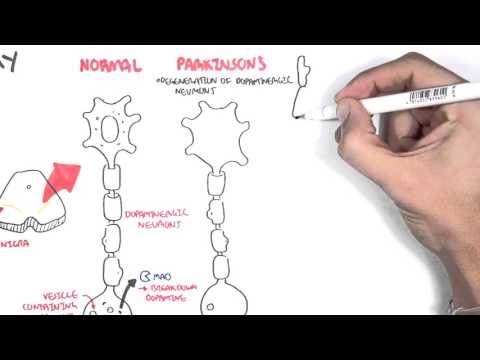
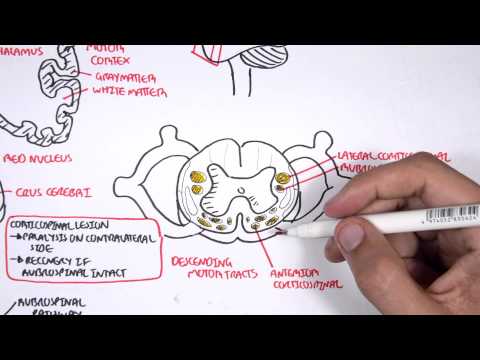
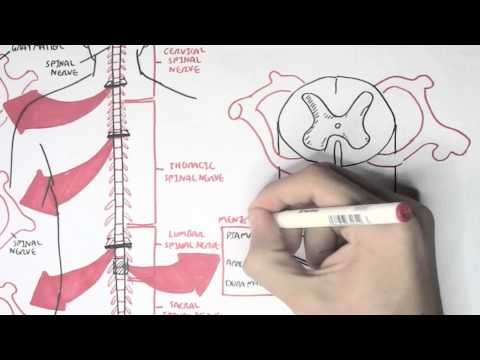
0:00 In this neurology video, we will look at the neuron, the neurons are the 0:19 communication 0:19 cells. 0:21 They receive signals. 0:22 What you see, smell here, is thanks to a group of sensory neurons. 0:28 Neurons also send out signals, or information. 0:32 When we move our hands every time we breathe, it's because of commands being 0:36 sent via 0:36 efferent neurons. 0:39 So neurons are a big deal, and because of this we have billions of neurons in 0:43 our body. 0:46 Here's a typical structure of a neuron. 0:48 It consists of dendrites, which receive an information, a signal. 0:53 The cell body, the soma, the axon hillock, the axon where information or the 1:01 signal in 1:02 a form of an impulse is propagated through. 1:06 There can be myelin, which wraps around the axon to help in insulation and 1:10 speeding up 1:11 the impulse. 1:12 And all the impulse will end at the synaptic terminal, where the impulse, the 1:17 information, 1:18 is passed on to a target cell. 1:24 So looking at it, an input signal is received by the dendrites, gets passed on 1:29 to the cell 1:29 body for integration, and then the output signal is released from the synaptic 1:34 terminal to 1:35 a target cell, for a specific response, a desired effect response. 1:43 The target cell, in this case, is another neuron, but this neuron is different 1:48 in that it is 1:50 an unmyelinated neuron. 1:53 It has no myelin sheath wrapping around it. 1:57 This means that the propagation of the impulse along the axon is much slower. 2:04 When you have a neuron with myelin sheath, the impulse travels much faster. 2:09 But now you might ask yourself, how is the information from a neuron is passed 2:17 on to 2:17 another cell? 2:18 Well, let's zoom into this area here, where these two cells are close to each 2:23 other, where 2:24 they synapse with each other. 2:27 Here we have part of the synaptic terminal of the first neuron, and its presyn 2:32 aptic membrane. 2:35 And here is part of the dendrite of the second neuron, and its postsynaptic 2:40 membrane. 2:41 The gap between the first and second neuron is known as the synaptic cleft. 2:47 In the ends of the synaptic terminal region, like here, we find many mitochond 2:53 ria and vesicles 2:55 containing what's called neurotransmitters. 2:58 These neurotransmitters are released for communication for the communication 3:03 process between cells. 3:07 What happens is that when a signal arrives at the dendrites of the neuron, it 3:11 will create 3:12 an impulse that will carry this information and propagate it towards the 3:17 terminal. 3:18 This impulse is an action potential. 3:21 The action potential will cause, once it arrives at the synaptic terminal, it 3:27 will cause the 3:28 vesicles here to release the neurotransmitters into the synaptic cleft, where 3:33 the neurotransmitters 3:35 will then bind onto the cell's postsynaptic membrane. 3:41 So we can say that the synapse is the site for intracellular communication. 3:48 And seeing that the postsynaptic membrane of the postsynaptic cell belongs to 3:54 the dendrite 3:55 of a neuron, it will receive this information and then create another action 4:01 potential that 4:02 will propagate along the axon towards the synaptic terminal. 4:09 So a new input signal is received by the dendrites. 4:12 It will be integrated in a soma and then it will, the action potential, the 4:18 information 4:19 will pass along the axon towards the terminal and will be passed on as an 4:24 output signal 4:25 via neurotransmitters that will target a particular cell. 4:31 It can be a neuron again or it can be a muscle cell or an endocrine cell, any 4:35 kind of cell, 4:36 depending on where the neuron is located and what its desired response wants to 4:42 be, what 4:43 effect it wants to cause. 4:46 So now that we have an idea of how signals are being passed all around our body 4:51 and how 4:52 we receive signals all around our body, let's learn more about the soma of a 4:57 neuron and 4:58 how the neurotransmitters are packaged up, are made. 5:04 So here we have a close up of the soma of a neuron, we have the nucleus 5:07 containing the 5:08 genetic material, the rough endoplasmic reticulum around it with bound ribos 5:13 omes and free ribosomes 5:15 for protein synthesis, we have the Golgi apparatus for packaging and we have 5:21 the lysosome. 5:23 Now the protein neurotransmitters are synthesized in the rough endoplasmic ret 5:27 iculum by ribosomes 5:29 and then packaged up by the Golgi apparatus. 5:33 So here we have the rough endoplasmic reticulum synthesizing new neurotransmit 5:37 ters that passes 5:38 them on to the Golgi that will then package them up in vesicles. 5:44 These vesicles containing neurotransmitters from the Golgi are then brought to 5:50 the synaptic 5:51 terminal. 5:53 Here we have the synaptic bulb of the synaptic terminal that we're zooming into 6:00 . 6:00 So these vesicles containing the neurotransmitters and also mitochondria, they 6:06 move down via 6:07 microfilaments or microtubules and they move to the terminal bulb here. 6:16 The vesicles are in the synaptic bulb where they can be released via exocytosis 6:22 to the 6:23 synaptic cleft when an action potential arrives. 6:28 The neurotransmitters can be reabsorbed from the synaptic cleft and formed ves 6:32 icles and 6:33 then these vesicles can be recycled. 6:36 They can travel back to the soma of the neuron where they were fused with lysos 6:40 omes. 6:40 The lysosomes will digest these vesicles for recycling. 6:48 So neurons are a big deal, what we just talked about, for cellular 6:54 communication, for sending 6:56 out signals and also receiving signals, receiving information. 7:00 These neurons, I just drew, is actually a typical structure or typical shape of 7:07 a specific 7:07 type of neuron, an efferent somatic neuron that is. 7:12 However, there are a few types of structures neurons can be categorized into. 7:18 And these structural categories, it can be determined by which part of the 7:22 nervous system 7:23 the neurons belong to, if that made any sense. 7:27 I'll just draw a diagram to explain this. 7:31 So the nervous system, remember it can be divided into two major parts, that is 7:35 the central 7:36 nervous system and the peripheral nervous system. 7:40 Now I drew two peripheral nervous systems because the peripheral nervous system 7:43 consists 7:44 of a sensory division and a motor division or better yet an efferent division. 7:52 The sensory division of the peripheral nervous system consists of sensory 7:56 neurons that look 7:57 something like this. 8:00 It has dendritic branches here, the axon on either side of the soma, the cell 8:05 body and 8:05 then the synaptic terminal here. 8:09 This type of neuron is categorized under the structure of a unipolar neuron. 8:16 Now we also have another type of sensory neuron which is slightly similar in 8:21 that it also 8:22 consists of dendritic branches but the dendrite will extend to the soma. 8:29 Then we have the axon and finally the synaptic terminal. 8:33 This type of neuron is categorized under the structure of a bipolar neuron. 8:37 As you can see, the unipolar and bipolar neuron are only slightly different. 8:43 The bipolar neuron we have two separate processes separated by the cell body. 8:48 So we have the dendrite and then the axon on one end. 8:54 The central nervous system consists of many interneurons. 8:58 Interneurons you can say are neurons that bring signals within the central 9:01 nervous system, 9:02 so from the brain to the spinal cord for example. 9:05 But we also have interneurons that act as glial cells, helper cells. 9:10 Anyway, these interneurons have some completely different structures to other 9:14 neurons. 9:15 An example of an interneuron is this, what I am drawing. 9:18 And it doesn't look like it has an axon but only has a cell body in the center 9:23 with many 9:24 dendritic branches around it. 9:26 This type of neuron is categorized under the structure of an anoxic neuron. 9:32 Then we have a multipolar neuron type which contains dendritic branches on one 9:37 end and 9:37 then straight away an axon terminal branch on the other separated by the cell 9:45 body. 9:46 Some multipolar neurons in the central nervous system look slightly different 9:51 than this and 9:52 we shall soon see what I am talking about. 9:56 Now the efferent division of the peripheral nervous system contains efferent 10:01 neurons, 10:02 motor neurons which are all multipolar in structure and this is the type of 10:08 neuron I drew in the 10:09 beginning of this video. 10:11 We can have efferent neurons with myelin wrapping around it or we can have eff 10:15 erent neurons 10:16 without myelin wrapping around it. 10:19 Either way, both are multipolar in structure in that it consists of dendritic 10:26 branches and 10:26 then we have the cell body and then the axon and terminal branches. 10:32 As you can see, this is the other type of multipolar neuron I was talking about 10:37 in the 10:37 central nervous system. 10:39 The terminal branch doesn't have to be really close to the soma body. 10:45 In the efferent division, the terminal branch is extended with the axon. 10:51 Hope that made sense. 10:53 Anyway, that was it for the neuron video for neurology. 10:58 I hope you enjoyed it and hopefully I'll make a video on action potentials or 11:03 action potentials 11:04 soon. 11:05 Thank you.