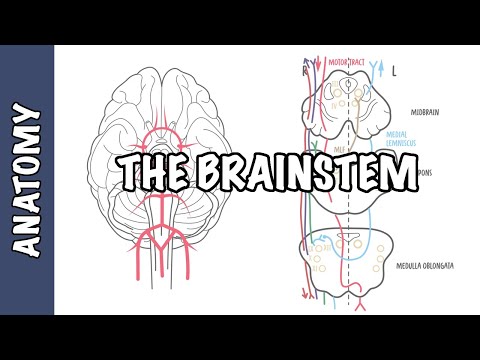
0:00 Hello, in this video we're going to talk about somatosensory pathways focusing 0:11 on a 0:11 dorsal column, also known as the medial liminiscal pathway. 0:16 The pathways from sensory receptors to the cortex are different for the various 0:20 sensations. 0:21 We will mainly be focusing on the pathways which carries touch, vibratory sense 0:26 , and 0:27 proprioception sensations to the cerebral cortex. 0:31 This pathway is the dorsal column, also known as the medial liminiscal pathway. 0:35 Let's revise the spinal cord anatomy and some tracts. 0:39 Here is a section of the spinal cord. 0:42 The dorsal root here will carry sensory neurons from the periphery to the 0:46 central nervous 0:46 system, so the spinal cord. 0:50 The ventral roots carry motor neurons from the central nervous system to the 0:53 peripheral 0:54 nervous system. 0:57 The dorsal column tract is here at the back of the spinal cord. 1:01 It can be divided into two parts, laterally is a fasciculus cuneatus, and med 1:07 ially is 1:07 a fasciculus gracillus. 1:10 The dorsal column tracts are responsible for carrying sensory information on 1:16 touch, pressure, 1:16 vibration, and proprioception to the somatosensory cortex in the brain. 1:21 Let's take a cross-section of the brain and at the somatosensory cortex here. 1:25 The somatosensory cortex is where the somatic sensory information is perceived. 1:31 The thalamus here is an important relay station in the ascending pathway. 1:36 The cerebrum continues to the brainstem, which is made up of three parts, the 1:41 midbrain 1:41 puns and the medulla. 1:44 The spinal cord is here, and we're focusing on the cervical spinal cord as well 1:48 as the 1:48 lumbar spinal cord cross sections. 1:56 Dorsal aspect of the spinal cord is the dorsal column tract, part of the white 2:00 matter, which 2:01 again carries sensory information on touch, pressure, vibration, and proprio 2:07 ception. 2:08 The cutaneous receptors, so the skin receptors for touch and pressure, 2:12 including vibration, 2:14 are the mechanoreceptors, now mechanoreceptors are found in a number of cells. 2:19 Mechanoreceptors include mercal cells, which carry touch and pressure 2:23 information from 2:24 the superficial skin. 2:26 This cell will carry this sensory information to the dorsal column of the 2:30 spinal cord, in 2:31 this case, the cervical spinal cord. 2:36 Refini endings are stimulated by sustained pressure. 2:39 Dicenar corpuscles are stimulated by sensory input of tap and fotters. 2:45 Asinine corpuscles pick up sensation, including deep pressure, as well as 2:50 vibration. 2:51 So when you use a shooting fork on the skin, the pacinine corpuscles can detect 2:54 these change 2:55 and send sensory information to the central nervous system. 3:00 Each of these cells, which are stimulated by touch, pressure, or vibration, 3:03 will carry 3:03 this sensory information to the dorsal column tract. 3:09 This cell is called the first order neuron. 3:12 Now again, the dorsal column, if you remember, is divided into two sections, 3:16 the fasciculus 3:17 cuneatus and the fasciculus chrysalis. 3:20 The fasciculus cuneatus is responsible for carrying sensory information from 3:25 the upper 3:25 body. 3:26 And so, because this is the cervical spinal cord, this would constitute the 3:32 upper body. 3:33 So this first neuron will travel up the fasciculus cuneatus section of the 3:38 dorsal column towards 3:39 the medulla, where it will synapse with the second order neuron at the nucleus 3:45 cuneatus. 3:46 The second order neuron will cross over at the midline of the medulla and 3:51 travel up the 3:52 medial lemniscal tract of the brainstem, towards the ventral posterior lateral 4:00 nucleus 4:00 thalamus. 4:03 Here the second order neuron will synapse with a third order neuron, which will 4:07 then carry 4:08 this sensory information in a highly specific way to the primary somatosensory 4:14 cortex in 4:14 the post-central gyrus of the parietal lobe. 4:17 The somatosensory cortex is divided into regions that correlate with specific 4:22 areas in the 4:23 body, such as the face, hands, legs. 4:27 Specific areas of the somatosensory cortex, in this case, the hand, because 4:30 this is where 4:31 the sensory receptors detected something. 4:34 This ascending system is called the dorsal column, or the medial lemniscal 4:39 system. 4:40 It involves first order neuron, second order neuron, and third order neurons. 4:45 The other thing I wanted to highlight is that sensation that is felt on the 4:48 left side of 4:49 the body is perceived by the right side of the brain, as shown. 4:53 Similarly, sensation that is perceived by the right side of the body is 4:56 perceived by the 4:57 left side of the brain. 4:59 Remember, there are two sections of the dorsal column, the fasciculus cuneatus 5:03 and the fasciculus 5:04 cresilis. 5:06 Faciculus cresilis is a part involved in carrying sensory information from the 5:10 lower limbs. 5:12 In the lumbus spinal cord depicted here, only the fasciculus cresilis exists, 5:18 whereas 5:18 in the cervical spinal cord, the fasciculus cuneatus and the fasciculus cresil 5:22 is both 5:23 exist. 5:25 So imagine if this first order neuron is carrying sensory information from the 5:30 foot and the 5:31 lower leg. 5:33 It will come to the dorsal column from the dorsal root of the spinal cord. 5:38 It will travel up the fasciculus cresilis towards the medulla, where it will 5:44 synapse 5:45 with the second order neuron at the nucleus cresilis. 5:49 The second order neuron will cross over at the midline of the medulla and 5:54 travel up the 5:54 medial lemniscal tract to the end at the contralateral ventral posterior 6:00 lateral nucleus of the thalamus. 6:02 Here, the second order neuron will sign up to the third order neuron, which 6:06 will carry 6:07 then the sensory information in a highly specific way to the primary somatosens 6:11 ory cortex, 6:12 and specifically to the region of the somatosensory cortex which represents the 6:16 foot to the leg. 6:18 So those are examples of the somatosensory pathways of touch, pressure and 6:22 vibration. 6:23 Let's now talk about proprioception. 6:26 Proprioception is defined as the sense through which we perceive, the position 6:30 and movement 6:31 of our body, including sense of equilibrium and balance. 6:35 It basically is a sensation that allows us to keep our body balanced in space. 6:42 When you think about proprioception, you think about proprioceptives, which are 6:45 the 6:46 receptors. 6:47 And these proprioceptives are located in our muscles, tendons and joints, and 6:51 relay information 6:52 about muscle length and tension. 6:55 So let's recap the anatomy again quickly first. 6:59 Here again is the somatosensory cortex, the midbrain, pons, and the medial and 7:03 miniscule 7:04 tracts, the medulla which have the nucleus gracilis and the nucleus cuneatus, 7:09 the spinal 7:09 cord is here. 7:10 Let's just say it's the cross section of the cervical spinal cord. 7:13 Okay, let's talk about proprioception and the proprioceptives. 7:18 Let's look at the right elbow joint as an example of changes in muscle tension 7:24 and stretch. 7:26 Our muscles contain muscle spindles. 7:29 The muscle spindles is a type of proprioreceptor that provides information 7:33 about changes in 7:35 muscle length. 7:36 The Golgi tendon is another sensory receptor, a type of proprioreceptor, which 7:40 basically 7:41 lies on the tendons. 7:43 The proprioreceptives will detect changes in muscle tension and length and then 7:48 will relay 7:49 this information through the dorsal column up to the brain. 7:54 In this case, because it is the upper body, the first order neuron will travel 7:58 up the 7:58 fasciculus cuneatus and will go up towards the medulla where it will sign up at 8:03 the nucleus 8:04 cuneatus with the second order neuron. 8:07 The second order neuron will cross over at the midline of the medulla and 8:10 travel up the 8:11 medial and miniscule tract to the end at the contralateral side to the central 8:15 posterior 8:16 lateral nucleus. 8:18 Here, the second order neuron will sign up to the third order neuron, which 8:21 will carry 8:22 sensory information in a highly specific way to the primary somatosensory 8:27 cortex, to the 8:27 region of the elbow joint, for example.