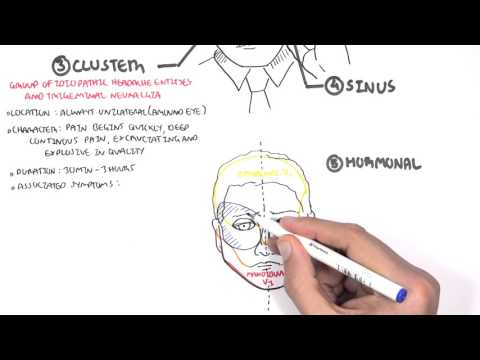
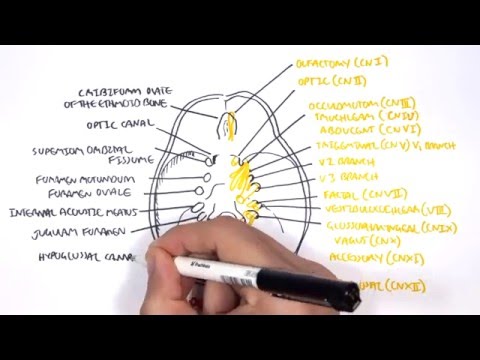
0:00 Imagine having intense headaches that last seconds, usually around the eye and 0:12 on one 0:12 side of the head, associated with these cranial autonomic features such as pt 0:18 osis, dripping 0:19 of one eye, conjunctival injections, lacrimation, nasal congestion, and rhinorr 0:27 hea. 0:28 These types of headaches are known as trigeminal autonomic cephalges, and 0:32 unfortunately thoughts 0:33 would affect less than 0.1% of the population. 0:39 They're call trigeminal because they seem to affect the distribution of where 0:42 the trigeminal 0:43 nerve innervates. 0:45 The trigeminal nerve is a sensory nerve of the face, with three main branches, 0:50 designated 0:51 V1, V2, and V3. 0:54 Cephalge pertains to the cranial autonomic features found in this headache, and 1:00 cephalge 1:01 comes in the Greek cephal, which is head and alga, which is aches or pains. 1:07 There are actually five main types of trigeminal autonomic cephalges, and all 1:13 share common 1:14 features, but also common pathophysiology. 1:21 The first to discuss in the pathophysiology is what's called the trigeminal 1:25 autonomic 1:26 reflex. 1:28 The thought is that stimulation of the trigeminal afferents can cause cranial 1:34 autonomic outflow. 1:36 So pain from the cranium travels to the nucleus of the trigeminal nerve. 1:41 From here, it sends pain information to the higher brain center where we 1:46 perceive pain 1:47 itself. 1:50 The autonomic features of this headache suggest cranial parasympathetic 1:56 activation. 1:57 A trigeminal autonomic reflex. 2:01 Activation of the parasympathetic nerves causes the lacrimation, rhinorrhea, 2:05 nasal congestion, 2:07 and eyelid edema. 2:11 This reflex, you also get inhibition of the sympathetic fibers, causing ptosis 2:18 and meiosis. 2:19 So the trigeminal autonomic reflex is responsible for inactivating the autonom 2:26 ic nerve fibers 2:28 as well, the parasympathetic and sympathetic, causing the autonomic 2:33 manifestations of trigeminal 2:34 autonomic cephalges. 2:36 The actual activation of the trigeminal autonomic reflex is thought to be 2:42 caused in part by the 2:44 hypothalamus itself, hypothalamic activation. 2:54 The posterior hypothalamic region plays an important role in the pathophys 2:59 iology of trigeminal 3:00 autonomic cephalges, because these headaches display the following 3:04 characteristics. 3:05 Firstly, there's a relapsing remaining course, there's seasonal variation, and 3:11 there's a 3:11 clockwise regularity of a single attack, and this implies involvement of the 3:17 biological 3:17 clock, namely the hypothalamus, in the origin of the illness. 3:22 The last theory is the vascular theory, where clinical symptoms of cluster 3:26 headaches are 3:28 caused by neurogenic inflammation of the walls of the cavernous sinus. 3:39 Here, in part, we can say that the hypothalamic activation leads to trigeminal 3:43 autonomic 3:44 reflex. 3:46 Hey guys, a quick word from the sponsors of this video. 3:53 Now preparing for the USMLE is a lot of work, and many students spend a lot of 3:57 their time 3:57 studying only a fraction of USMLE questions. 4:01 One Academy covers many questions with high yield pointers, saving you time. 4:07 Learn techniques on how to approach this sort of question with world's 4:10 prominent educators 4:11 in medicine. 4:13 So subscribe today to Unacademy, link will be below, and get access to more 4:17 than 800 comprehensive 4:18 videos, over 300 review lectures, and over 3000 question bags, and much more 4:24 for only 4:24 one year. 4:26 Remember to use the referral code Armando10 to get 10% off your subscription. 4:32 It's a good way to start confidently preparing yourself for your USMLE. 4:44 As mentioned, there are five main types of trigeminal autonomic cephalges. 4:49 They differ in their duration, seconds, minutes, hours, and days, and they also 4:55 differ by how 4:55 frequently they attack in one day. 4:57 So for example, one a day, eight times a day, or even a hundred times a day. 5:04 Cluster headaches usually last minutes to hours and relatively low frequency up 5:10 to eight times 5:11 a day. 5:13 Paroxysmohimicrania occurs more frequently, but at a shorter duration of 5:20 minutes. 5:21 Then you have short-lasting, unilateral neuralgiform headache attacks with conj 5:26 unctival injection 5:27 and tearing, called sunt, or short-lasting, unilateral, neurofalgiform 5:34 headaches attacks 5:36 with cranial autonomic symptoms, or SUNA. 5:39 With these headaches, they only last seconds, with a frequency of up to 200 5:45 times a day. 5:46 Hemecrania continua, as the name suggests, are constant headaches, lasting days 5:52 . 5:52 Everyone with trigeminal autonomic cephalges syndromes requires an MRI to 5:57 assess for any 5:58 other underlying pathology. 6:02 Let's talk about each of these headaches briefly. 6:06 So cluster headaches is the most common trigeminal autonomic cephalge. 6:10 It's so bad it's called the suicide headache. 6:14 It is much more common in men. 6:16 Cluster headaches is characterized by recurrent episodes lasting 15 to 180 6:22 minutes of severe 6:23 unilateral periorbital pain with autonomic features. 6:27 Episodes tends to last one to eight times a day, in clusters lasting weeks or 6:33 months, 6:33 separated by periods of remission of one to two years. 6:37 The mid-age of onset is 20 to 50 years. 6:41 This may be precipitated by nitrates and alcohol. 6:44 The treatment of cluster headaches specifically includes administration of 100% 6:49 oxygen, usually 6:50 via a Hudson mask, for 20 minutes. 6:53 Trip 10, such as summa trip 10, subcutaneously, or intranasal. 6:58 There's also bridging treatment, including steroids or occipital nerve block, 7:02 and there's 7:02 also preventative strategies such as using verapamil. 7:06 Paroxysmohimicrania are more common in women. 7:12 With a mean age of onset in the 20s, more frequent attacks with shorter 7:20 duration often 7:21 responds selectively within days to endomethicin, a non-steroidal anti- 7:29 inflammatory drug. 7:31 The main features differing, paroxysmohimicrania from cluster headaches, are 7:38 the higher frequency 7:40 and shorter duration of attacks, higher incidence in women's, and the response 7:45 to treatment 7:45 with endomethicin. 7:52 Oct ansoana is a rarest of all trigeminal autonomic afoulges, it's a stabbing, 7:59 lancinating, burning 8:01 pain, frequency up to 100-200 times in one day, duration are seconds, usually 8:10 very brief. 8:12 Treatments include lomatrogen, which is a type of anti-epileptic. 8:19 Econium and endomethicin does not help with sunt or suna. 8:28 Hemicrania Continua is a constant unilateral headache on one side, with 8:34 moderate intensity. 8:35 The frequency is daily with a duration of 30 minutes to days. 8:40 It does respond to endomethicin. 8:43 This can also receive greater occipital nerve injections, or block, as well as 8:48 occipital 8:48 nerve stimulation, to help with the pain. 8:53 In summary, in this video we talked about trigeminal autonomic afoulges and 8:57 their five 8:58 main types, cluster headaches, paroxysmohimicrania, sunt and suna and hemicran 9:06 ia continuum. 9:08 Treatment does differ between each of these types. 9:12 Thank you for watching.