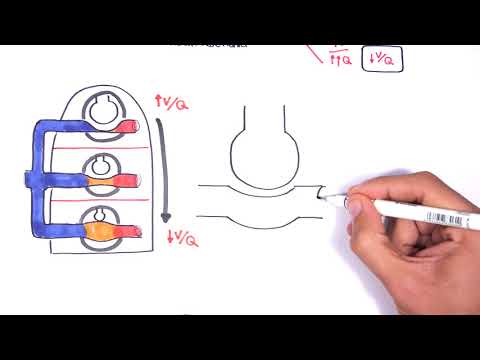
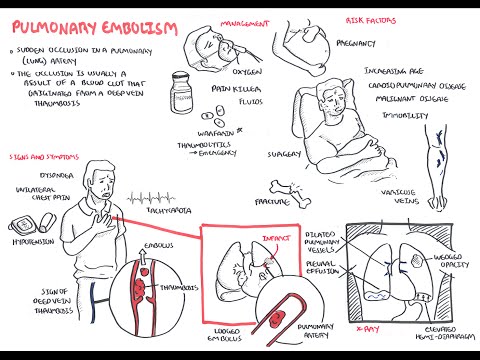
0:00 Hello, in this video we're going to look at pulmonary circulation and we're 0:08 also going 0:08 to talk about the causes of pulmonary hypertension. 0:12 So here we have the heart and the heart has four chambers. 0:16 Here we have the right side, which is composed of the right atrium and right 0:21 ventricle. 0:22 The right side of the heart receives deoxygenated blood from circulation. 0:27 The right ventricle will then pump this blood through the pulmonary trunk, 0:31 which will branch 0:32 into the right pulmonary artery and the left pulmonary artery, before branching 0:37 even more 0:38 within the lungs. 0:40 The lungs will re-oxygenate the blood. 0:43 This newly oxygenated blood will then return back to the heart via the left and 0:49 right pulmonary 0:50 vein. 0:52 The pulmonary veins will return the oxygenated blood to the left atrium. 0:58 The blood from the left atrium will then join with the left ventricle before 1:01 being pumped 1:02 around the body. 1:04 Let us now look at the lungs and see the structures responsible for re-oxygen 1:07 ating the blood in 1:08 a little bit more detail. 1:10 Here is a cluster of alveolar, sacs. 1:14 Now the alveoli are the ends of the respiratory tract basically and here is one 1:19 alveolus. 1:19 So you can imagine, here is the pulmonary artery coming from the right side of 1:24 the heart, 1:24 bringing in deoxygenated blood in blue. 1:28 The pulmonary artery will branch again and again before arriving at these 1:33 terminal alveoli. 1:35 The arterial is now capillary to these alveoli. 1:41 Here the carbon dioxide from the vessels is absorbed into the respiratory tract 1:45 and exhaled 1:46 out while simultaneously oxygen is inhaled and re-oxygenating the blood vessels 1:53 . 1:53 The newly oxygenated blood supply will now return to the left side of the heart 1:58 via the 1:58 pulmonary venules which will eventually join with other vein venules to form 2:03 the main pulmonary 2:04 vein. 2:05 Let us now zoom in and focus on one alveolus. 2:10 Here is a cross section of an alveolus and here is the heart. 2:16 Now as we mentioned the right side of the heart will pump deoxygenated blood 2:19 through the pulmonary 2:19 arteries into the lung. 2:22 The pulmonary artery will branch until it forms capillaries for each of these 2:27 alveolus 2:27 or alveoli in the lung. 2:30 The blood is reoxygenated. 2:33 This newly reoxygenated blood will then return to the heart via the pulmonary 2:37 veins. 2:38 It enters the left atrium of the heart before going into the left ventricle and 2:42 the left 2:42 ventricle will then pump this blood to the systemic circulation through the a 2:47 orta. 2:48 When we measure blood pressure we are actually measuring the systemic 2:51 circulation pressure 2:51 really, not the pulmonary circulation pressure. 2:55 The normal systemic circulation pressure or the normal blood pressure in our 2:59 body is about 3:00 120 on 80. 3:02 The pulmonary circulation pressure on the other hand is 24 on 12. 3:09 Another difference between systemic and pulmonary circulation is the response 3:14 to low oxygen 3:15 levels. 3:16 For example in systemic circulation a decrease in oxygen supply will cause 3:21 systemic vasodilation 3:23 and this is to increase blood flow and thus hopefully increase oxygen supply to 3:28 the systemic 3:29 organs. 3:30 However, in the pulmonary circulation a decrease in oxygen, a decrease in 3:35 ventilation or supply 3:36 to the body, means that the pulmonary circulation will constrict. 3:41 They constrict to compensate for the decrease in ventilation. 3:45 There is normal blood flow but poor ventilation, a pulmonary shunt occurs. 3:52 The volume of blood in the pulmonary vessels at any one time is about 1 liter, 3:56 of which 3:57 less than 100 mils is in the pulmonary capillaries. 4:01 Pulmonary capillary pressure is about 10 millimeters mercury, whereas the onc 4:07 otic pressure 4:08 is 25 millimeters mercury. 4:11 So that an inward directed pressure gradient of about 15 millimeters mercury 4:16 keeps the 4:16 alveoli free of all but a thin film of fluid. 4:20 When the pulmonary capillary pressure or the pulmonary arterial pressure is 4:24 more than 25 4:25 millimeters mercury, pulmonary congestion and edema result. 4:31 Which really means pulmonary hypertension. 4:34 Pulmonary hypertension or pulmonary arterial hypertension is when the pulmonary 4:41 arterial 4:41 pressure is above 25 millimeters mercury at rest or 30 millimeters mercury on 4:50 exertion. 4:51 When there's a buildup of pressure, let's just say from edema, part of this 4:54 fluid in 4:54 the interstitium, the fluid can be drained via the lymphatic system back to the 4:59 hot. 5:00 However, often times in pulmonary hypertension, the lymphatic system is not 5:05 great enough to 5:06 return the pulmonary vascular pressure back to homeostasis. 5:10 So what causes pulmonary hypertension? 5:14 So now let's briefly talk about pulmonary hypertension and its causes. 5:19 Before that we first need to know what four values or factors can influence the 5:25 pulmonary 5:25 arterial pressure. 5:27 These are the cardiac output, the pulmonary artery and thus the pulmonary arter 5:32 ial pressure, 5:34 pulmonary vascular resistance and left atrial pressure, also known as pulmonary 5:38 venous pressure. 5:40 To keep things simple, pulmonary hypertension is when your arterial pulmonary 5:44 pressure is 5:45 above 25 millimeters mercury at rest or 30 millimeters mercury with exertion. 5:52 Now many things affect your pulmonary arterial pressure. 5:55 And because of this many things can cause pulmonary hypertension. 5:59 The pressure of the pulmonary artery is equal to the cardiac output multiplied 6:04 by pulmonary 6:04 vascular resistance plus left atrial pressure. 6:09 So basically any rise in cardiac output, any rise in pulmonary vascular 6:13 resistance or 6:14 any rise in left atrial pressure will cause an increase in pulmonary arterial 6:18 pressure, 6:19 which means we'll cause pulmonary hypertension. 6:23 So let's draw out what each of these mean. 6:27 Here is a lung which is the alveoli and here is the right side of the heart 6:31 which is pumping 6:32 into the lung deoxygenated blood through the pulmonary artery. 6:37 The pressure of the pulmonary artery here is the pressure in the pulmonary 6:41 artery which 6:42 again when high will really tell us if you have pulmonary hypertension or not. 6:47 The pulmonary artery will branch and form capillaries supplying each alveoli. 6:52 Using the alveoli in the capillaries is the space called the interstition. 6:57 Cardic output is the amount of blood pumped by the heart in one minute. 7:01 Pulmonary vascular resistance is a pressure in the pulmonary circulation. 7:05 Then the capillaries will form the pulmonary veins and will return oxygenated 7:10 blood to 7:10 the left side of the heart. 7:12 The other important factor affecting pulmonary artery pressure is the left at 7:16 rium, here where 7:17 the pulmonary veins drain into. 7:20 And of course the left side of the heart will pump oxygenated blood to the 7:23 systemic circulation. 7:25 This is also your cardiac output from the other side. 7:27 Now to help diagnose pulmonary hypertension you really perform a right sided 7:34 cardiac catheterization 7:36 which if the value is above 25 millimeters mercury at rest it is diagnostic of 7:42 pulmonary 7:42 hypertension. 7:44 You can also use a trans thoracic echocardiogram to help diagnose pulmonary 7:50 hypertension. 7:51 The pulmonary wedge pressure can help assess the left side of the heart. 7:59 Causes of pulmonary hypertension from the left heart include mitral valve 8:02 disease which 8:02 will increase your left atrial pressure. 8:08 Left sided heart failure which will also increase your left atrial pressure and 8:11 so increase 8:12 pulmonary artery pressure which will then lead to pulmonary hypertension. 8:18 Hypoxemia due to different lung diseases can also cause pulmonary hypertension. 8:22 These include COPD, interstitial lung disease, obstructive sleep apnea which 8:28 all will increase 8:30 pulmonary vascular resistance. 8:33 Pulmonary embolism is another important cause. 8:35 This is where you get occlusion of the pulmonary artery branches and or capill 8:40 aries. 8:41 This will increase pulmonary vascular resistance and so increase pulmonary 8:45 artery pressure 8:46 and so will lead to pulmonary hypertension. 8:51 There are also miscellaneous causes such as granulomas as a result of sarctard 8:55 osis or 8:56 connective tissue disease. 8:58 They essentially can cause obstruction and reduce perfusion to the lungs and so 9:02 as a 9:02 consequence they will sort of increase the pulmonary artery pressure causing 9:06 pulmonary 9:07 hypertension. 9:09 I hope this video on pulmonary circulation and just an overview of the causes 9:15 of pulmonary 9:16 hypertension made sense. 9:17 I hope you enjoyed it. 9:18 Thank you.