

Fistula-In-Ano
Overview
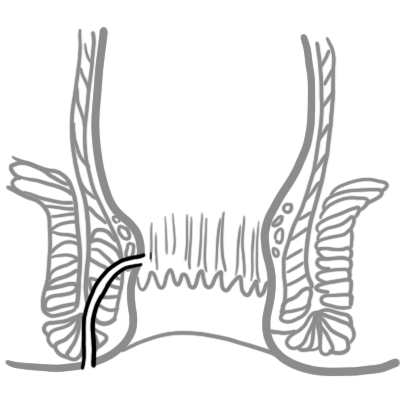
Fistula-In-Ano, also referred to as “Anorectal fistula”, is an abnormal tunnel between the anal canal (hollow viscus) and the surface of the body. Over 90% are attributed to prior anorectal abscess. It may occur in the presence of Crohn’s Disease and has an association with obesity and diabetes. Patients experience intermittent rectal pain, pruritus and malodorous drainage.1
Definition
Fistula: An abnormal connection of two epithelial surfaces
Fistula in Ano: abnormal connection of the anorectal epithelial surface to the perineal skin
Sinus: Granulating track leading from a source of infection to a surface
Crohn Disease is associated with ano-rectal disease.
Anatomy
Anal canal – channel connecting the rectum to the anus, located within the anal triangle of the perineum, between the two ischioanal fossae
Anal Sphincters
- Internal sphincter
- Involuntary control – continuation of circular fibers of the colon so it receives autonomic supply
- Surrounds upper 3/4 of anal canal
- External sphincter
- Voluntary control
- Surrounds entire length of anal canal
- Consists of three parts – subcutaneous, superficial and deep
Intersphincteric plane
- Between external sphincter muscle laterally and the longitudinal muscle (inner sphincteric muscle) medially
- Contains anal glands
- Can be opened up surgically to provide access for operations on the sphincter muscles
Anal glands
- Apocrine glands
- Occasionally infected and act as a source of anal fistula
Dentate (pectinate) line
- Junction of the proximal and distal segments of the anal canal
- Divides the anus into proximal 2/3 and distal 1/3
- Situated at the middle of internal sphincter
| Above Dentate line | Below Dentate line | |
| Embryology | Hindgut (endoderm) | Proctodeum (ectoderm) |
| Epithelium | Columnar | Stratified squamous |
| Arterial supply | Superior rectal a. | Middle rectal a.Inferior rectal a. |
| Venous drainage | Superior rectal v. | Middle rectal v.Inferior rectal v. |
| Innervation | Visceral – Inferior hypogastric plexus(insensitive to pain) | Somatic – Inferior rectal nerves: branches of Pudendal nerve(sensitive to pain) |
| Lymph drainage | Internal iliac | Superficial inguinal |
Hilton’s Line also called while line/anocutaneous line indicates lower end of the internal sphincter. Ischiorectal abscess when communicates with anal canal usually opens at or below Hilton’s line.
Aetiology & Risk factors
- Anal abscess (most common)
- Crohn disease
- Obstetric injury
- Radiation proctitis
- Rectal foreign bodies
- Infectious disease – Lymphogranuloma venerum and Actinomycosis
- Malignancy
Most anorectal fistulas are cryptoglandular, meaning they are caused by a prior anorectal abscess.
Pathophysiology
Most anal fistulas arise through the cryptoglandular pathway: obstruction and infection of an anal gland lead to an anorectal abscess. After spontaneous or surgical drainage, the tract may heal. Persistent infection and epithelialisation of the drainage tract can instead maintain a connection between the anal canal and perianal skin, forming a fistula. If its external opening closes while the tract persists, a recurrent abscess may develop.4,5
This chart describes the common cryptoglandular mechanism; secondary fistulas, including those associated with Crohn’s disease, may develop through different pathways.
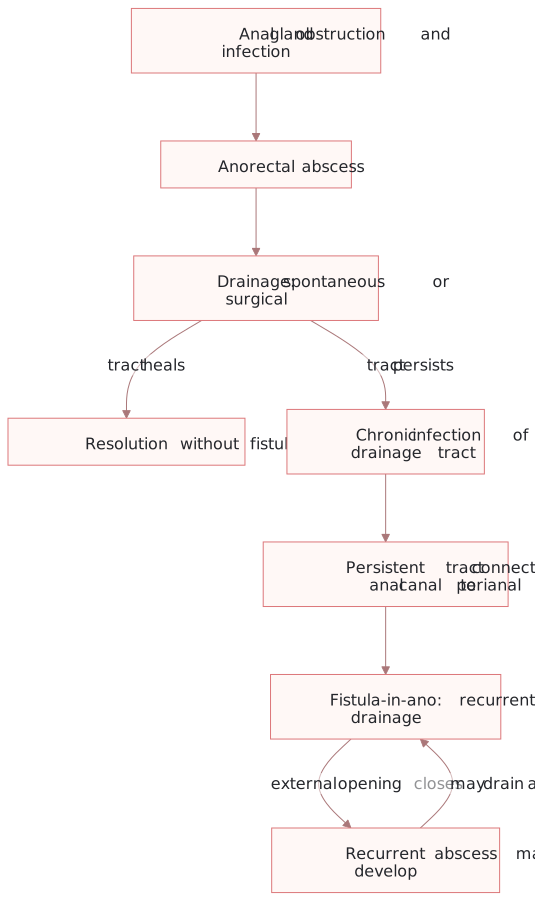
Common cryptoglandular pathway: an abscess may resolve after drainage or leave a persistent fistula with recurrent drainage and abscess formation.
What to notice
Detailed image description
Anal gland obstruction and infection cause an anorectal abscess. Following spontaneous or surgical drainage, the tract may heal without a fistula. If the drainage tract persists, chronic infection and epithelialisation can maintain a connection between the anal canal and perianal skin, producing fistula-in-ano with recurrent drainage. Closure of the external opening while the fistula persists may lead to a recurrent abscess, which may drain again. This schematic describes the common cryptoglandular pathway, rather than every cause of anal fistula; Crohn's disease and other secondary causes follow different mechanisms.
Classification
Relationship to anal sphincter muscles:
- Intersphincteric
- From dentate line to anal verge
- Travels along intersphincteric plane
- Transsphincteric
- Through external sphincter into ischiorectal fossa
- Travels through both internal and external sphincter
- Suprasphincteric
- From anal crypt to ischiorectal fossa
- Encircles the entire sphincter apparatus
- Extrasphincteric
- Proximal to dentate line
- Encompasses the entire sphincter apparatus
- Usually not of cryptoglandular origin
- Superficial (submucosal)
- Does not involve any sphincter muscle
Complexity:
- Complex
- High transsphincteric fistulas involving at least 30% of external sphincter
- Suprasphincteric
- Extrasphincteric
- Horseshoe – fistulas in which the tract encircles the anal canal
- Recurrent fistula
- Fistulas associated with: Crohn’s, radiation, malignancy, faecal incontinence
- Simple
- Low transsphincteric involving <30% of external sphincter
- Superficial
- Intersphincteric
Clinical Manifestation
- Acute: severe perianal pain (particularly during defecation and sitting), swelling and erythema (+/- fever and tachycardia)
- Recurrent: regular purulent discharge +/- bleeding
- Chronic: discharge of seropurulent fluid with an identifiable punctum (opening)
Examination
- The perianal skin may be excoriated and inflamed
- External opening visible (may drain pus or blood on manual compression)
- Internal opening identification may need a proctoscope (or sigmoidoscope if internal opening in rectum)
- Palpable cord-like tract
Goodsall’s rule (law): Relates the external opening of an anal fistula to its internal opening. Fistulas can be described as anterior or posterior relating to a line drawn in the coronal plane across the anus. Anterior fistulas will have a direct track into the anal canal. Posterior fistulas will have a curved track with their in internal opening lying in the posterior midline of the anal canal. An exception to the rule are anterior fistulas lying more than 3cm from the anus, which may open in the anterior midline of the anal canal.
Differential diagnosis:
- Anal abscess
- Anal fissure
- Anal ulcer or sores
- Crohn disease
- Hidradenitis
- Pilonidal disease
Diagnosis
Clinical Diagnosis with history and physical exam findings (3Ps):
- Pain
- Purulent discharge
- Perirectal skin lesion
Investigations:
- Endoanal ultrasound
- Fistulography
- CT scan
- MRI (gold standard for demonstrating the anatomy of a fistula)
3Ps for anal fistula diagnosis: Pain, Purulent drainage, Perirectal skin lesion.
Treatment
Medical management:
- Sitz baths
- Irrigation
- Packing to ensure healing from inside to outside
Surgical management:
- Abscess drainage
- Fistulotomy – allows healing through secondary intention; used for simple uncomplicated fistulas
- Seton – used for complex fistulas; two main types:
- Loose (draining) – keep tract open allowing drainage and preventing abscess recurrence
- Cutting – gradually tightens to cut through tissue and allows healing behind it; associated with risk of incontinence
- Sphincter sparing procedure – at least 6 weeks after Seton placement:
- Fistula plug
- Fibrin glue
- LIFT (ligation of intersphincteric fistula track)
- Advancement flap
- Proctectomy
- Modified Hanley procedure 2 3
Complications
- Recurrence
- Faecal incontinence from surgery
References
- Vogel JD. Anorectal fistula: Clinical manifestations and diagnosis. In: Weiser M, editor. UpToDate [Internet]. [updated 2025 Oct 30; cited 2025 Nov 7]. Available from: UpToDate
- Champagne BJ. Operative management of anorectal fistulas. In: Weiser M, editor. UpToDate [Internet]. [updated 2024 Aug 22; cited 2025 Nov 7]. Available from: UpToDate
- Simpson JA, Banerjea A, Scholefield JH. Management of anal fistula. In: BMJ Best Practice [Internet]. 2012 [cited 2025 Nov 7]. Available from: BMJ Best Practice
- Gaertner WB, Burgess PL, Davids JS, Lightner AL, Shogan BD, Sun MY, et al. The American Society of Colon and Rectal Surgeons Clinical Practice Guidelines for the Management of Anorectal Abscess, Fistula-in-Ano, and Rectovaginal Fistula. Dis Colon Rectum. 2022;65(8):964–985. doi: 10.1097/DCR.0000000000002473.
- American Society of Colon and Rectal Surgeons. Abscess and Fistula Expanded Information [Internet]. [cited 2026 Oct 2]. Available from: ASCRS.








Members only discussions coming soon…