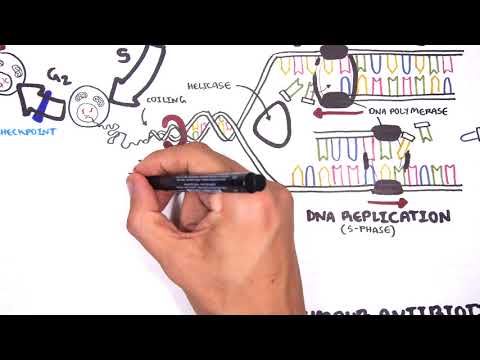
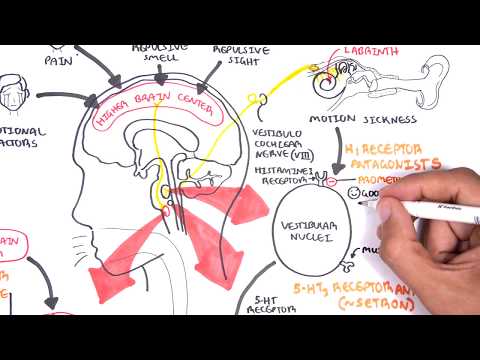
0:00 Hello in this video we're going to talk about the acute side effects of 0:09 chemotherapy drugs. 0:11 In order to understand this, we have to just recap the cell cycle. 0:15 So a cell at risk can enter the cell cycle from the G0 phase. 0:19 It enters the cell cycle, the first phase being the G1, where the organelle 0:23 duplicates, 0:24 and then it's the S phase when a DNA duplicates, and then the G2 phase where 0:29 the cell prepares 0:30 itself before mitosis, the M phase, where a cell divides into two identical 0:36 daughter cells. 0:38 These new daughter cells can then re-enter the cell cycle or it can go back to 0:42 rest at 0:42 the G0 phase. 0:45 Chemotherapy drugs target different phases of the cell cycle, and because of 0:50 this, it 0:51 does also target cells that have a high turnover. 0:56 Because chemotherapy drugs target different phases of the cell cycle, it will 1:01 thus target 1:02 the cells that actually enter the cell cycle more frequently. 1:07 These cells include skin cells, the lining of the mucosa, and even your blood 1:13 cells from 1:13 the bone marrow. 1:14 And because of this chemotherapy drugs also have these very important side 1:18 effects to 1:18 keep note of. 1:21 So let's talk about these acute side effects. 1:24 The first most common side effects of chemotherapy drugs is nausea and vomiting 1:28 . 1:29 If we zoom into the medulla of the brainstem, it contains an area called the 1:33 chemoreceptor 1:34 trigger zone. 1:36 Chemotherapy toxins will actually target the chemoreceptor trigger zone because 1:40 these chemotherapy 1:41 toxins actually circulate in the blood, and the chemoreceptor trigger zone, or 1:46 CTZ, is 1:47 not within the blood-brain barrier, and so these toxins can stimulate the chem 1:52 oreceptor 1:53 trigger zone. 1:54 When the chemoreceptor trigger zone is stimulated, it will stimulate another 1:58 area near it called 1:59 the vomiting center, and the vomiting center will essentially induce or cause 2:04 the emetic 2:05 reflex, the vomiting reflex. 2:08 Obviously, one way to go around this is to give the patients having 2:12 chemotherapy anti-emetics. 2:16 Other side effects acutely of chemotherapy drugs include problems in the brain, 2:22 such 2:22 as mood changes, it's also known as chemo brain. 2:27 Because chemotherapy drugs target cells with high turnover, it also target your 2:32 hair cells 2:33 because they also have a high turnover, and so you get alopecia, loss of hair. 2:39 Similarly, the lining of your mucosa, such as the mouth, is also a potential 2:46 for side 2:47 effects from chemotherapy drugs, such as methotrexate. 2:50 You can develop ulcers and also mucocytus. 2:57 Another important side effect is also the constipation and diarrhea, as well, 3:01 because 3:02 your hair and nails have also high turnover, chemotherapy agents can cause 3:06 changes in skin 3:08 and nails. 3:10 Some chemotherapy agents acutely can cause side effects of the nerves, 3:14 specifically 3:15 chemotherapy agents targeting the M phase of the cell cycle, such as being the 3:20 alkaloids 3:20 and tachines, and these guys can cause what's called peripheral neuropathy, 3:25 being a sensory 3:26 change or even pain within the peripheries. 3:30 Another important side effects of chemotherapy agents acutely, but mainly long 3:36 term, is 3:36 gonadal dysfunction, but this again depends on the duration, age, and the sex 3:40 of the patient. 3:42 For example, the female has an ovary and the ovary contains many follicles. 3:46 Each cycle, each menstrual cycle, the follicle will grow and it will 3:51 essentially rupture, 3:52 releasing an egg. 3:55 Chemotherapy drugs can affect any part of this cycle and can actually cause an 4:00 ovulation, 4:01 so causing the follicle not to ovulate. 4:06 Long term chemotherapy agents can affect the follicles itself causing premature 4:12 menopause. 4:13 For male, the testes is a site where sperm production occurs, spermatogenesis. 4:18 Chemotherapy agents can actually target the spermatogenesis and actually 4:22 decrease spermatogenesis 4:23 because spermatogenesis has a high turnover every day, males are producing 4:28 sperm. 4:28 Long term, and very rarely now, chemotherapy agents can stop sperm production 4:34 altogether. 4:35 Probably the most important acute side effects of chemotherapy agents is its 4:41 effect on bone 4:41 marrow. 4:42 So, for example, you have your pluripotent stem cell, which can become a myel 4:46 oid progenitor 4:47 cell. 4:48 Your myeloid progenitor cell can make a few cells, possibly the three important 4:53 ones here 4:54 are your neutrophils, which are your acute immune cells for acute inflammation. 4:59 They have a very short half life, about eight hours. 5:02 Or myeloid progenitor cell can eventually become a mega carrier site and 5:06 release platelets, 5:07 which are important for initiating the clotting cascade. 5:11 Now, platelets have a short half life as well, about seven days. 5:15 Finally, the myeloid progenitor cell can become red blood cells, your erythrocy 5:18 tes, 5:19 which carry oxygen throughout your body. 5:21 These guys have about 120 days. 5:23 Now, you can imagine if chemotherapy agents are used, they target cells with 5:27 high turnover, 5:29 and so they can induce myelosuppression. 5:32 When you decrease production of neutrophils, you get neutropenia. 5:36 When you have neutropenia, the person is more susceptible to febronutropenia. 5:42 This is where someone on chemotherapy gets a high grade fever, and this is most 5:46 likely 5:46 due to an underlying infection. 5:51 Myelosuppression can cause thrombocytopenia, low platelets, and so the person 5:55 is more prone 5:55 to bleeding. 5:58 Myelosuppression can cause anemia, and when you have anemia, you essentially 6:03 feel tired 6:04 of the time, lethargy, and decreased oxygen supply to the body. 6:08 Now, it's important to know how to manage each of these complications briefly. 6:14 So with febronutropenia, if someone on chemotherapy drugs presents with a fever 6:19 who has chemotherapy, 6:21 you have to do a full workup, a full septic workout, investigations, including 6:25 blood cultures, 6:26 x-ray, urine cultures, et cetera. 6:29 And finally, it's really important to also give prophylactic antibiotics until 6:34 the organism 6:35 possibly is found. 6:37 Another important drug to give is granulocyte colony stimulating factor, which 6:41 will hopefully 6:42 help with the production of the neutrophils. 6:47 For thrombocytopenia, it's important to assess the medications, particularly if 6:51 the patient 6:52 is on antiplatelet drugs, such as aspirin and clopidogrel, can it be stopped? 6:58 Another thing is if it's very low, that's the platelet count, potentially a 7:02 platelet infusion, 7:04 and even some cytokines can be administered to help promote platelet production 7:11 . 7:12 For anemia, blood transfusion is given. 7:15 Blood transfusion is given to those who are symptomatic and usually have a hem 7:18 oglobin below 7:19 80. 7:20 Thank you for watching. 7:21 I hope you enjoyed this video on the acute side effects of chemotherapy drugs. 7:26 The chronic side effects of chemotherapy drugs will be discussed elsewhere.