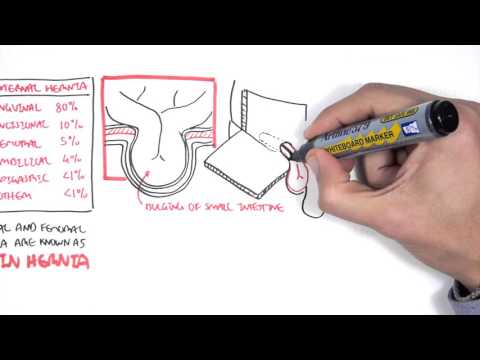
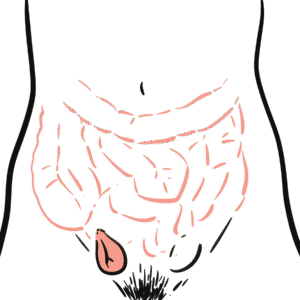
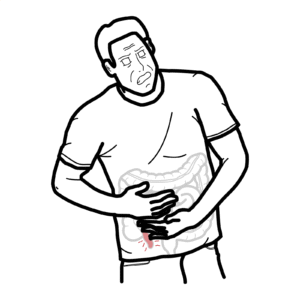
0:00 In this video we're going to look at bowel obstruction. 0:09 Let's first begin with the signs and symptoms and how a person can present. 0:14 So the signs and symptoms of a bowel obstruction include nausea, vomiting, cr 0:19 amping, abdominal 0:21 pain, obstipation, an inability to basically do a poo. 0:28 Diarrhea, possibly, there can be a distended abdomen, fever, as well as tachy 0:35 cardia. 0:36 So bowel obstruction, as the name suggests, is obstruction of the bowel. 0:41 It can be of the small intestine or it can be of the large intestine. 0:47 In this video we're going to mainly focus on the small intestine, but it 0:52 applies for 0:52 the large as well. 0:55 So let's first draw an obstructed bowel here. 1:03 I'm going to draw a sphincter-like thing in red, just to represent the 1:09 obstruction. 1:10 And the obstruction can be caused by many things, which we will look at. 1:15 But essentially if you have an obstruction, the food that we eat will pile up, 1:20 of course. 1:21 And this can cause some serious problems, because normally in the intestine we 1:27 actually find 1:27 bacteria, commensal organisms that live within our intestine. 1:33 And when the bacteria is exposed to all this nutrition, it will begin to grow, 1:40 essentially. 1:41 But before looking at the pathophys, let's look at how bowel obstruction can be 1:47 categorized. 1:48 And it can be categorized into a mechanical obstruction or a pseudo obstruction 1:55 . 1:55 Let us first focus on mechanical obstruction. 1:58 And there are five main types of mechanical obstruction. 2:03 The first type of mechanical obstruction, the most common, is what's known as 2:08 an adhesion. 2:09 And it's essentially where two parts of the bowel are basically connected with 2:16 each other 2:16 by a sort of fibrous band. 2:19 So this is referred to as adhesion, and this can cause an obstruction. 2:23 The other most common type of obstruction is where we have essentially a tumor, 2:28 a cancer 2:28 growth within the bowel itself. 2:31 And this can lead to an obstruction. 2:34 Another type of mechanical obstruction is known as an intersusception. 2:40 Intersusception is essentially when the part of the bowel invaginates itself. 2:47 So there's some terminology we have to know about intersusception. 2:52 And the first one is the part of the bowel that goes into the other part of the 2:59 bowel. 3:00 This is known as the intersusceptum. 3:04 The part of the bowel that is on the outside surrounding it is now known as the 3:11 intersusipient. 3:13 Another cause of a mechanical obstruction, a type of mechanical obstruction, is 3:20 a hernia. 3:21 And a hernia is essentially a protrusion of the part of the intestine through 3:26 the abdominal 3:27 wall because the abdominal wall can be weak, for example. 3:31 And this can sort of strangulate the part of the intestine causing an 3:36 obstruction. 3:37 Finally, the last type of mechanical obstruction is known as a volvulus. 3:43 And this is essentially where we get twisting of the bowel. 3:51 So now let us look at each of these five types and sort of describe it in a bit 3:58 more detail. 4:00 The most common cause of mechanical obstruction is post-operative adhesion. 4:06 So this is essentially when you have a surgery of the abdominal cavity and 4:11 opening the abdominal 4:13 cavity, it can cause fibrous adhesions to cause between segments of the bowel. 4:21 So adhesions are fibrous bridges between bowel segments. 4:26 Adhesions cause extrinsic compression of the bowel which thus can lead to an 4:33 obstruction. 4:35 Now the cancer. 4:37 So colorectal cancer is a common and lethal disease. 4:43 And risk factors for cancer of the bowel include age, family, obesity, 4:50 inflammatory bowel disease 4:52 and certain diets. 4:55 So this is self-explanatory. 4:57 A tumour can grow so large that it can cause an obstruction. 5:02 Now intersusception. 5:05 Intersusception is rare in adults. 5:08 Between about one to five percent of mechanical bowel obstruction is a result 5:13 of intersusception. 5:15 Common sight of intersusception is the ileosecal valve. 5:19 So this is essentially when the valve, the ileosecal valve just basically goes, 5:25 invaginates into 5:27 the cecum resulting in an intersusception. 5:31 The next type of mechanical obstruction is hernia which is defined as a protr 5:36 usion, bulge 5:37 or projection of an organ or a pot of an organ through the body wall that 5:43 normally contains 5:44 it. 5:46 It can be internal or external. 5:49 So in the diagram above, we have an example of a hernia that is bulging out the 5:54 intestine 5:54 that is bulging out of the abdominal cavity which is the wall that normally 5:58 contains it. 6:00 The last type of mechanical obstruction we'll talk about is the volvulus which 6:03 is twisting 6:04 of the segment of the intestine around a fixed point. 6:09 Common sights of volvulus include the cecum and sigmoid area of the colon. 6:15 A small bowel adhesion, adhesion of the small bowel can lead to a volvulus. 6:24 So those were examples of mechanical obstruction, adhesions, cancer, intersus 6:29 ception, hernia 6:30 and volvulus. 6:31 Now let's look at pseudo obstruction. 6:34 Pseudo obstruction as the name implies is pseudo false obstruction, false 6:39 obstruction, 6:40 but regardless it does result in an obstruction of the bowel. 6:44 So the main examples we look at are myopathy, problems with the muscle and 6:50 neuropathy, problems 6:51 with the innervation of the bowel. 6:55 And then we'll look at a specific type of condition known as Hirschbrung 7:00 disease. 7:01 Hirschbrung disease affects the distal part of the colon. 7:07 So a myopathy, problem with the muscles, results in no movement, no peristaltic 7:12 contractions. 7:13 And thus this can lead to an obstruction, because the food just doesn't go 7:19 through. 7:20 A neuropathy, problems with the innervation of the bowel means that we can have 7:26 no innervation 7:27 of the smooth muscles, which means we have abnormal movement, so we get an 7:33 obstruction. 7:33 Finally, Hirschbrung disease is a congenital condition, so it's present in the 7:41 baby. 7:42 And this is where we have nerves that are missing at the distal end of the 7:46 colon, which means 7:47 that we have no to no or abnormal peristaltic contractions, so movement. 7:55 And this can mean that we can have an obstruction. 8:01 A surgery can correct this. 8:05 So regardless of the cause, you know, pseudo obstruction or mechanical 8:09 obstruction, it results 8:11 in obstruction. 8:12 And an obstruction means that the material, the substance that we eat cannot 8:16 pass through 8:17 our bow smoothly. 8:18 It accumulates in the area. 8:20 And this can result in a few things. 8:22 So let's just go back to the diagram here and look at what it can cause. 8:27 So food that pileups here can be metabolized by the bacteria that are normally 8:32 reciting 8:33 in the area to produce gas. 8:36 Mass accumulates causing a bowel, causing bowel distention. 8:41 Bowel distention, you know, it can compress the vessels that supply the bowel 8:45 so we can 8:46 have venous compression. 8:48 When we have venous compression, this means that we have decrease in oxygen 8:52 supplied to 8:53 the area, to the bowel, and thus we have decrease in oxygenation. 8:59 Decrease in oxygenation results in a few things. 9:02 Firstly, because we have no oxygen supply to the bowel, the cells of the 9:06 intestine die. 9:08 Second, no oxygen supply decreases peristalsis, further aggravating the bowel 9:14 distention. 9:14 So essentially we have more distention. 9:18 Decrease in oxygenation also promotes the bacteria in the area to enter 9:23 circulation. 9:24 Because they're anaerobic, they can enter circulation. 9:27 So when the bacteria enter the circulation, and when we have the intestinal 9:32 cells dying, 9:33 all this essentially are toxic, and these are toxins that can enter the 9:38 circulation resulting 9:39 in some form of septic reaction. 9:44 So that was one aspect of it. 9:47 Further, when we breathe, air goes down, you know, our intestine, it's normal. 9:54 But this realistically aggravates the bowel distention. 9:58 It promotes the distention of the bowel. 10:01 So again, we have, you know, bowel distention, and it compresses the vessels. 10:05 We get venous compression. 10:08 And when we have venous compression, which we haven't looked at, it can 10:11 actually result 10:12 in fluid being secreted because of all the fluid piling up in this area. 10:18 It just gets secreted out into the bowel. 10:22 When fluid is being secreted into the bowel, we lose water. 10:26 And when we lose water, we lose electrolytes. 10:31 And when we lose electrolytes and water, this results in hypotension. 10:36 So we actually get shock. 10:38 So bowel distention simply results in hypotension. 10:44 Also when we get a distention of the bowel, this sort of triggers some nerves 10:49 in the bowel, 10:50 which sends signals up to the brain to trigger the vomiting response. 10:57 Because the brain thinks that there's something wrong in this area and it wants 11:00 to get rid 11:00 of it. 11:01 So vomiting is triggered. 11:04 But vomiting doesn't really help the scenario because when we vomit, we lose 11:09 water and we 11:10 also lose electrolytes, which results in hypotension again. 11:15 So we get shock, hypovolemic shock. 11:19 So shock can result from hypotension or shock can result from sepsis, which is 11:24 when we get 11:25 the bacteria entering the circulation. 11:28 So I hope that all made sense. 11:30 But the complications of bowel obstruction can be three main things. 11:33 One, bowel ischemia, which we just means that we have decreased supply of 11:39 oxygen to the 11:39 bowel. 11:40 Two, perforation, if the bowel is distended so much, it can perforate. 11:47 Three, sepsis when the toxins of the bacteria enter circulation due to the nec 11:52 rosis of the 11:53 area, et cetera, necrosis of tissue of the area. 11:57 So again, when we have venous compression, this means that a healthy liver 12:04 doesn't get 12:05 a blood supply to it and thus it dies. 12:08 And when it dies, this releases toxins to circulation. 12:11 It also allows the bacteria to move from the bowel into circulation. 12:17 Number two, the complication, perforation. 12:19 So here we have the lumen of the bowel. 12:21 If the bowel grows, distends due to the gas buildup in the air and whatnot, it 12:27 essentially 12:27 perforates releasing gut content into the peritoneum. 12:32 This can cause peritonitis causing a massive problem. 12:37 Next, sepsis, sepsis can be due to the perforation and due to the systemic 12:42 dissemination due to 12:44 the dying cells in the area. 12:47 So that was sort of an overview of bowel obstruction, the different types of 12:52 bowel obstruction, 12:53 which is mechanical and pseudo obstruction, as well as we looked at the path 12:57 ophysiology 12:57 and the complications associated with bowel obstruction. 13:00 I hope you enjoyed this video, thank you for watching. 13:07 [BLANK_AUDIO]