

Anal Abscess

Overview
Anorectal abscess is an infection of soft tissue around the anus. It causes severe perianal pain and swelling. 30% to 70% of anorectal abscesses are associated with an anorectal fistula. It is two times more likely to present in males.1 2
Definition
Anorectal abscess: collection of pus in anorectal spaces resulting from infection of anal crypt glands or secondary causes.
Perianal abscess: superficial abscess located just below the skin near the anus.
Perirectal abscess: deeper abscess involving one of the internal anorectal compartments. It presents with more severe symptoms and less obvious external signs.
Fistula-in-Ano: abnormal connection of the anorectal epithelial surface to the perineal skin.
Anatomy
Anal canal – channel connecting the rectum to the anus, located within the anal triangle of the perineum, between the two ischioanal fossae
Anal Sphincters
- Internal sphincter
- Involuntary control – continuation of circular fibers of the colon so it receives autonomic supply
- Surrounds upper 3/4 of anal canal
- External sphincter
- Voluntary control
- Surrounds entire length of anal canal
- Consists of three parts – subcutaneous, superficial and deep
Intersphincteric plane
- Between external sphincter muscle laterally and the longitudinal muscle (inner sphincteric muscle) medially
- Contains anal glands
- Can be opened up surgically to provide access for operations on the sphincter muscles
Anal glands
- Apocrine glands
- Occasionally infected and act as a source of anal fistula
Dentate (pectinate) line
- Junction of the proximal and distal segments of the anal canal
- Divides the anus into proximal 2/3 and distal 1/3
- Situated at the middle of internal sphincter
| Above Dentate line | Below Dentate line | |
| Embryology | Hindgut (endoderm) | Proctodeum (ectoderm) |
| Epithelium | Columnar | Stratified squamous |
| Arterial supply | Superior rectal a. | Middle rectal a.Inferior rectal a. |
| Venous drainage | Superior rectal v. | Middle rectal v.Inferior rectal v. |
| Innervation | Visceral – Inferior hypogastric plexus(insensitive to pain) | Somatic – Inferior rectal nerves: branches of Pudendal nerve(sensitive to pain) |
| Lymph drainage | Internal iliac | Superficial inguinal |
Hilton’s Line also called while line/anocutaneous line indicates lower end of the internal sphincter. Ischiorectal abscess when communicating with anal canal usually opens at or below Hilton’s line.
Aetiology & Risk factors
- Cryptoglandular disease – blocked anal glands (most common)
- Crohn’s disease
- Hidradenitis suppurativa
- Trauma
- Anal fissures
- Malignancy
- Tuberculosis
- Immunocompromised states2 3
most common cause of anorectal abscess is cryptoglandular infection.
Pathophysiology
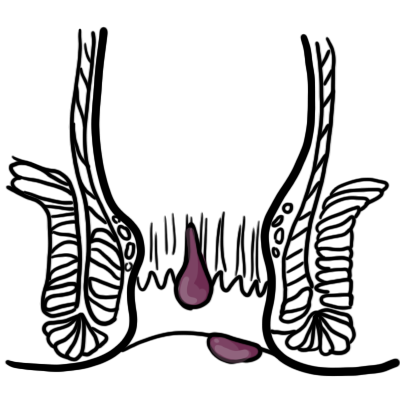
In the common cryptoglandular pathway, obstruction of an anal gland duct permits bacterial proliferation and pus collection in the intersphincteric space. Infection may extend into adjacent anorectal spaces, with abscess expansion and local tissue destruction.3
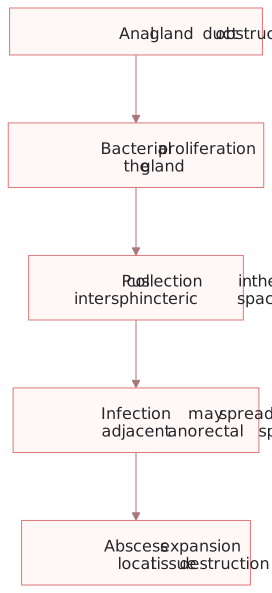
Cryptoglandular infection begins in an obstructed anal gland and forms an intersphincteric abscess; infection may then extend into adjacent anorectal spaces.
What to notice
Detailed image description
Anal gland duct obstruction permits bacterial proliferation within the gland. Pus collects in the intersphincteric space. Infection may spread into adjacent anorectal spaces, with abscess expansion and local tissue destruction. This depicts the common cryptoglandular mechanism, rather than every cause of anorectal abscess.
Classification
Based on the relationship to anal sphincter from superficial to deep.
Divide into two groups: perianal and perirectal2
Perianal abscess:
- Most common
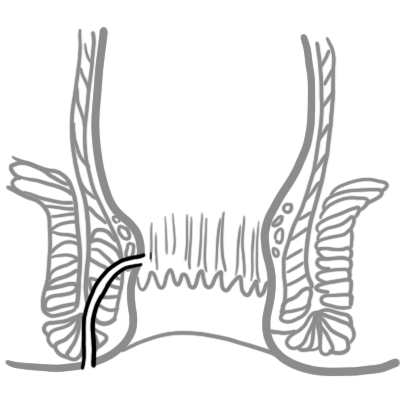
- Results from infection invading laterally and distally in the intersphincteric groove
Perirectal abscess – 4 types:
| Type of Abscess | Anatomical location | Path of spread/Origin | Physical exam findings |
| Ischiorectal (ischioanal) | Ischiorectal space | Through external anal sphincter into ischiorectal fossa | Tender, fluctuant area in buttockLarge swelling |
| Intersphincteric | Intersphincteric groove | From infected anal gland | Fluctuant mass on DRE protruding in lumenMinimal skin changes |
| Supralevator | Above levator ani | Two origins:- Upward extension of cryptoglandular infection- Pelvic pathology | Fluctuant mass above anorectal ring on DREMinimal external findings |
| Horseshoe | Deep postanal space, extending around anal canal | Deep postanal space into bilateral ischiorectal fossae | Posterior tendernessPotential bilateral buttock swelling |
perirectal abscesses present with more severe symptoms, systemic features and absence of external signs on exam.
Clinical Manifestations
- Constant severe pain in anal or rectal area
- Worse when sitting
- Usually not associated with bowel movements
- Skin irritation: swelling, erythema
- Systemic symptoms: fever, chills, malaise
- Purulent rectal drainage
- Urinary retention – rare, may be seen in supralevator abscess
Clinical Examination
- General inspection
- Superficial abscess – area of fluctuance, erythema, indurated skin
- Deep abscess – may not have any findings
- Digital rectal exam
- Severe pain
- Induration
- Fluctuance
Differential diagnosis
- Anal fissure
- Anal fistula
- Haemorrhoids
- Pilonidal disease
- Buttock skin abscess
- Bartholin abscess
- Hidradenitis suppurativa
- STI
Diagnosis
Clinical diagnosis is sufficient in most cases
Imaging – used when a deep abscess is suspected but cannot be palpated on physical exam:
- CT
- MRI
- Ultrasonography 2 4
Treatment
Surgical incision and drainage – first line:
- Do not delay unless patient unstable
- Done under local or general anaesthetic
Antibiotics – suggested for all patients after incision and drainage
Patients with concomitant anal fistula might undergo a primary fistulotomy during abscess drainage.
Complications & Prognosis
Complications
- Anal fistula
- Fournier’s gangrene (necrotising soft tissue infection)
- Sepsis
- Recurrent abscess
- Faecal incontinence 1 4
Anal fistula is the common complication of anorectal abscesses.
Prognosis
- 30 to 50% will develop anal fistula months to years following drainage
- Recurrence of abscess in about 11% of patients 1
References
- Rakinic J. Anorectal abscess. In: BMJ Best Practice [Internet]. 2022 [cited 2025 Nov 20]. Available from: BMJ Best Practice
- Bleday R. Perianal and perirectal abscess. In: Weiser M, editor. UpToDate [Internet]. [updated 2024 Jul 22; cited 2025 Nov 20]. Available from: UpToDate
- Kata A, Abelson JS. Anorectal Abscess. Clin Colon Rectal Surg. 2024;37(6):368-75. Available from: https://pmc.ncbi.nlm.nih.gov/articles/PMC11466523/
- Conner JN, Eren S, Tuma F. Perianal Abscess. National Library of Medicine. 2023. Available from: https://www.ncbi.nlm.nih.gov/books/NBK459167/








Members only discussions coming soon…