
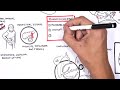
0:00 In this video, we're going to look at chronic pancreatitis. 0:09 This is an overview and introduction. 0:12 Chronic pancreatitis is a syndrome involving progressive inflammatory changes 0:17 in the pancreas 0:18 that result in permanent structural damage. 0:23 Chronic changes can lead to impairment in exocrine and endocrine function. 0:31 The pathology of chronic pancreatitis, we see global fibrosis and scarring, 0:37 pancreatic duct 0:39 dilation, and stones. 0:44 These changes correspond with the signs and symptoms we see in chronic pancreat 0:50 itis. 0:50 These signs and symptoms are nausea and vomiting, dull epigastric pain that may 0:50 radiate to the 0:58 back, weight loss and malnutrition and steatoria. 1:04 Because of insufficient pancreatic exocrine function, the pancreas cannot sec 1:10 rete or 1:11 produce lipase. 1:13 Finally, tripotting may relieve some pain, and thus, patients are often in this 1:19 position. 1:20 It is important to know the difference between acute pancreatitis and chronic 1:26 pancreatitis. 1:27 In general, acute pancreatitis is an acute inflammatory response to pancreatic 1:33 injury, 1:34 and is usually non-progressive. 1:37 Recurrent episodes of acute pancreatitis may lead to chronic pancreatitis over 1:44 time. 1:45 Acute pancreatitis is always painful, whereas chronic can be asymptomatic over 1:51 long periods 1:52 of time. 1:56 In acute pancreatitis, the whole pancreas, or part of the pancreas is affected, 2:01 and 2:01 is characterized by presence of innate immune cells, the neutrophils. 2:07 Whereas in chronic pancreatitis, it tends to be patchy and focal disease with 2:13 monocyte 2:13 infiltration and fibrosis. 2:18 In the blood, amylase and lipase are increased in acute pancreatitis, whereas 2:24 there may be 2:25 normal amylase and normal lipase in chronic pancreatitis. 2:33 Investigations that can be performed for suspected pancreatitis is an end 2:39 oscopic retrograde 2:40 colon angiopancreato graph, or ECRP. 2:46 Now, this technique uses an endoscope that is fed down the esophagus, stomach, 2:52 and to 2:53 the duodenum. 2:55 From here, the endoscope utilizes a wire that can be guided into the pancreas, 3:01 where it 3:02 can then eject contrast. 3:05 The contrast is used to visualize the pancreas with imaging. 3:12 When the images are taken, the pancreas can be easily visualized to show 3:17 certain pathological 3:19 changes, and this allows for classification and prognosis of chronic pancreat 3:28 itis. 3:29 So for example, in mild pancreatitis, there is mild dilation of the pancreatic 3:35 duct and 3:36 clubbing of the pancreatic duct branches. 3:40 This can be seen with the ECRP. 3:44 In severe pancreatitis, there is clubbing and presence of dilated pancreatic 3:49 ducts, more 3:50 than one and a half times the normal size. 3:56 And again, this can be seen through the ECRP visualization technique. 4:04 Another investigation that can be performed is serology for glucose, amylase, 4:11 and lipase. 4:12 Glucose and lipase tend to be normal. 4:15 Lipase is more specific for the pancreas because amylase is produced elsewhere 4:20 in the body. 4:22 Glucose is tested because the pancreas is also an important endocrine organ 4:27 that produces 4:28 insulin. 4:29 Without insulin production, blood glucose increases and can lead to a secondary 4:36 complication, 4:37 which is diabetes. 4:38 Finally, a CT scan is also useful. 4:43 Here is a section of a CT scan at L1. 4:49 And we are looking at this section from an inferior view. 4:54 Here are the kidneys, liver, heart of the GI tract. 5:00 Here is the spleen, this is the abdominal aorta, and this is the inferior vena 5:07 cava. 5:08 Here is the pancreas. 5:10 Changes that can be seen on CT include pancreatic calcification, focal or 5:15 diffuse enlargement, 5:17 and ductal dilation. 5:20 Here are calcifications. 5:27 There are three criteria that can be used to diagnose chronic pancreatitis in 5:31 its late 5:32 stage. 5:33 These are the presence of pancreatic calcifications, steatoria and diabetes my 5:44 elitis. 5:46 The management of chronic pancreatitis is firstly to stop taking pancreatotox 5:51 ins, such 5:52 as alcohol and smoking. 5:56 Arceitamol can be used for pain relief, non-strotal anti-inflammatory drugs are 6:02 not advised. 6:03 Pancreatic enzymes are also supplied, and this is in order to help with food 6:09 digestion 6:09 and absorption, because the pancreas cannot produce its own enzymes. 6:16 Omeprozol, which is a proton pump inhibitor, is used in conjunction with 6:21 pancreatic enzymes. 6:23 Because by reducing acidity, the pancreatic enzymes activity increases. 6:31 It's important or advised to give nil by mouth, as enteral feeding may reduce 6:40 pain, and has 6:41 overall benefit. 6:43 Food modifications such as low-fat diet can also help with symptoms. 6:48 Alternative stress is a major hypothesis to explain the pathogenesis of chronic 6:53 pancreatitis, 6:54 and so antioxidants are also given. 6:58 Octreotide, which is a synthetic analog of somatostatin, may help relieve pain 7:05 through 7:05 anti-nociceptive activity in the spinal dorsal horn. 7:09 It can also inhibit neurogenic inflammation and/or inhibit coli, cystokinin 7:15 release and 7:17 pancreatic secretion. 7:22 Draining excess fluid from the pancreas may need to be performed. 7:25 This can be done through percutaneous or endoscopic drainage. 7:39 [BLANK_AUDIO]