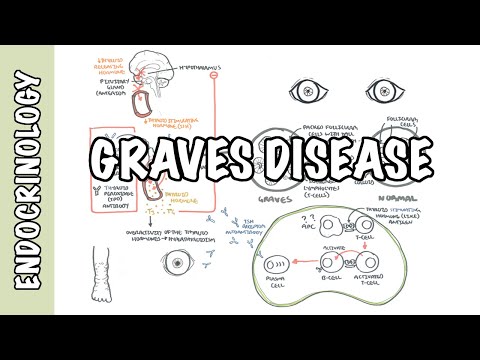
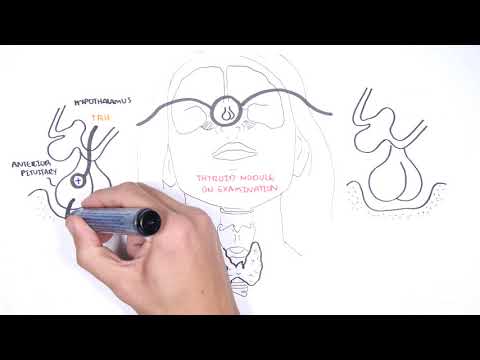
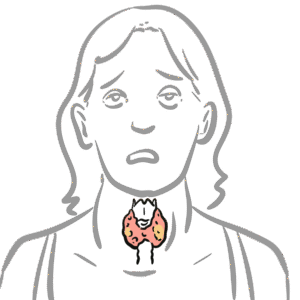
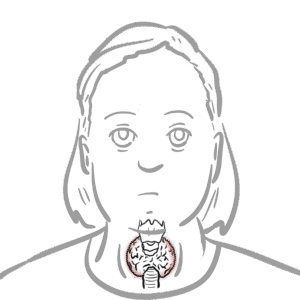
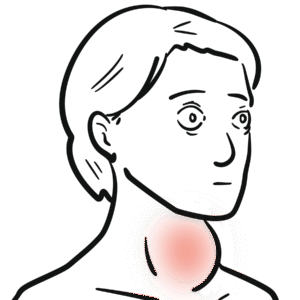
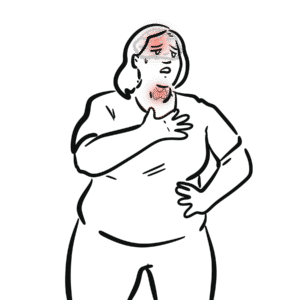
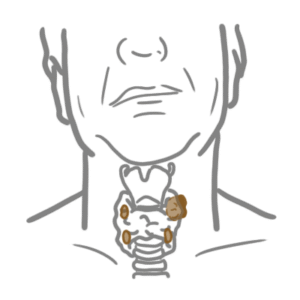
0:00 Hello, in this video we're going to talk about hyperthyroidism, which is 0:10 defined as 0:10 elevated thyroid hormone levels in circulation. 0:14 Thyroid hormones are very important in fetal development and also in metabolism 0:17 , so high 0:18 levels of thyroid hormones in circulation, as you can imagine will amp up 0:22 metabolism to 0:23 a point where it becomes pathological. 0:27 Diaphragm and thyroid toxicosis actually mean kind of the same thing. 0:32 However, some define hyperthyroidism specifically to be increased synthesis of 0:39 thyroid hormones 0:40 in the thyroid gland, whereas thyroid toxicosis refers to a clinical syndrome 0:44 of excess circulating 0:45 thyroid hormones, irrespective of the source. 0:49 In this video, hyperthyroidism will mean high levels of thyroid hormones in 0:55 circulation, 0:55 causing the signs and symptoms of hyperthyroidism. 1:00 Understanding the physiology of the thyroid gland, the hypothalamic pituitary 1:04 thyroid 1:04 axis is important to understanding hyperthyroidism. 1:12 Thyroid trope in releasing hormone TRH stimulates the synthesis and secretion 1:16 of thyroid stimulating 1:18 hormone TSH, which acts at the thyroid to stimulate all steps of thyroid 1:24 hormone biosynthesis 1:26 and secretion by binding onto thyroid stimulating hormone receptors. 1:31 The thyroid hormones are triadothyronin T3 and thyroxin T4. 1:36 These thyroid hormones control the secretion of TRH and TSH by negative 1:43 feedback to maintain 1:44 the physiological levels of the main hormones of the hypothalamic pituitary 1:49 thyroid axis. 1:51 In hyperthyroidism, there's elevated circulating thyroid hormones, which means 1:55 there will be 1:56 a negative feedback loop causing a decrease in TRH and TSH. 2:07 The functional units of the thyroid glands are the follicles made up of foll 2:12 icular cells. 2:13 The center of the follicle is the choloid. 2:16 The thyroid gland has a rich blood supply and here are the capillaries, which 2:20 will bring 2:21 TSH thyroid stimulating hormones to these cells. 2:27 Next to the follicles are the parafolicular cells, also known as C cells, which 2:32 produce 2:32 calcitonin, another hormone, which we'll not talk about, but has an important 2:37 role in calcium 2:38 homeostasis. 2:41 Zooming closer now at the interaction between the capillary and the follicle, 2:46 the capillaries 2:47 of course brings thyroid stimulating hormone to the area. 2:52 The inner part of the follicle is a choloid, the center. 2:58 On the follicular cells, you have thyroid stimulating hormone receptors. 3:02 When thyroid stimulating hormone reaches the thyroid follicular cells, it binds 3:07 to thyroid 3:07 stimulating hormone receptors, causing a number of things. 3:11 Firstly, it will stimulate tharglobulin production, tharglobulin will enter the 3:18 choloid. 3:19 Tharglobulin contains tyrosine groups, which are important in making the 3:24 thyroid hormones. 3:26 TSH also stimulates the expression of channels such as sodium iodide channels, 3:31 allowing circulating 3:33 iodide to enter the follicular cells. 3:36 From here, iodide enters the choloid via another channel, and becomes oxidized 3:43 to iodine. 3:44 Iodine and tharglobulin is what makes our thyroid hormones, T3 and T4. 3:52 T3 and T4 will enter circulation. 3:55 The thyroid hormones travel in circulation bound to proteins, the main protein 4:00 being 4:01 thyroxine binding protein, and here it will target the different cells around 4:06 our body 4:07 to elicit an effect, so increasing metabolism. 4:12 In this video, hyperthyroidism will mean high levels of thyroid hormones in 4:18 circulation, 4:18 causing the signs and symptoms of hyperthyroidism. 4:22 Causes of hyperthyroidism can be divided into two groups. 4:26 One group is where you have increased synthesis of thyroid hormones, of 4:31 whatever cause. 4:33 This group is called hyperthyroidism with normal or high radioiodine uptake. 4:40 Increased iodine uptake makes sense, because increased thyroid hormone 4:45 synthesis requires 4:46 an increase in iodine. 4:50 The other group is hyperthyroidism with near absent radioiodine uptake. 4:57 This means that hyperthyroidism is not a result of increased synthesis of 5:03 thyroid hormones. 5:04 Can you think of any? 5:06 If not, just wait and we'll find out together. 5:09 Let us first focus on hyperthyroidism, where there is an increase in thyroid 5:14 hormone synthesis 5:16 production. 5:21 The autoimmune disorder Graves' disease is the most common cause of hyperthy 5:25 roidism. 5:27 The disease is much more common in women than in men and begins between ages 20 5:32 and 40 years. 5:33 In Graves' disease, there is a presence of autoantibodies against thyroid 5:37 stimulating 5:37 hormone receptor. 5:39 These antibodies stimulate and activate the thyroid stimulating hormone 5:44 receptor. 5:45 Extended thyroid stimulating hormone receptor, as we have learned, means 5:49 increase in thyroid 5:50 globulin and iodine in the choloid, which means more T3 and T4 can be produced. 5:58 More T3 and T4 then enter circulation bound to proteins resulting in hyperthy 6:06 roidism. 6:07 Another cause of hyperthyroidism is toxic adenoma, or toxic multinodular goita. 6:13 In this case, the nod just can be initially not toxic, but through time, they 6:19 can undergo 6:20 genetic mutations, causing an abnormal thyroid stimulating hormone receptor. 6:27 The mutated thyroid stimulating hormone receptor becomes autonomous. 6:32 It can activate by itself in the presence or in the absence of TSH. 6:38 This means more thyroid globulin, more iodine in the choloid. 6:42 This means more T3 and T4 can be produced, more T3 and T4 enter circulation, 6:49 resulting 6:49 in hyperthyroidism. 6:54 Another example, although very rare, is iodine excess. 6:58 We know that the normal process of TSH will stimulate the TSH receptor, and we 7:04 know that 7:05 iodine is very important in the production of thyroid hormones. 7:10 If we have a lot of iodine, this will, of course, shift production to the right 7:15 more, 7:15 so we produce more thyroid hormones, with more thyroid hormones, which means 7:19 that we 7:20 have hyperthyroidism. 7:23 A very interesting cause of hyperthyroidism is during early stages of pregnancy 7:28 gestation. 7:30 When beta-HCG, the pregnancy hormone, is produced by the fertilized egg. 7:37 At very high levels, human chorionic gonadotropin, the beta-HCG or HCG, not 7:44 only interacts with 7:46 its cognate receptors, the luteinizing hormone receptors, but it also cross-re 7:53 acts with 7:54 thyroid stimulating hormone receptors. 7:56 This results in a physiological increase in thyroid hormone synthesis and a 8:01 decrease in 8:02 thyroid stimulating hormone levels. 8:05 In some women, this mechanism can actually lead to overt hyperthyroidism during 8:11 pregnancy. 8:13 Autonomous secretion of thyroid stimulating hormone by a pituitary adenoma is a 8:17 rare cause 8:18 of hyperthyroidism. 8:20 Pituitary adenoma can be malignant or non-malignant. 8:24 Regardless, it causes an increase in thyroid stimulating hormone production. 8:29 With more thyroid stimulating hormone in circulation, this means the thyroid 8:32 stimulating hormone 8:33 receptor is stimulated. 8:36 Activated thyroid stimulating hormone receptor increases thyroid globulin and 8:39 iodine in the 8:39 colloid, which means more T3 and T4, more T3 and T4 than enter circulation 8:45 bound to protein 8:46 resulting in hyperthyroidism. 8:51 The causes of hyperthyroidism we have discussed so far are all examples of an 8:56 increase in 8:57 thyroid hormone synthesis. 8:59 This is why these examples are categorized as hyperthyroidism with normal or 9:05 high radio 9:05 iodine uptake, because increase in thyroid hormone synthesis means more iodine 9:11 needs 9:11 to be taken up. 9:14 The other cause of hyperthyroidism is where there is near absent iodine uptake, 9:19 which 9:19 means there is no actual increase in thyroid hormone synthesis in the thyroid 9:25 gland. 9:26 A good example of this is ingestion of thyroid hormones, either fictitious 9:30 ingestion of 9:30 thyroid hormones or overdosing accidentally with a levothyroxine. 9:37 When you ingest thyroid hormones, they are absorbed easily in the gut and can 9:42 enter circulation 9:43 easily causing hyperthyroidism. 9:46 This still has that negative feedback to the brain to reduce thyroid trope in 9:50 releasing 9:51 hormone and thyroid stimulating hormone levels. 9:55 An interesting cause of hyperthyroidism here in this group is called hamburger 10:00 thyroid 10:00 toxicosis. 10:02 Probably not common now, but back in the day when beef was being made, some of 10:06 the burgers 10:07 contained the cow's thyroid glands. 10:11 Because you are eating thyroid glands, you probably are consuming all that 10:15 stored thyroid 10:16 hormone, which will increase the thyroid hormone levels in the blood causing 10:23 hyperthyroidism. 10:24 Thyroid production of thyroid hormones from thyroid cancer metastasis to other 10:29 organs, 10:29 for example, thyroid cancer metastasis to the bones nearby is in other cause. 10:36 This metastatic thyroid cancer can begin to produce thyroid hormones, 10:40 increasing thyroid 10:41 hormone levels. 10:42 Not sure why this is placed under the hyperthyroidism with near absent radio 10:47 iodine uptake, because 10:48 technically there is an increase in thyroid hormone synthesis. 10:52 Anyway, the final cause of hyperthyroidism with near absent radio iodine uptake 10:58 is thyroid 10:59 itis, which is inflammation of the thyroid gland. 11:03 When you have inflammation of the thyroid gland, you can imagine the follicular 11:08 cells 11:08 are destroyed, releasing all its content into the bloodstream, resulting in 11:14 hyperthyroidism. 11:15 There are many causes of hyperthyroidism, radiation, medication, lithium and 11:22 infection, 11:22 and even autoimmune. 11:24 All these different types of thyroiditis have their own unique names, which we 11:30 will 11:30 not go into. 11:32 So those are the causes of hyperthyroidism. 11:34 To summarize, hyperthyroidism is where you have excess amounts of T3 and T4 in 11:40 circulation. 11:41 Vibing can be divided into hyperthyroidism with normal to high radioidine 11:47 uptake, which 11:48 means basically increase in thyroid synthesis in the thyroid gland, or hyperthy 11:55 roidism with 11:56 near absent radioidine uptake, which basically means there is no synthesis of 12:01 thyroid hormones 12:02 from the thyroid gland.