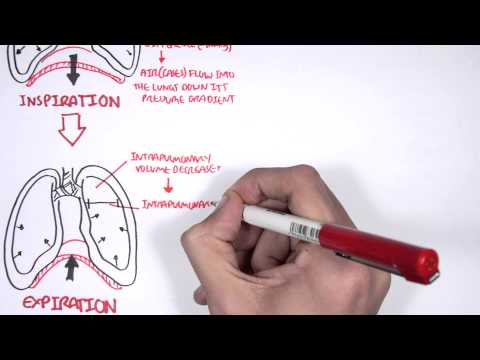
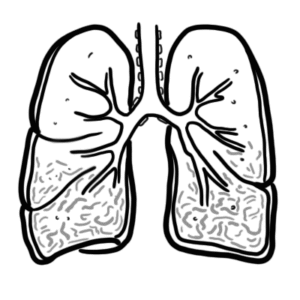
0:00 Hello, in this video, we're going to talk about lung function focusing on the 0:06 four important 0:07 lung volumes and then talk about the lung capacities. 0:12 And following this video, there's a follow up on spirometry and how it relates 0:17 to these 0:18 values. 0:19 So we begin by looking at the anatomy of the lungs. 0:22 Here is a person's respiratory system, the upper and lower respiratory tract. 0:27 Here are the ribs which wrap around the lungs and help protect it. 0:31 The muscular diaphragm which plays the main role in helping with respiration as 0:36 well as 0:36 the intercostal muscles. 0:39 The lungs allow us to take in or inspire oxygen and remove or exhale carbon 0:45 dioxide. 0:46 This is an exchange. 0:48 The exchange of gases occur in the building blocks you can see of the lungs 0:52 called the 0:52 alveolus. 0:53 An important calculation of lung function can be gleamed from the displacement 0:59 of air 0:59 volume during inspiration and/or expiration. 1:03 I'm going to represent the four important lung volumes using the alveoli as an 1:09 example. 1:10 This is just a concept to hopefully understand the differences in lung volumes. 1:15 We're going to talk about the lung volume of a typical adult male. 1:20 Without females have slightly lower values than the ones I'll be talking about. 1:25 But here, the concept is the main thing, so I hope it makes sense. 1:31 The amount of air we breathe in and out in our lungs normally can be referred 1:36 to as 1:36 the tidal volume. 1:39 Typical values of the tidal volume are on the order of 500 to 750 mils. 1:44 However, we can also take a deep breath in, deep inspiration, thus our volume 1:51 of air in 1:52 our lungs can increase. 1:55 This is the inspiratory reserve volume. 1:58 The air inspired with a maximal inspiratory effort in excess of the tidal 2:02 volume. 2:03 Typically, the inspiratory reserve volume is about 3 liters. 2:10 So again, we're looking at the four important lung volumes. 2:13 Here again is an example of your tidal volume, and this is your inspiratory 2:22 reserve volume. 2:25 We can also exhale more than usual. 2:28 The amount of air we can exhale in addition to the tidal volume is the inspir 2:32 atory reserve 2:33 volume. 2:34 This is typically 1.5 liters. 2:37 Thus, at the end of the day, there is always an amount of air or volume 2:43 remaining in our 2:45 lungs after a maximal expiratory effort. 2:49 This is the residual volume, and is about 1 litre. 2:54 When all four of the above volume components are taken together, they make up 2:59 the total 2:59 lung capacity, about 6 liters, and we will talk more about this later. 3:07 There's this also thing called dead space. 3:09 This is basically the part of the respiratory tract or part of the lungs that 3:12 does not participate 3:14 in gas exchange. 3:16 Now let's learn more about those four volumes by representing it in a graph, 3:21 because these 3:22 volumes have important implications in health and disease. 3:27 So here is a graph on the y-axis is the lung volume in mill. 3:33 Here our total lung volume is about 6 liters, so 6,000 mls, in adult males. 3:42 So let's draw it out. 3:43 Going up here is when we inspire, so inspiration, and increase our lung volume 3:50 obviously, and 3:51 going down the y-axis is when we exhale air, so we are decreasing our lung 3:56 volume, which 3:57 kind of makes sense. 3:59 The x-axis is just time, nothing really specific. 4:03 So let's now first recap our four important lung volumes. 4:07 If you remember, the amount of air that moves into the lungs with each 4:12 inspiration during 4:14 quiet breathing is their tidal volume, typically 500 mls, 0.5 liters, just like 4:26 so. 4:27 Remember the dead space, we are not talking about this area because it has no 4:30 role in 4:31 gas exchange. 4:34 Let's just say we are breathing normally, and then suddenly take the biggest 4:38 breath in. 4:39 This is the in-spiritory reserve volume, and can get up to 3 liters in addition 4:45 to the 4:46 tidal volume. 4:48 Don't worry, here I drew 1,200, but it's meant to be 3 liters. 4:54 It will correct itself soon. 4:58 And let's say we breathe normally, so normal tidal volume, and then we have a 5:03 maximal 5:04 expiratory phase. 5:06 This is the expiratory reserve volume, typically 1.5 liters. 5:14 And the air left in the lungs after a maximal expiratory effort is the residual 5:19 volume, 5:19 which is about 1 litre. 5:23 So an adult male will typically have a total lung capacity of 6 liters, a 5:31 female 4.5 liters. 5:33 Now different textbooks have different values. 5:37 Now just like we talked about those four lung volumes, there are four lung 5:42 capacities. 5:43 I already introduced the total lung capacity, which is one of them. 5:48 Now let's recap the same graph containing the lung volumes again, and also 5:54 introduce 5:55 the lung capacities. 5:58 So the amount of air that moves into the lungs with each inspiration during 6:02 quite normal 6:03 breathing is called the tidal volume, about 500 ml or 0.5 liters. 6:09 The air inspired with a maximal in-spiritory effort in excess of the tidal 6:14 volume is the 6:15 in-spiritory reserve volume, which is typically 3 liters. 6:21 The volume expelled by an active expiratory effort of the passive expiration is 6:26 the expiratory 6:28 reserve volume, which is about 1 litre. 6:31 And of course you have the air left in the lungs after a maximal expiratory 6:35 effort, which 6:36 is the residual volume, about 1 litre as well. 6:42 The vital lung capacity refers to the maximum amount of air expired from a 6:48 fully inflated 6:49 lung, which means that it's essentially the tidal volume plus the in-spiritory 6:55 reserve 6:56 volume plus the expiratory reserve volume. 7:00 These three components will give you the vital lung capacity. 7:05 The maximum amount of air inspired from the end expiratory level is the in- 7:12 spiritory capacity, 7:14 which is about 3.5 liters. 7:17 So it's essentially the in-spiritory reserve volume plus the tidal volume. 7:27 The functional residual capacity, which should not be mixed up with the 7:32 residual volume, represents 7:34 the volume of air remaining in the lungs after expiration of a normal breath. 7:40 So this is essentially the residual volume plus the expiratory reserve volume. 7:48 And the amount is typically 2.5 liters. 7:51 Finally, the fourth lung capacity that we have already talked about is the sum 7:56 of all 7:56 the lung volumes essentially. 7:58 And this is the total lung capacity. 8:01 Again, in the males, the total lung capacity is about 6 liters and in females, 8:05 about 4.2 8:06 liters, but different textbooks say different things. 8:09 Now that we have a better understanding of the lung volumes and lung capacities 8:13 , let us 8:13 see how this can be used to diagnose and monitor certain lung conditions. 8:19 What I mean specifically is chronic obstructive pulmonary disease and also 8:24 restrictive lung 8:25 diseases.