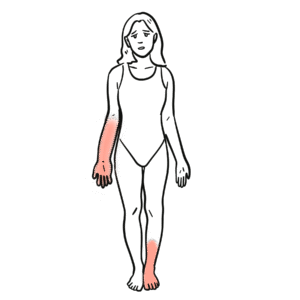
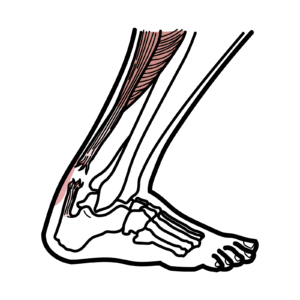
0:00 The ankle joint is referred to as the tailocrual joint. 0:14 It is formed by the bones of the leg, the tibia, and fibula, and the foot, the 0:20 talus. 0:21 The medial ankle pain is common and are often a result of specific foot biome 0:29 chanics. 0:31 The inner ankle, also known as the medial ankle, have a number of important 0:35 structures. 0:37 These are the medial malleolus, which is the distal part of the tibia. 0:41 On the medial side, the sastanaculum tali, the medial ligaments, also known as 0:47 the deltoid 0:47 ligaments, the tibialis posterior tendon, the flexor halicis lungus tendon, the 0:54 navicular 0:54 tubercle, and the mid-tastal joint. 0:58 Pain in the inner ankle can be caused by problems in any one of these areas. 1:03 Let's take a look at some causes of medial ankle pain, beginning with ligament 1:10 injuries 1:11 on the medial aspect, which is one of the most common causes of medial ankle 1:22 pain. 1:24 The medial or deltoid ligaments is injured, usually as a result of e-version 1:32 injury. 1:33 The medial ligament is usually very strong, much stronger than the lateral lig 1:38 aments, 1:38 and are more often accompanied by additional injuries, such as a fracture, for 1:44 example 1:44 the medial malleolus, the distal, fibula, as well as the tailor dome. 1:55 Medial malleola fracture is another cause of medial ankle pain. 2:00 It is very uncommon to happen by itself. 2:04 It usually occurs as a bi-malleola or tri-malleola fracture. 2:11 Bi-malleola fracture means that both the medial and the lateral malleola are 2:16 fractured. 2:17 Tri-malleola means both the lateral and medial malleola fracture, but also the 2:23 posterior 2:23 aspect of the tibia as well. 2:31 The next cause of medial ankle pain is tibialis posterior tendinopathy, which 2:35 is essentially 2:36 irritation of the tibialis posterior tendon. 2:40 This tendon comes around the medial malleolus before attaching to the navicular 2:47 tuberosity. 2:48 This tendon and muscle function is to cause foot inversion as well as plantar 2:55 flexion 2:56 as well. 2:58 Now people with tendinopathy of the tibialis posterior present with medial 3:04 ankle pain, 3:05 most often over the retinaculum posterior inferior to the medial malleolus, 3:10 although 3:11 the patient may also complain of medial midfoot pain at the site of insertion 3:16 of the tendon. 3:18 The pain is exacerbated by resisted inversion and passive eversion. 3:28 When asked to do a single heel raise, it will demonstrate a lack of hindfoot 3:34 supination, 3:36 because normally this is what the tendon will do. 3:38 It will perform supination or inversion. 3:41 And so there will be lack of this because the tendon is not working. 3:46 It may be associated also with excessive pronation as a result, so becoming 3:52 more flat-footed. 3:55 Rupture of the tibialis posterior presents with postural medial tibial pain 3:59 extending 4:00 around the medial malleolus to the navicular tubercle, where the tendon 4:11 attaches. 4:12 Another cause of medial ankle pain is issues with the flexorhalosis-longus 4:17 tendon, causing 4:18 tendinopathy. 4:20 Here there is irritation of the flexorhalosis-longus tendon. 4:25 The flexorhalosis-longus arises from the distal fibula and inserts at the dist 4:33 al phalanx of the 4:34 great toe. 4:36 It causes the great toe to flex. 4:42 Flexorhalosis-tendinopathy occur as a result of impingement of the flexorhal 4:47 osis-longus 4:48 tendon, with resultant tendonitis and even tendon rupture along the posterior 4:56 ankle joint. 4:58 This causes pain on plantar flexion. 5:06 The pain is exacerbated by resisted flexion of the first toe, with pain on 5:13 passive extension 5:15 of the first toe as well. 5:22 Flexorhalosis-longus tendonopathy can be associated with posterior impingement 5:27 syndrome, triggering 5:28 of the first toe in severe cases, and is often a result of secondary overuse, 5:35 specifically 5:36 seen in people who perform ballet due to extreme plantar flexion. 5:47 Another cause of medial ankle pain is tassel tunnel syndrome. 5:51 Tassel tunnel syndrome is, essentially, entrapment neuropathy of the posterior 5:57 tibial nerve, 5:58 as the nerve becomes trapped in the fibro-osseous tassel tunnel around the 6:07 medial maliolis. 6:09 This compression may be a result of trauma and inversion injury overuse, 6:14 excessive pronation, 6:17 footwear or chronic flexor Tino-synovitis. 6:26 In most patients, the posterior tibial nerve divides into three terminal 6:31 branches, the medial 6:33 plantar nerve, lateral plantar nerve, and the medial calcineal nerve within the 6:38 tassel tunnel. 6:41 Tassel tunnel entrapment itself can be divided into proximal syndromes or dist 6:47 al syndromes. 6:48 Tassel syndromes is, essentially, compression of the posterior tibial nerve, 6:54 whereas a distal 6:56 tassel tunnel syndrome implies compression of one or more of the terminal 7:02 branches I mentioned, 7:04 including the medial or the lateral plantar nerves. 7:12 In tassel tunnel syndrome, on examination, there is local tenderness on palp 7:17 ation to 7:17 that area. 7:18 There is also a positive tennel sign, meaning that if you tap along that area, 7:24 it will cause 7:25 essentially firing of the nerves, and so you get this tingling or pain 7:29 sensation where 7:30 the nerve runs through in the foot. 7:39 The medial plantar nerve entrapment, also known as joggers foot, is where the 7:44 medial plantar 7:46 nerve, which is a branch of the posterior tibial nerve, becomes entrapped or 7:52 compressed. 7:53 This is actually a type of distal tassel tunnel syndrome, because remember, the 7:58 medial plantar 7:59 nerve is a branch of the posterior tibial nerve. 8:03 The medial plantar nerve may be compressed between the abductor halocyst fascia 8:09 and its 8:10 origin at the navicular and calcaneus, or as it passes through the medial int 8:14 ramuscular 8:15 septum. 8:22 There is pain over the calcaneum, and this pain may radiate to the arch of the 8:28 foot. 8:29 Training aggravates the symptom, and it may be associated with pronation. 8:40 Recently acquired orthotics can provoke symptoms as well. 8:44 Again examination, when you press around where the medial plantar nerve is, it 8:48 can cause local 8:49 tenderness, and if you tap around there, it can elicit a positive tinnel sign, 8:55 similar 8:56 to what you see in carpal tunnel syndrome when you perform the tinnel's test. 9:05 So in summary, medial ankle pain is typically due to poor biomechanics of the 9:10 foot. 9:11 There are specific causes of medial ankle pain, and these are medial ligament 9:16 injuries, 9:17 the deltoid ligaments, medial malleolar fractures, tendinopathy of the tibialis 9:24 posterior, or 9:25 the flexihalosis longus, tassel tunnel syndrome, which can be both proximal or 9:32 distal, distal, 9:33 one of them being joggers, foot, which is medial plantar nerve entrapment. 9:40 Thank you for watching. 9:55 You