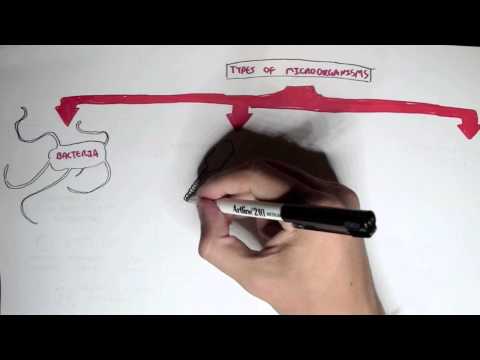
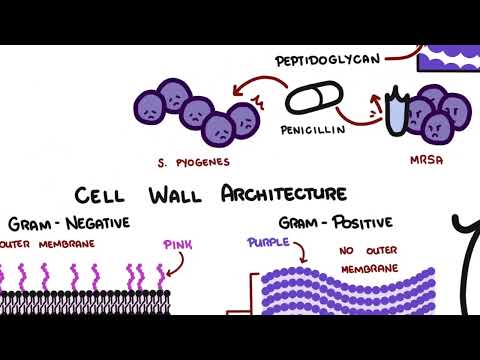
0:00 In this video, we're going to talk about the mode of action of antibiotics. 0:13 So we're not going to look into extreme detail, but we'll just look at the 0:18 overview in a way. 0:20 So a mode of action of antibiotics. 0:22 Now we have to know that antibiotics either destroy or slow down the growth of 0:30 bacterias. 0:32 So therefore, if it destroys a bacteria, it is bacterial sidal. 0:38 If it slows down the growth of bacteria, it's a bacterial static. 0:43 Here I am drawing a typical bacteria with cell membrane and cell wall. 0:50 The cell wall and cell membrane structure I am drawing is characteristic of a 0:56 gram positive 0:56 bacteria, but we will just assume it is any type of bacteria. 1:03 Within a cytoplasm, within the bacteria, we have a circular DNA. 1:07 We can have RNA being synthesized and ribosomes here. 1:13 Ribosomes will synthesize proteins. 1:17 The first type of antibiotic are the ones that I want to talk about, are the 1:21 ones that 1:22 target the cell membrane. 1:25 These antibiotics will disrupt the cell membrane function, which means that 1:30 they disrupt the 1:31 phospholipid bilayer. 1:34 So here is the cell membrane, and here is the cell wall, known as a peptidogly 1:39 can. 1:40 They are different. 1:43 The antibiotic binds here to the cell membrane. 1:47 It will alter the cell membrane structure and will make it more permeable. 1:52 This will disrupt the osmotic balance, causing leakage of cellular molecules, 1:58 and essentially 1:59 it will increase the word uptake leading to cell death. 2:04 Examples of these drugs are polymixins, which I spelled wrong, and polyins. 2:10 Now, polyins are actually specifically used against fungal pathogens, but that 2:18 's just 2:18 a note to know, that you can use polyins that target cell membranes, in fact, 2:26 in fungus. 2:28 So polymixins and polyins target cell membranes. 2:33 Other antibiotic classes target the cell wall. 2:37 These antibiotics will inhibit cell wall synthesis. 2:41 So these drugs are therefore bacterial-cidal. 2:44 They will cause bacterial bacteria to die. 2:48 Examples of these drugs are penicillin, cephalosporin, and basitrussin, all 2:55 these drugs have different 2:57 mechanisms of action when it comes to inhibiting the cell wall to synthesis. 3:04 A good thing about these drugs is that it won't affect human cells, because 3:08 human cells do 3:09 not have peptidoglycans. 3:12 We do not have cell walls. 3:16 Penicillin and cephalosporin are beta-lactams. 3:21 And then you have the basitrussin and other glycopepidides that prevent the 3:25 synthesis of 3:26 cell walls as well. 3:31 Notice that disruptive cell wall is pretty extensive, and so hopefully I will 3:34 make a video 3:35 on that. 3:37 Cell walls are important to bacterias. 3:40 Disrupting the cell wall or preventing in cell wall synthesis will result in 3:43 cell death. 3:49 The next type of antibiotic class is the ones that can inhibit here DNA 3:56 synthesis, or what's 3:58 occurring here, RNA synthesis. 4:01 These antibiotics will inhibit RNA or DNA synthesis. 4:08 Here the bacteria are typically having DNA replicated, of course, like so. 4:17 We have antibiotics that prevent DNA from being synthesized. 4:23 These are quinolines and also a class known as nalydicic acids. 4:31 And then, of course, RNA can be made from the DNA, and there are drugs such as 4:37 rifomycin, 4:38 which prevents RNA synthesis and therefore protein synthesis. 4:48 Other classes of antibiotics also inhibit protein synthesis itself. 4:53 Protein synthesis is carried out typically by ribosomes, which translate mRNA 5:00 into proteins. 5:02 Bacteria need to make proteins in order to survive. 5:05 However, there are antibiotics that target either the 30S subunit or the 50S 5:11 subunit 5:12 of the ribosomes. 5:14 Rifromycin and chlorofenicole target the 50S subunit of ribosomes, whereas 5:22 there are 5:23 tetracycline, streptomycin, and guineteromycin that target the 30S subunit. 5:28 Either way, this will disrupt the ribosomes from making proteins, which will 5:34 result in 5:35 the bacteria, obviously, unable to make proteins, so the bacteria is pretty 5:39 much useless. 5:41 Thus, the bacteria can still be alive, but it just is unable to make anything. 5:46 And so, these antibiotics that target protein synthesis are bacteria-ostatic. 5:51 They prevent bacterial growth. 5:56 Last type of antibiotic are the ones that inhibit folic acid metabolism. 6:01 So normally, normally, this green thing here, called PABA, which stands for 6:07 paraaminobenzoyic 6:09 acid, it's a precursor to folate. 6:13 So the bacteria can metabolize PABA into folate. 6:21 There are antibiotics out there that inhibit folate, or folic acid metabolism. 6:27 See, papa normally can be metabolized to folic acid within the bacteria. 6:32 And folic acid, or folic, is essential for the synthesis of adenine and thiam 6:38 ine, two 6:39 of the four nucleic acids that make up DNA. 6:44 These antibiotics, such as sulfanoamides and tri-methoprim, prevent conversion 6:51 of PABA 6:52 to folate, and therefore prevent proper synthesis, you can say. 6:59 Humans do not synthesize folic acid. 7:01 And so, these antibiotics are okay to take for humans and are selective towards 7:08 bacteria. 7:09 I hope you enjoyed this short video on antibiotics. 7:12 Thank you for watching.