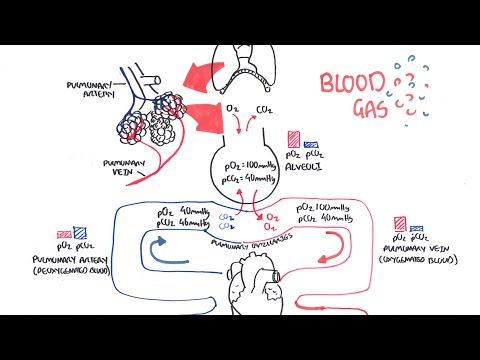
0:00 Armando histidine on biology and medicine videos, please make sure to subscribe 0:03 , 0:03 join the forum and group for the latest videos, please visit facebook armando 0:07 histidine. 0:07 In this video, we're going to look at gas exchange. So essentially, we're 0:11 looking at how gases 0:13 are transported around our body, the oxygen and carbon dioxide and how our 0:21 tissues receive this 0:22 oxygen and how our lungs receive the carbon dioxide so we can exhale it. So let 0:27 's just begin this 0:29 journey with the lungs here and here I'm drawing the heart as well and also 0:34 tissues. 0:34 So here is our tissue, our heart and our lungs. 0:42 After the tissue has utilized or used oxygen, the blood return will then return 0:52 to the heart. 0:53 The blood returning to the heart is deoxygenated blood because it contains, you 1:00 can say, low 1:00 oxygen, the oxygen has been used by the tissue. Now the blood leaving the 1:06 tissues in order will be 1:08 venules, veins and then as it enters the heart, it can either enter through the 1:15 inferior or 1:16 superior vena cava. So we'll enter the heart and then from the heart, the heart 1:22 will pump this 1:23 deoxygenated blood through the pulmonary artery. 1:27 So why is it called deoxygenated blood? Well, it's because we have more 1:35 concentration, 1:35 you can say, of carbon dioxide compared to oxygen or it's properly said we have 1:41 higher partial pressure of carbon dioxide compared to oxygen. That is why they 1:45 are deoxygenated. 1:47 As a deoxygenated blood enters the lungs, it will, the blood will offload the 1:54 carbon dioxide 1:55 and then the lungs will reoxygenate the blood essentially putting in more 2:00 oxygen into the blood 2:01 forming oxygenated blood. And this oxygenated blood supply will then go back to 2:08 the heart through 2:09 the pulmonary vein. So if we look at the partial pressure of oxygen and carbon 2:15 dioxide, again, 2:16 we can see that we have higher amounts of oxygen compared to carbon dioxide. 2:21 So as this pulmonary vein brings this oxygenated blood back to the heart, 2:28 the heart can then pump this oxygenated blood to tissues or around our body. 2:34 First of all, 2:36 through the aorta, then the arteries, then the arterioles, where the arterioles 2:41 would then form 2:41 capillaries and then into tissues. And if we look at the partial pressure of 2:46 gases in this 2:47 oxygenated blood supply, we can see that we have higher amounts of oxygen 2:51 compared to carbon 2:53 dioxide. And so within the tissues, again, we have oxygen being offloaded into 3:01 the tissues, 3:01 so the tissue can use it as energy and the carbon dioxide released back into 3:05 the blood. 3:05 As a byproduct. And within the tissues, if we look at the partial pressure of 3:10 the gases, 3:10 we have slightly higher amounts of carbon dioxide compared to oxygen. 3:14 Carbon dioxide and oxygen are transported mostly within red blood cells. Now 3:21 let's zoom into this 3:22 area here and see how the red blood cells offloads the oxygen to the tissues 3:28 and how the tissues 3:29 will then offload the carbon dioxide back to the blood and how carbon dioxide 3:33 is transported. 3:35 So zooming into this area, here we have the tissues, the cells of the tissue. 3:41 And here I'm drawing the lining of the blood vessel. So in red here, 3:45 this means that this is here is the blood and here is the interstitial fluid. 3:58 Let us firstly look at how oxygen enters the tissue. Some oxygen can be 4:05 dissolved in plasma 4:07 and can enter the interstitial fluid and then can enter the tissue where the 4:11 tissue can 4:12 neutralize it as energy. However, most oxygen in our body is transported in red 4:18 blood cells, 4:19 such as this one I am drawing here. Oxygen is transported bound to a molecule 4:27 known as hemoglobin, 4:29 HB. So here is hemoglobin, oxygen bound to hemoglobin. The hemoglobin and 4:37 oxygen can disassociate 4:39 forming hemoglobin and oxygen gas. This oxygen can then enter the interstitial 4:44 fluid and then oxygen 4:46 can be used by the tissue. Okay, so that was the two ways oxygen enters the 4:54 tissue from the blood. 4:55 Now let's look at carbon dioxide because the tissues form carbon dioxide as a 5:01 byproduct after 5:02 using oxygen. Some of the carbon dioxide or very little amount can actually 5:12 just enter the blood 5:14 and just be transported through plasma. Some of it can re-enter the blood, 5:20 react with water and 5:21 through a slow process form bicarbonate and hydrogen ions. And so carbon 5:27 dioxide in this case is being 5:29 transported as bicarbonate. However, most of the carbon dioxide will actually 5:40 enter the red blood 5:42 cells and then here it will react with water. Within red blood cells you have 5:46 these membrane 5:47 bound enzymes called carbonic anhydrase, which will through a fast process 5:54 convert carbon dioxide 5:56 and water to form bicarbonate and hydrogen ion. Exactly the same as the process 6:01 that occurred outside 6:03 which was slow. And then bicarbonate can then be trans pumped out by the red 6:09 blood cell into 6:10 the actual plasma and so be transported as bicarbonate. The transporter will 6:16 bring in 6:17 a chloride ion in exchange. The hydrogen ion here can react with the hemoglobin 6:26 molecule within the 6:27 red blood cell to form the hydrogen hemoglobin. And then you have another 6:33 mechanism where the 6:35 carbon dioxide can enter the red blood cell and actually attach with hemoglobin 6:40 to form 6:41 carbon amino hemoglobin. So now if we're going to look at the ways carbon 6:51 dioxide is transported 6:52 in the blood, we know that there are at least three mechanisms. The first is 6:57 that carbon dioxide 6:58 can dissolve in plasma, about 10% of it, which is this one. Or carbon dioxide 7:05 can react with a 7:06 hemoglobin within red blood cells to form carbon carbon amino hemoglobin. And 7:12 this is about 20% of 7:13 the carbon dioxide being transported this way. And the last, which is the 7:18 majority, which is the 7:19 major mode of transportation for carbon dioxide is as bicarbonate in plasma. 7:25 And this is about 70% 7:27 of the carbon dioxide. But again, forming bicarbonate, there are two ways. One 7:33 is that it can be formed 7:36 in red blood cells, which is a fast process, or it can be formed in the plasma 7:41 itself, which is 7:42 much slower. Now it's also important to understand that carbon dioxide and pH 7:51 is also very much 7:53 related. If we have an increase in carbon dioxide, this will actually cause a 7:59 decrease in pH, 8:01 which means that it will make the blood acidic. If we have a decrease in carbon 8:07 dioxide, this will 8:09 make the blood much more alkali. So it increase in pH. Why is this? Well, first 8:18 of all, let's just 8:19 pretend that we have more carbon dioxide. If we have more carbon dioxide, this 8:24 will shift 8:25 the reaction to form more bicarbonate and hydrogen ions. If we have more 8:30 hydrogen ions, this just 8:32 means that it will be more acidic. So that was looking at how carbon dioxide 8:41 gets transported. 8:42 Now let's look at how carbon dioxide gets offloaded, and then how oxygen is 8:47 transported in a bit 8:48 more detail. So let's, to look at this, let's go back to the lungs here and 8:55 zoom in. The lungs 8:56 are made up of branches of bronchioles and the ends of them called alveoli, or 9:03 an alveolar sac. 9:05 So the alveoli, this cluster of alveoli, they have blood supply, essentially 9:14 the pulmonary 9:15 artery coming in, and then the pulmonary vein leaving. So let us zoom into this 9:22 area here 9:23 where gas exchange takes place within the alveoli. 9:26 So here I'm drawing the cell lining of one alveoli, which is known as an alve 9:35 oli. And then 9:36 here I'm drawing the boundary of the blood vessel, and here we can find the red 9:41 blood cell. 9:43 So here's the alveoli, here is the blood with the red blood cell, and here's 9:47 just a fused membrane, 9:48 which is a thin gap. Before we continue, we have to understand that the alveoli 9:54 is the lung, 9:55 so it is what it is a structure that receives the carbon dioxide and that off 10:01 loads oxygen into 10:02 the blood. So let's first begin by looking at how carbon dioxide is transported 10:11 from 10:12 the blood back into the alveoli, into the lungs, so that we can exhale the 10:18 carbon dioxide. 10:19 So if you remember from the previous diagram, some of the carbon dioxide is 10:23 transported through 10:24 plasma, so this carbon dioxide can just enter the alveoli. A majority of the 10:29 carbon dioxide is 10:30 actually transported, if you remember, in the blood as bicarbonate, and so this 10:35 bicarbonate can 10:36 react with hydrogen ions in the blood, and through a slow process, form as an 10:43 end product carbon 10:44 dioxide and water. The carbon dioxide can then just enter the alveoli. Of 10:53 course, some of this, 10:56 actually a lot of it, or however much, of this bicarbonate in plasma, can 11:02 actually enter the red 11:04 blood cells through a transporter, which will bring out chloride ion in 11:08 exchange. 11:09 Within the red blood cell, bicarbonate can react with hydrogen ion, and through 11:17 a fast process, 11:18 and with the help of the enzyme, carbonic anhydrase, the bicarbonate hydrogen 11:24 reaction can form 11:27 carbon dioxide and water, and it's fast compared to the outside because of an 11:33 enzyme present, 11:34 and then this carbon dioxide can then just exit the red blood cell and enter 11:39 the alveoli. 11:40 Finally, you remember that some of the carbon dioxide is transported in the 11:46 blood bound to 11:48 hemoglobin, as carbon amino hemoglobin, and so this will disassociate, and then 11:54 the carbon 11:55 dioxide, after it's disassociated with hemoglobin, can then enter the alveoli. 12:00 Okay, so now we have a lot of the carbon dioxide in the alveoli. Our body will, 12:06 our lungs, will 12:07 exhale this carbon dioxide, and then we'll inhale oxygen. So oxygen enters the 12:12 alveoli, and then 12:13 oxygen can be transported via two ways. Small amount of oxygen will be 12:19 transported in plasma, 12:21 just enters the plasma. However, most of the oxygen will actually enter the red 12:25 blood cell, 12:26 and then bind to hemoglobin. Well, hydrogen bound hemoglobin, and then this 12:33 will form 12:33 essentially your oxy hemoglobin. And so this hydrogen ion is the hydrogen ion 12:42 that supplies 12:43 the bicarbonate reaction here. So again, just to stress what I'm trying to say, 12:51 oxygen transport occurs through two ways. It can be dissolved in plasma, which 12:58 this is less than 12:59 2% of oxygen is transported this way. Most of the oxygen is bound to hemoglobin 13:04 , which is 98% plus. 13:09 And this brings us to the last concept, which is called oxygen saturation. Now 13:15 oxygen saturation 13:16 is a kind of an important term to know, because it's essentially referring to 13:21 the concentration 13:22 of oxygen in the blood. And normal blood oxygen levels, normal blood oxygen 13:28 saturation levels, 13:29 should be at least 95 to 100%. Thank you for watching. I hope you enjoyed this 13:36 video on gas 13:37 exchange. The next video we will look at is control of respiration.