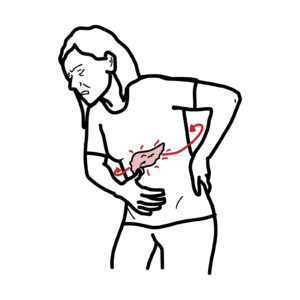
0:00 Acute appendicitis is one of the most common surgical emergencies typically 0:15 presenting 0:15 with right lower quadrant pain due to inflammation of the very form appendix or 0:20 the appendix. 0:22 The most commonly affects adolescents and young adults but can occur at any age 0:27 . 0:27 Some diagnosis and recognition are crucial to avoid complications such as per 0:32 foration 0:32 and sepsis. 0:35 Let's revise some anatomy. 0:41 The appendix is a narrow, blind-ended tube arising from the postural medial 0:47 wall of 0:47 the cecum, approximately 2 to 3 centimeters below the iliosecal valve. 0:53 It averages 8 to 10 centimeters in length and is suspended by the mesoapendics, 0:58 which 0:58 contains the appendicile artery, a branch of the iliocolic artery from the 1:04 superior mesenteric 1:06 artery. 1:07 Its variable position can include retrosical, pelvic, sub-secal, pre-ilial, or 1:15 post-ilial 1:17 can influence the clinical presentation and where the pain is located. 1:28 So the clinical presentation, the classic symptoms of appendicitis begin with 1:35 vague peri-ambilical 1:37 pain that then localizes to the right lower quadrant over 12 to 24 hours. 1:44 This may be accompanied by anorexia, so reduce appetite, nausea, vomiting, 1:50 fever, and constipation 1:52 or diarrhea. 1:54 Examination may reveal rebound tenderness, guarding, and localized peritoneism. 2:08 Intendentness is a sign that refers to pain or discomfort, felt upon the 2:15 release of pressure 2:17 from the abdomen where you are palpating or feeling. 2:22 Signs such as the roughsings, sewers, or up-trader signs may be present in 2:28 appendicitis, depending 2:30 on the location of the appendix. 2:34 Diagnosis may present differently with nonspecific abdominal pain, irritability 2:38 , fever, or gastrointestinal 2:40 symptoms such as vomiting or diarrhea. 2:43 Diagnosis in this group can be delayed due to atypical features and limited 2:47 communication. 2:48 Elderly and immunosuppress patients may present with sub-toscience and are more 2:59 prone to complications. 3:00 So why does appendicitis occur? 3:02 Well, the thought is that there is obstruction of the appendicitial lumen, and 3:07 this can be 3:07 due to fecalith, lymphoid hyperplasia, so the lymph glands here are becoming 3:13 bigger, 3:14 causing an obstruction of that lumen, the appendicitial lumen, or rarely a 3:18 cancer, neoplasm. 3:21 And essentially an obstruction of that lumen or that tunnel leads to increased 3:27 intralluminal 3:28 pressure, which then can lead to, you know, more bacteria proliferating, 3:32 because we normally 3:33 have bacteria around this area, it can lead to ischemia, lack of blood supply, 3:38 and eventually 3:39 transmural inflammation. 3:46 If untreated, this whole process of inflammation and ischemia can result in per 3:53 foration, abscess 3:54 formation due to the bacterial overgrowth, or, obviously with perforation, per 3:59 itoneism, 4:00 or peritonitis. 4:07 The risk factor is for developing appendicitis includes adolescents and young 4:11 adults, male 4:12 sex, but again, it occurs in both women and men, low fiber diet, family history 4:19 of appendicitis, 4:21 and recent viral gastrointestinal infections. 4:29 In terms of investigations, what is typically seen as an elevated neutrophilic 4:34 count, or 4:34 so neutrophilia, CRP is often elevated because of the inflammatory process. 4:41 Your analysis and beta-HCG are important to rule out other differentials, such 4:44 as UTI 4:45 or pregnancy. 4:47 Imaging, ultrasound is typically first-line investigation of imaging in 4:52 children and in 4:53 pregnancy, CT abdomen has high diagnostic accuracy, MRIs, obviously another 5:00 option for 5:01 pregnancy if CT scans are contraindicated or the diagnosis is uncertain. 5:08 But typically, the diagnosis is a clinical one, and a surgical review is 5:17 important. 5:19 Complication of appendicitis, we have already mentioned it earlier, but 5:24 includes perforation 5:25 of the appendix, and this can then lead to peritonitis or inflammation of the 5:30 peritoneum 5:31 that lines the abdominal cavity, appendicile absis, or flagmon canica, because 5:38 remember 5:39 there is the bacterial perforation and a small microperforation can cause an 5:44 absis, and if 5:45 perforated completely can lead to sepsis. 5:49 Small bowel obstruction can occur, stump appendicitis is a rare surgical rec 5:55 urrence of inflammation 5:57 of the appendix that has been cut out. 5:59 Of course, in rare circumstances, when you have sepsis, which is where the 6:03 bacteria enters 6:04 the bloodstream, this bacteria can then travel to the liver, resulting in hep 6:09 atic absis or 6:10 cortisol-paimia. 6:18 Management of appendicitis in uncomplicated cases laparoscopic appendectomy is 6:24 first-line, 6:25 and typically a single pre-op antibiotic dose is given. 6:28 In complicated cases, such as when you have an absis or an infection, IV 6:33 antibiotics is 6:34 very important. 6:37 Image-guided drainage can be a possibility, but typically there is an interval 6:41 appendectomy 6:42 after six weeks. 6:50 So in summary, appendicitis is a time-sensitive diagnosis requiring clinical 6:54 vigilance, particularly 6:55 in atypical presentation, imaging supports diagnosis, especially in uncertain 7:00 cases, 7:01 but typically it's a clinical diagnosis, and early surgical intervention 7:05 reduces the 7:06 risk of perforation and long-term complications. 7:25 You