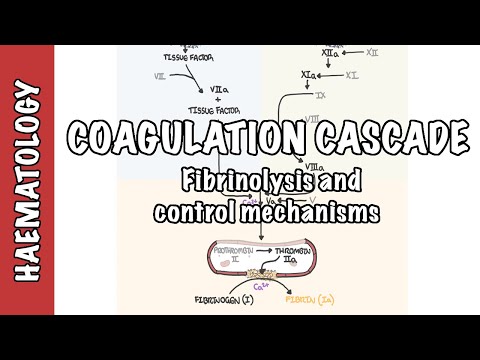
0:00 All tissues heal by similar mechanisms. 0:08 Wound healing is a complex process of overlapping phases that is initiated by 0:12 an injury or wound. 0:14 Normal wound healing is divided into phases defined by characteristic cellular 0:18 populations 0:19 and biochemical activities. 0:21 These phases include hemostasis, inflammation, proliferation, and remodeling. 0:29 Let us focus on the first phase of wound healing, which is hemostasis. 0:34 Immediately after injury, disruption of blood vessels leads to hemostasis. 0:39 The key players in this stage are platelets and clotting factors, which 0:43 normally circulate 0:44 in the blood. 0:46 Hemostasis involves vasospasm, vessel constriction, platelet plug formation, 0:53 and activation of 0:55 the coagulation system. 0:58 The final product of all of this is a fibrin mesh. 1:02 In addition to achieving hemostasis, the fibrin mesh serves as scaffolding for 1:07 the migration 1:09 into the wound of inflammatory cells, such as polymorphic leukocytes, which are 1:14 your 1:14 neutrophils and monocytes or macrophages. 1:19 Platelets release a number of substances which help initiate wound repair, such 1:23 as platelet-derived 1:24 growth factor, transforming growth factor beta, platelet activating factor, and 1:31 fibronectin. 1:33 Platelets also release serotonin, facilitating cell migration by increasing 1:38 vascular permeability. 1:41 In addition, injured endothelial and tissue immune cells release prostaglandins 1:46 and cytokines, 1:46 which promote the inflammatory response. 1:50 The inflammatory response, being an increase in adhesion molecules to allow 1:55 infiltration 1:56 of inflammatory cells, cytokines to attract the inflammatory cells, and also it 2:03 causes 2:04 vasodilation and increases vascular permeability to facilitate the transport of 2:10 the inflammatory 2:11 cells. 2:13 And this all will lead to our second phase of wound healing, which is 2:18 inflammation. 2:19 In inflammation, the key players are the neutrophils and the macrophages. 2:26 Neutrophils are the first inflammatory cells that infiltrate the wound site, pe 2:31 aking at 2:31 24 to 48 hours. 2:34 The primary role of neutrophils is phagocytosis, which is eating of things, 2:38 such as the bacteria 2:39 and tissue debris. 2:42 Macrophages is the most important regulatory cell in the wound healing 2:47 inflammatory phase, 2:48 typically they appear in the wound site 72 hours after the injury. 2:54 Macrophages are very important in wound healing as they play many roles, 2:59 including phagocytosis 3:00 of bacteria and tissue debris, recruitment and activation of fibroblasts, endot 3:06 helial 3:06 cells and more inflammatory cells, angiogenesis, which is the formation of new 3:13 blood vessels. 3:14 And lastly, as we will soon find out, promoting the extracellular matrix 3:20 synthesis, which 3:21 is important to create new tissue basically. 3:27 This leads to our third phase of wound healing, which is proliferation. 3:32 During the proliferative phase, a new vascular bed is formed to provide oxygen 3:36 ated blood 3:37 to the wound, and the wound fills then with granular tissue. 3:42 The key players here are the cells that have been recruited and have prolifer 3:46 ated thanks 3:46 to the cytokines released by the macrophages during the inflammatory phase. 3:52 These cells include fibroblasts, endothelial cells and in skin injury keratin 3:59 ocytes. 4:00 The proliferative phase can be subdivided into three major processes, angi 4:06 ogenesis, granulation 4:07 and reepithelialization. 4:12 In angiogenesis, the endothelial cells proliferate extensively, forming new 4:17 blood vessels. 4:19 And this process is promoted by cytokines and growth factors, such as tumor nec 4:23 rosis 4:23 factor alpha, transforming growth factor beta and vascular endothelial growth 4:29 factor. 4:30 Angiogenesis is essential to successful wound healing. 4:34 In granulation, which is the second step, growth factors such as platelet drop 4:39 growth 4:39 factor and transforming growth factor beta attract fibroblasts to the wound. 4:44 And fibroblasts are the cells which produce the granulation tissue. 4:49 Fibroblasts proliferate and form this matrix consisting of adhesive proteins, 4:55 proteoglycans 4:57 and glycosaminoglycan gel, as well as fibrous proteins such as collagen and el 5:02 astin. 5:03 And these components are essential for new matrix formation and tissue repair, 5:10 granulation 5:11 tissue. 5:13 The third is reepithelialization. 5:17 After the provisional matrix has been formed, the surrounding keratinocytes 5:21 will facilitate 5:22 reepithelialization by proliferating and migrating across the damaged area to 5:28 reestablish barrier 5:30 function. 5:32 The final phase of wound healing is the maturation or remodeling. 5:37 The primary purpose of the remodeling phase is the formation of new epithelium 5:41 and scar 5:42 tissue. 5:43 And this process can take up to a year to complete. 5:47 The main players here are the fibroblasts and their evolution called the myof 5:52 ibrablast. 5:53 Firstly, remodeling involves a balance of matrix accumulation, as well as later 6:01 dampening 6:02 the matrix formation and actually causing matrix to break down. 6:06 Essentially, during the remodeling process, fibroblasts will alter the extrace 6:12 llular matrix 6:13 that is produced. 6:14 They will transform to myofibrablast and then they will undergo apoptosis or 6:22 cell death. 6:23 Myofibrablast are quite amazing. 6:25 They are capable of contracting as they contain actin filaments. 6:30 The contraction of the myofibrablast and the alteration in the matrix material 6:36 produces 6:36 the scar tissue. 6:39 Scar remodeling will continue for many months, 6 to 12 months after the injury. 6:45 Gradually the cells in the scar will undergo apoptosis, resulting in a mature, 6:51 A-vascular 6:52 and A-cellular scar. 6:55 And so that completes wound healing and the four phases. 6:59 But it's important to know that there are so many factors that can lead to 7:03 impaired 7:03 healing and these factors can be divided into local factors or systemic factors 7:09 . 7:10 Local factors include the wound type, the wound size and location. 7:16 If there's a pressure on the wound, if there's edema or dehydration, the blood 7:21 supply to the 7:22 wound, if there's an underlying infection or foreign material. 7:27 Economic factors include increasing age, certain medications such as the use of 7:32 steroids or 7:33 antibiotics, comorbidities including diabetes, heart failure and obesity, as 7:39 well as nutritional 7:40 deficiencies, specifically vitamin C. 7:47 Now focusing on skin wounds or cutaneous wounds, specifically, there are two 7:52 main types of 7:54 healing, there's primary intention or secondary intention. 7:59 Primary intention is where the edges are sutured or stapled clothes and the 8:05 wound heals quickly 8:06 with minimal tissue loss. 8:09 This typically occurs during surgery. 8:12 Healing by secondary intention occurs when the sides of the wound are not 8:17 opposed, therefore 8:18 healing must occur from the bottom of the wound upwards. 8:24 In healing by secondary intention, the wound heals through a process that 8:27 includes granulation 8:29 tissue formation and reepithelialization, specifically. 8:34 Secondary intention wound healing is commonly done after an excessive loss of 8:39 soft tissue, 8:40 such as major trauma or severe burns. 8:42 Myofibroblasts play a major role in this type of wound healing. 8:48 So in summary, wound healing involves four phases, hemostasis, inflammation, 8:53 proliferation 8:53 and remodeling. 8:54 We discuss factors that could impair wound healing, local factors and systemic 8:59 factors.