

Adductor-related Groin Pain
Overview
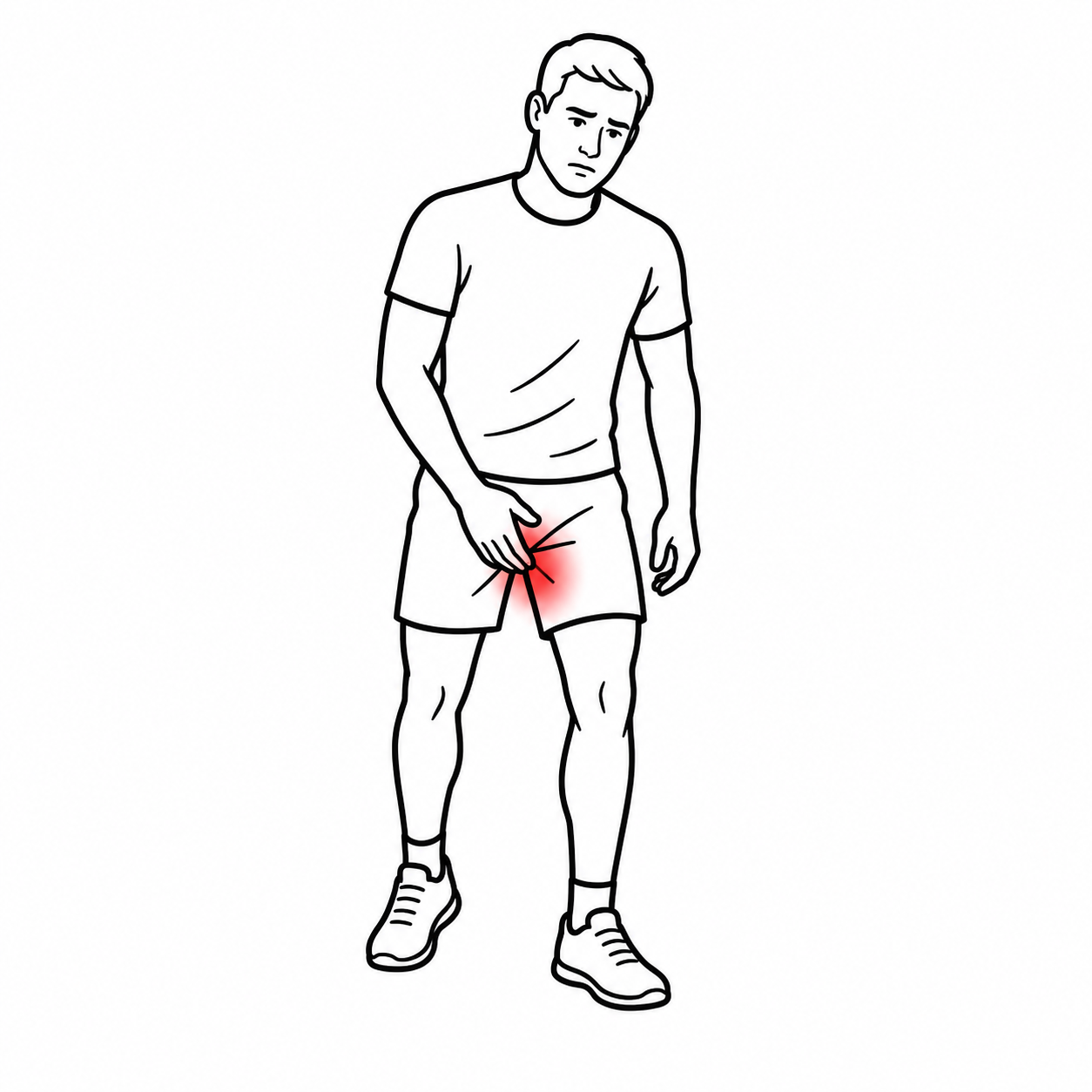
Adductor-related groin pain is a clinical entity characterised by pain localised to the hip-adductor region, with both tenderness of the adductors and recognisable pain reproduced by resisted hip adduction. It commonly affects athletes participating in sports involving kicking, sprinting, rapid acceleration, cutting or change of direction.1
The term encompasses acute adductor injuries and longer-standing presentations involving the muscle, musculotendinous junction, tendon or enthesis. It avoids imprecise labels such as “groin strain” or “adductor tendinitis” when the exact pathological structure has not been established. Athletes may have more than one concurrent source of groin pain.1
Definition
- Adductor-related groin pain
- Pain in the adductor region accompanied by adductor tenderness and recognisable pain during resisted hip adduction.
- Acute adductor injury
- Sudden-onset injury involving an adductor muscle, musculotendinous junction, tendon or attachment.
- Long-standing adductor-related groin pain
- Adductor-related symptoms persisting beyond the expected recovery period, commonly associated with repeated loading rather than one discrete traumatic event.
- Recognisable pain
- Pain reproduced during examination that matches the athlete’s usual symptoms.
Anatomy & Physiology
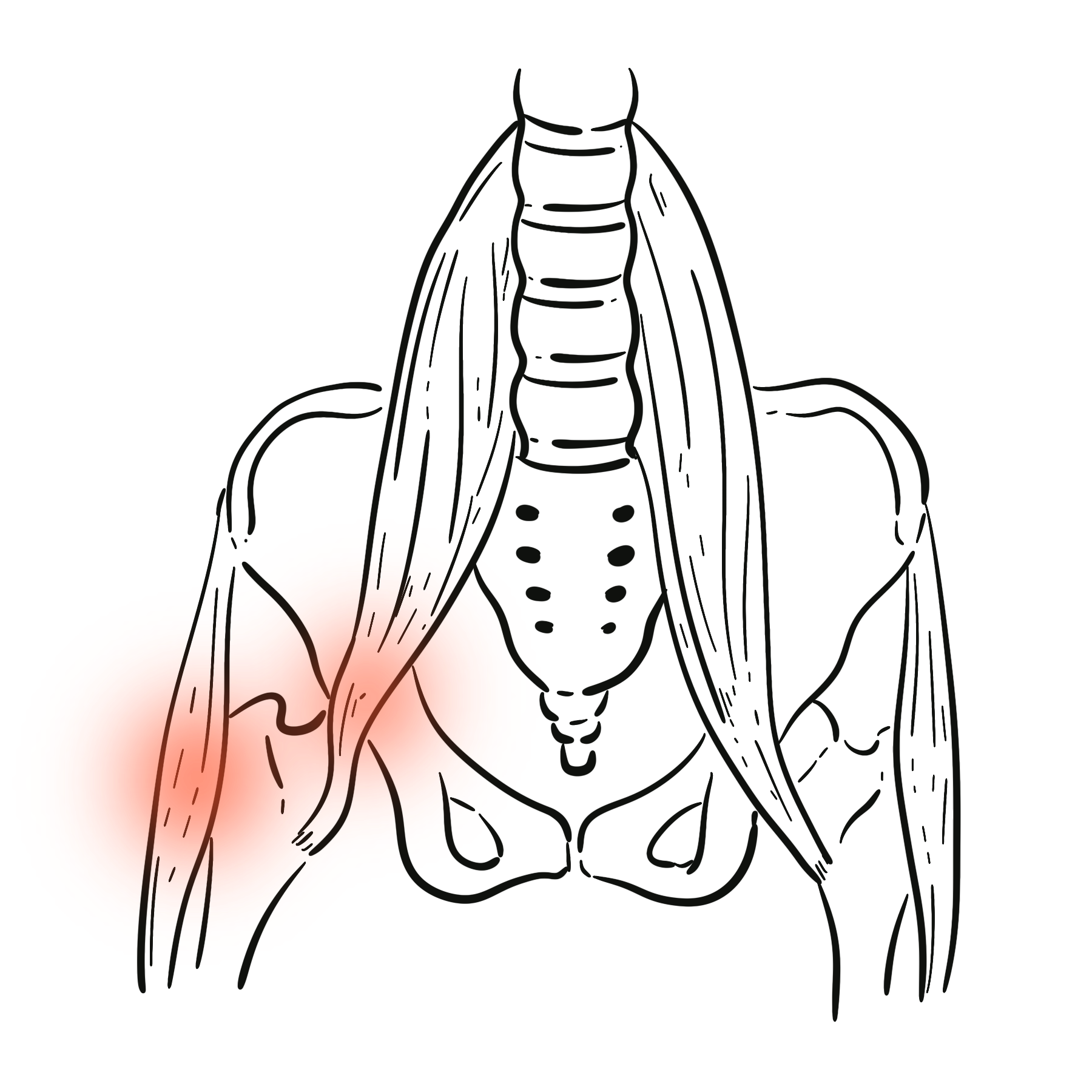
The hip-adductor group comprises the adductor longus, adductor brevis, adductor magnus, gracilis and pectineus. The adductor longus is particularly relevant because its proximal attachment near the pubic symphysis is commonly symptomatic or injured in athletes.
The adductors generate hip adduction and contribute to stabilisation of the pelvis and lower limb during running, kicking and rapid changes of direction. Their function varies with hip position; several adductors also assist hip flexion or extension.
The proximal adductor attachments have a close anatomical and functional relationship with the pubic symphysis, abdominal wall and surrounding aponeurotic structures. This helps explain why adductor-related, pubic-related and inguinal-related pain may coexist.
Aetiology & Risk Factors
Aetiology
- Acute high-force eccentric contraction, often during kicking, sprinting, tackling, slipping or rapid change of direction
- Repetitive tensile and compressive loading of the proximal adductor muscle–tendon unit
- Inadequate recovery between high-load sporting sessions
- Persistent reduction in tissue capacity relative to sporting demands
- Recurrence after incomplete rehabilitation or premature return to sport
Long-standing symptoms are usually multifactorial. Imaging may demonstrate tendinous, entheseal or bony abnormalities, but these findings do not necessarily identify the sole pain generator.2
Risk Factors
- Previous groin injury
- Reduced hip-adductor strength or strength relative to the abductors
- Abrupt increases in training or competition load
- Sports involving frequent kicking, acceleration and cutting
- Incomplete rehabilitation before return to sport
- Reduced sport-specific conditioning
- Concurrent hip-related, inguinal-related or pubic-related groin pain
Risk factors are not diagnostic, and their contribution varies between athletes.
Pathophysiology
Acute injury occurs when force transmitted through the adductor muscle–tendon unit exceeds its immediate capacity. Injury may involve muscle fibres, the musculotendinous junction, intramuscular tendon, proximal tendon or enthesis. Local disruption produces pain, loss of force and pain-mediated inhibition.
In longer-standing presentations, repeated loading without adequate adaptation may produce persistent pain and impaired load tolerance. Altered strength, motor control and sporting mechanics may subsequently increase stress across the adductor–pubic region. Structural abnormalities on magnetic resonance imaging (MRI) can coexist with symptoms but may also occur in asymptomatic athletes.2
Clinical Manifestations
Symptoms
- Unilateral or bilateral groin pain localised to the adductor region
- Pain during kicking, sprinting, cutting, skating or rapid change of direction
- Pain during resisted hip adduction
- Pain after training that may progress to symptoms during activity
- Reduced sporting performance or inability to participate
- Acute pain after a specific high-force movement
- Gradual-onset symptoms associated with repeated loading
Pain may radiate along the medial thigh but should be distinguishable from predominant inguinal, pubic, hip-joint, abdominal, genitourinary or neurological symptoms.
Examination Findings
- The athlete’s indicated location of pain
- Focal tenderness along the adductor muscle–tendon unit, particularly proximally
- Reproduction of recognisable pain with resisted adduction
- Adductor strength and pain during strength testing
- Passive adductor stretch
- Hip range of movement and hip-joint provocation tests
- The pubic symphysis and inguinal canal
- Abdominal resistance and cough or Valsalva provocation when indicated
- Gait, running and sport-specific movements
Bruising, swelling, a palpable defect or marked loss of strength suggests a more substantial acute injury. A comprehensive examination is important because multiple Doha clinical entities frequently coexist.1,2
Diagnosis & Investigations
Adductor-related groin pain is primarily a clinical diagnosis. Under the Doha agreement, both of the following are required:1
- Tenderness of the adductors
- Pain during resisted hip adduction that is felt in the adductor region and reproduces the athlete’s recognisable symptoms
Pain elsewhere during adduction testing does not, by itself, establish adductor-related groin pain.
Imaging
Imaging is not routinely required when the clinical presentation is characteristic and recovery is progressing appropriately.2
Plain radiography may be considered for suspected avulsion injury, fracture or stress injury, hip-joint disease, substantial bony abnormality, or persistent unexplained symptoms.
MRI may define the location and extent of an acute injury; assess suspected tendon avulsion or intramuscular tendon involvement; evaluate persistent or atypical symptoms; identify pubic bone, hip-joint or other soft-tissue pathology; and assist management when the diagnosis remains uncertain.
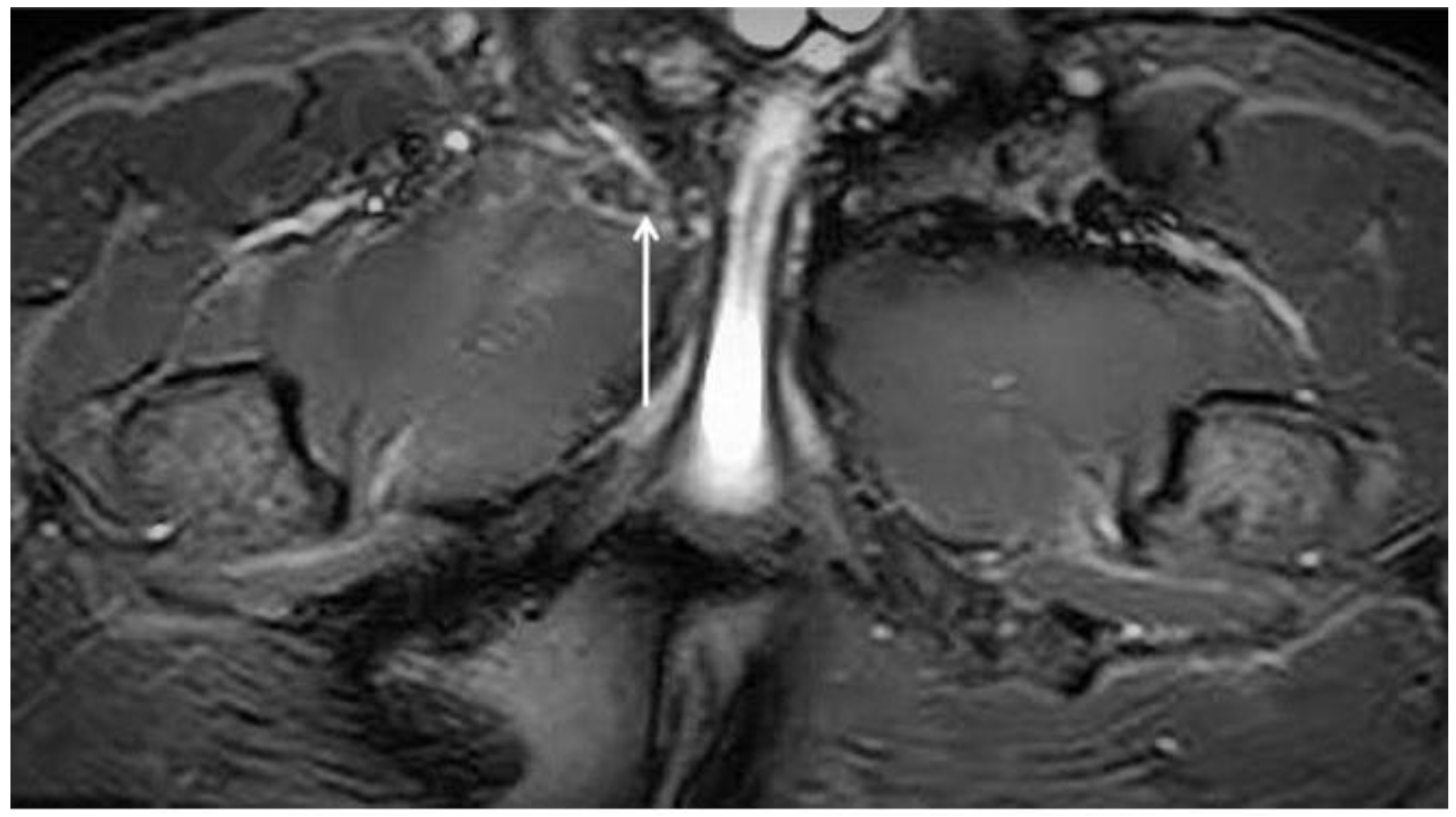
Axial oblique MRI showing right adductor longus tendinopathy. Source: Bisciotti et al., Figure 10; reproduced under CC BY 4.0.
What to notice
Detailed image description
Source: https://www.mdpi.com/2075-4418/14/8/814 (Figure 10). Creator: Bisciotti GN, Di Pietto F, Rusconi G, Bisciotti A, Auci A, Zappia M, Romano S. Licence: Creative Commons Attribution 4.0 International (CC BY 4.0), https://creativecommons.org/licenses/by/4.0/. Imported without modification for Armandoh educational use.
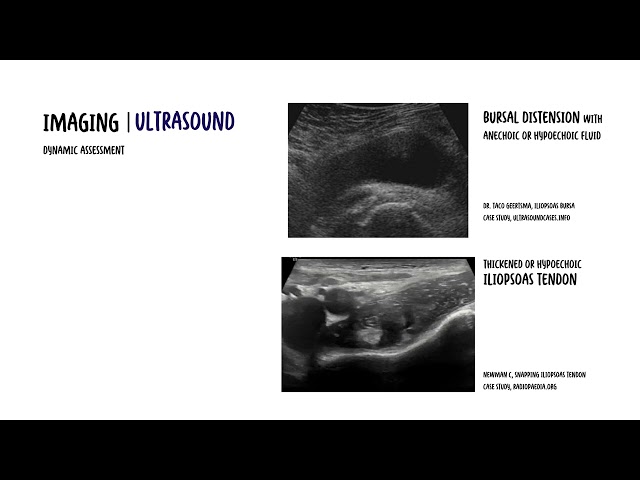
Ultrasound can assess superficial muscles and tendons dynamically, but its diagnostic value is operator-dependent. Imaging findings must be correlated with the clinical presentation because abnormalities may be present without symptoms.2
Differential Diagnosis
| Differential | Distinguishing features |
|---|---|
| Iliopsoas-related groin pain | Iliopsoas-region pain; more likely with pain during resisted hip flexion or hip-flexor stretching |
| Inguinal-related groin pain | Inguinal-canal pain and tenderness without a palpable hernia; often aggravated by abdominal resistance, coughing or Valsalva |
| Pubic-related groin pain | Local tenderness over the pubic symphysis and immediately adjacent bone |
| Hip-related groin pain | Mechanical symptoms, restricted hip movement or pain reproduced by hip-joint testing |
| Femoral neck or pelvic stress injury | Load-related deep groin pain, progressive pain, pain with hopping or weight-bearing, and relevant training or bone-health risks |
| Acute fracture or apophyseal avulsion | Sudden severe pain, impaired weight-bearing, focal bony tenderness or adolescent athlete |
| Inguinal or femoral hernia | Palpable or dynamic swelling, cough impulse or bowel-related symptoms |
| Referred lumbar or neurological pain | Back pain, paraesthesia, neurological deficits or neural-tension findings |
| Genitourinary or intra-abdominal disease | Urinary, testicular, menstrual, gastrointestinal or systemic symptoms |
Urgent investigation is required for severe unremitting pain, inability to bear weight, fever, systemic illness, testicular pain or swelling, a non-reducible groin mass, neurological deficits, suspected fracture or suspected stress injury.
Classification
The Doha agreement classifies groin pain in athletes into three broad groups:1
- Defined clinical entities: adductor-related, iliopsoas-related, inguinal-related and pubic-related groin pain
- Hip-related groin pain
- Other causes of groin pain
An athlete may meet the criteria for more than one entity. The entities should be documented separately and, where possible, ranked according to their clinical importance. The presentation may also be described as acute or long-standing, but this temporal description does not replace the clinical entity.
Treatment
Initial Management
Management should be individualised according to symptom duration, injury severity, sporting demands and associated pathology.
- Temporarily modify activities that provoke significant pain
- Maintain tolerable general conditioning
- Use short-term analgesia when clinically appropriate
- Assess strength, range of movement and functional limitations early
- Begin a structured rehabilitation plan with progressive loading
Complete rest should generally be limited. Prolonged unloading may reduce tissue capacity without correcting the deficits required for return to sport.
Exercise-Based Rehabilitation
Progressive active rehabilitation is the mainstay of treatment. In athletes with long-standing adductor-related groin pain, active training directed at the muscles of the pelvis produced better return-to-sport outcomes than passive physiotherapy in a randomised trial.4 Subsequent reviews continue to support exercise-based management while recognising that evidence for many individual interventions remains limited or heterogeneous.5
- Controlled isometric and isotonic adductor loading
- Progressive hip-adductor strengthening through increasing ranges
- Trunk, hip and pelvic strengthening
- Restoration of acceleration, deceleration and change-of-direction capacity
- Graded running
- Kicking or other sport-specific loading
- Progressive return to team training and competition
Progression should be criteria-based rather than determined by time alone. Acute rehabilitation protocols use clinical milestones followed by progressive running, change-of-direction drills and controlled sports training.6
Adjunctive and Escalation Options
Manual therapy or other passive modalities may provide short-term symptom relief but should not replace progressive loading. Evidence supporting corticosteroid injection, platelet-rich plasma and prolotherapy is insufficient or inconsistent; these should not be presented as routine first-line treatment.5
Specialist reassessment is appropriate when symptoms fail to improve despite a well-adhered rehabilitation programme; the diagnosis remains uncertain; imaging suggests substantial tendon disruption or avulsion; important concurrent hip, pubic or inguinal pathology is present; or recurrent symptoms prevent return to sport.
Surgery is rarely first-line and should be reserved for carefully selected, persistently symptomatic athletes after diagnostic reassessment and adequate conservative management.
Complications & Prognosis
Complications
- Persistent pain and reduced sporting performance
- Recurrent injury
- Loss of adductor strength or confidence with high-speed movement
- Prolonged absence from training or competition
- Secondary deconditioning
- Failure to recognise concurrent hip-related, pubic-related, inguinal-related or other pathology
Prognosis
Most athletes improve with appropriate load modification and progressive rehabilitation, although recovery varies with acuity, injury location, severity, sporting demands and coexisting pathology.
In a prospective cohort of male athletes with acute adductor injuries, meeting clinically pain-free rehabilitation criteria was associated with fewer reinjuries. Athletes with lower-grade MRI injuries generally returned sooner than those with complete tears, although these timelines should not be applied as fixed deadlines to an individual athlete.6
Delayed presentation, previous groin injury, substantial tendon involvement, multiple concurrent pain entities and failure to restore sport-specific capacity may contribute to a prolonged or recurrent course.
References
- Weir A, Brukner P, Delahunt E, et al. Doha agreement meeting on terminology and definitions in groin pain in athletes. Br J Sports Med. 2015;49(12):768–774. doi:10.1136/bjsports-2015-094869.
- Thorborg K, Reiman MP, Weir A, et al. Clinical examination, diagnostic imaging, and testing of athletes with groin pain: an evidence-based approach to effective management. J Orthop Sports Phys Ther. 2018;48(4):239–249. doi:10.2519/jospt.2018.7850.
- Bisciotti GN, Di Pietto F, Rusconi G, et al. The role of MRI in groin pain syndrome in athletes. Diagnostics (Basel). 2024;14(8):814. doi:10.3390/diagnostics14080814.
- Hölmich P, Uhrskou P, Ulnits L, et al. Effectiveness of active physical training as treatment for long-standing adductor-related groin pain in athletes: randomised trial. Lancet. 1999;353(9151):439–443. doi:10.1016/S0140-6736(98)03340-6.
- Bisciotti GN, Chamari K, Cena E, et al. The conservative treatment of longstanding adductor-related groin pain syndrome: a critical and systematic review. Biol Sport. 2021;38(1):45–63. doi:10.5114/biolsport.2020.97669.
- Serner A, Weir A, Tol JL, et al. Return to sport after criteria-based rehabilitation of acute adductor injuries in male athletes: a prospective cohort study. Orthop J Sports Med. 2020;8(1):2325967119897247. doi:10.1177/2325967119897247.

Members only discussions coming soon…