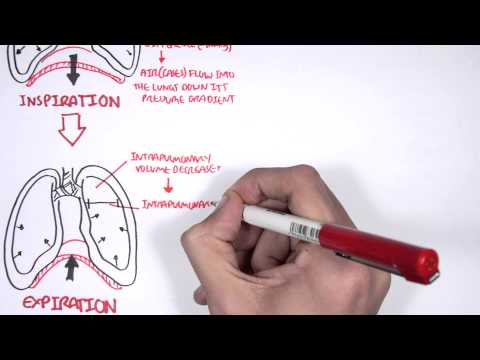
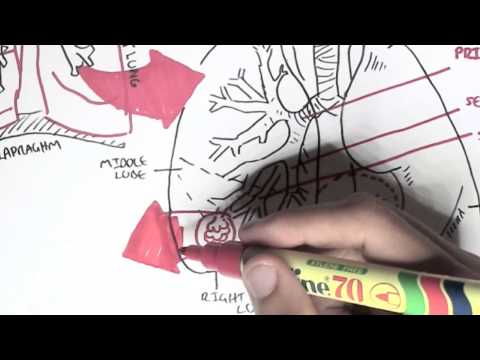
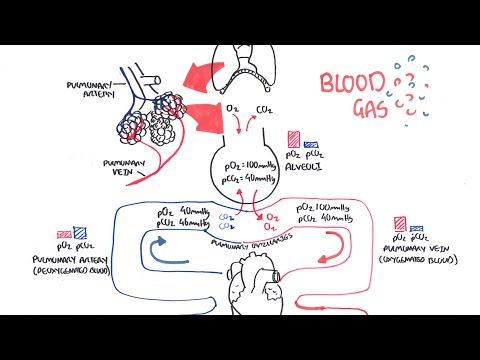
0:00 (speaks in foreign language) 0:03 (speaks in foreign language) 0:05 Please make sure to subscribe. 0:07 During the forming group for the latest videos, 0:09 please visit Facebook or (speaks in foreign language) 0:12 In this video, we are going to look 0:14 at control of respiration. 0:15 Now, the modillary respiratory centers control respiration. 0:20 The modillary respiratory centers are made up 0:23 of the ventral and dorsal groups. 0:26 The ventral group is responsible 0:29 for the rhythmicity, you can say, of breathing. 0:33 If that didn't all make sense, let's look at a diagram. 0:37 So here I'm drawing the brain. 0:39 If we zoom into the brain stem region here, 0:42 we can locate where the medulla oblongare is. 0:45 Here I'm drawing three red circles. 0:53 The two red circles here make up 0:55 the modillary respiratory center, 0:57 which is made up of the ventral and dorsal respiratory groups. 1:02 The ventral being the front 1:04 and the dorsal being the back. 1:06 The dorsal group is responsible for inspiration, 1:12 the diaphragm, and the ventral one is responsible 1:17 for the rhythmicity of breathing. 1:20 But then you have this other respiratory center, 1:24 located in the pond, known as the pontine respiratory center. 1:29 The pontine respiratory center will interact 1:32 with the medulla respiratory center 1:34 to smooth respiration. 1:36 It will provide tonic input to the medullary network here 1:42 to help coordinate smooth respiratory rhythm. 1:47 So they will send signals to here 1:50 and then they will send signals to here. 1:53 And then the medulla respiratory centers will work together 1:57 and then will send signals for inspiration and exploration. 2:02 So to understand how it sends signals 2:07 for inspiration and exploration, 2:09 let us look at the thorax. 2:11 So here I am drawing the thorax, 2:14 which is made up of the ribs here, 2:17 as well as the sternum here. 2:19 Now within the thorax, we find the lungs. 2:24 Beneath the lungs, we have an important muscle 2:27 known as the diaphragm. 2:28 The diaphragm is one of the important muscles in respiration. 2:33 And then you have another important muscle in respiration, 2:36 which are known as the intercostal muscles, 2:39 which run between the ribs. 2:41 Here I'm drawing the trachea, 2:43 which connect the larynx to the lungs. 2:47 So in a very simplified way, 2:52 the respiratory center will send impulses 2:54 to the muscles of the lungs 2:56 to trigger inspiration or exploration. 3:01 So for example, here we have impulses being sent via neurons 3:06 to the intercostal muscles to cause inspiration. 3:10 So the ribs will rise 3:12 and the impulses are also being sent to the diaphragm 3:15 to cause inspiration. 3:17 So the diaphragm will descend. 3:22 The respiratory center will send impulses 3:26 to cause inspiration and exploration. 3:31 The more, the quicker the impulse, 3:33 the faster the breathing, 3:37 the slower the impulse, 3:39 the slower the breathing. 3:40 And that's the important concept to understand. 3:46 Now let us see what can influence the respiratory center. 3:51 And so what can increase respiration? 3:56 So increase breathing. 3:58 And what can suppress breathing? 4:00 So slow down breathing. 4:01 Firstly, we have the higher centers of the brain, 4:05 which where we can have voluntary control. 4:10 So as we know, we have some control over our breathing. 4:14 We can stop breathing for a while before our heart, 4:16 before the brain just takes over. 4:20 The higher centers of the brain are also important 4:23 for the perception of pain, emotion and temperature. 4:26 And so all these factors can influence 4:31 the respiratory rate. 4:33 So they will firstly either stimulate or suppress 4:37 the pontine respiratory center, 4:40 which then will stimulate or suppress 4:42 the medullary respiratory center and respiration itself. 4:48 But the main regulator or influencer of respiration 4:52 would be the peripheral chemo-receptors, 4:55 which are located in the carotid and aortic bodies. 4:58 They detect changes in the blood, 5:02 chemical changes in the blood. 5:04 So for example, if they detect a decrease in oxygen, 5:07 a decrease in blood pH, 5:09 which means an increase in hydrogen ions, 5:11 and an increase in CO2, 5:15 this will stimulate or trigger the chemo-receptors 5:18 located here in the carotid bodies and aortic bodies. 5:22 And they will stimulate these chemo-receptors 5:26 to stimulate the respiratory center. 5:29 And so when the respiratory center is stimulated, 5:32 there'll be a quicker respiratory rate. 5:36 So you will breathe in and breathe out quicker. 5:39 And so you can breathe in more oxygen 5:42 and you can breathe out more carbon dioxide 5:44 to neutralize everything. 5:46 There are also chemo-receptors located in the medulla 5:54 known as central chemo-receptors. 5:56 The medullary's chemo-receptors do exactly the same thing. 6:01 They can detect changes in pH. 6:04 A decrease in pH, for example, 6:06 and an increase in CO2 will stimulate the chemo-receptors 6:10 to simulate the respiratory center 6:14 so that you can breathe faster 6:15 and thereby breathing out more carbon dioxide 6:18 and inhaling more oxygen. 6:20 You also have receptors in your muscles and in your joints. 6:25 And these will be stimulated when you exercise. 6:28 And so when you exercise, 6:30 these receptors will stimulate the respiratory center 6:34 so you can breathe quicker. 6:36 And it's important to breathe quicker when you exercise 6:39 so that you can take in more oxygen 6:42 and you can blow out all the acid that has built up. 6:45 And finally, you have things in your lungs 6:49 that can regulate the respiratory center, 6:52 that can influence the respiratory center in the brainstem. 6:56 Firstly, you have things called irritant receptors, 6:59 which are receptors that are protective in the lungs 7:02 that help essentially blow off the irritant. 7:06 And so when they're stimulated, 7:08 they will suppress the respiratory center 7:11 to slow down respiration. 7:13 And then you have stretch receptors in the lungs, 7:15 which cause the hearing-breever reflex, 7:18 a reflex that is protective. 7:20 It's a protective reflex initiated by extreme 7:24 over-inflation of the lungs. 7:26 And so when these stretch receptors are stimulated, initiated, 7:31 they will suppress respiration 7:34 so they will slow down the respiratory rate. 7:38 Hope you enjoyed this video. 7:39 Thanks for watching.