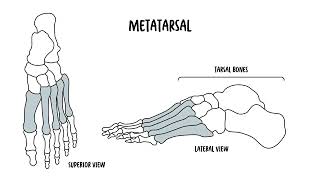
0:00 In this video, we're going to talk about the bones of the foot and touch on 0:16 briefly 0:17 the joints. 0:19 The bones of the foot provide mechanical support for the soft tissues. 0:23 They help the foot withstand the weight of the body, while standing and in 0:30 motion. 0:31 The bones of the foot can be divided into three groups, tassels, metatarsals 0:37 and phalanges. 0:39 The tassels are set of seven irregularly shaped bones. 0:43 They are situated proximally in the foot, in the ankle area. 0:48 The metatarsals connect the phalanges to the tassels. 0:53 They are five in number, one for each digit. 0:59 The phalanges are the bones of the toes. 1:01 Each toe has three phalanges, the proximal, intermediate and distal, except the 1:07 big toe, 1:08 which only has two phalanges. 1:16 Let's look at each of these regions, beginning with the tassel bones. 1:22 The tassel bones consist of seven short bones located at the proximal region of 1:27 the foot. 1:28 They are arranged in proximal, intermediate and distal rows. 1:33 The proximal include the calcaneus bone, the talus bone, intermediate is the 1:40 navicular 1:41 bone, and the distal is the cuneiform bone and the cuboid bone. 1:53 Focusing on the proximal tassel bones. 1:56 The calcaneus bone is the largest tassel bone that projects posteriorly as the 2:03 heel. 2:04 The superior surface of the calcaneus bone articulates with the talus. 2:09 The posterior surface provides attachment plates for the Achilles tendon, 2:13 specifically 2:14 it inserts into the calcaneal tuberosity. 2:17 The inferior surface forms the major weight bearing area of the calcaneus and 2:21 provides 2:21 attachment for the plantar aponeurosis and plantar muscles. 2:32 The talus bone, on the other hand, rests on the upper surface of the calcaneus. 2:38 It is the link between the foot and the leg through the ankle joint. 2:42 The talus and calcaneus form what's called a sub-tailor joint, sub as in below, 2:47 so below 2:48 the talus. 2:55 The intermediate tala bones are really just the navicular bone. 3:00 The navicular bone is interposed between the talus and three cuneiform bones. 3:06 Cala actually is the name given because it's shaped like a boat. 3:11 In Latin, navis is a boat, so think of the navy, the boat. 3:19 Anyway, on the plantar surface of the navicular, there is a tuberosity for the 3:23 attachment of 3:24 part of the tibialis posterior tendon, which comes immediately. 3:37 Finally, the distal tala bones include the cuneiform bone and the cuboid bone. 3:43 The cuneiform bone is located at the distal row articulating with the metatars 3:46 al bones 3:47 and the navicular bone. 3:49 The cuneiform consists of three bones, the medial, intermediate and lateral c 3:53 uneiform bones. 3:54 The cuneiform are also the attachment point for several muscle tendons. 4:02 The medial cuneiform, for example, is the attachment side for the tibialis 4:07 anterior, 4:08 part of the tibialis posterior, the fibularis longus. 4:15 The lateral cuneiform bone is the origin for the flexor halousus brevis, which 4:21 goes and 4:22 attaches to the big toe. 4:29 The cuboid bone is located at the lateral side of the distal row. 4:32 It articulates with the calcaneus to the fourth and fifth metatarsals. 4:37 The inferior surface of the cuboid bone is Machbergouve, for where the tendon 4:42 of the 4:43 fibularis longus, also known as a perineus longus, goes through. 4:50 Let's talk about some clinical anatomy. 4:56 Firstly, talus and calcaneus fractures, again these are the proximal tailor 5:04 bones. 5:05 The talus and calcaneus are primarily involved in transmitting forces from the 5:09 body to the 5:10 ground and vice versa. 5:12 The calcaneum is the most commonly fractured tassel bone. 5:16 It is most commonly injured following a fall from height, whereby there is a 5:21 significant 5:21 axial loading directly onto the bone. 5:25 As such, this injury is often associated with concurrent fractures, 5:28 particularly spinal 5:30 or contralateral calcaneus fractures. 5:35 Tailor fractures typically occur following high energy trauma, such as a fall 5:38 from height 5:39 or road traffic accidents. 5:43 This occurs during which the ankle is forced into dorsiflexion, so the foot 5:50 pointing up. 5:52 This causes the talus to press against the tibial plumb fond, resulting in a 5:58 fracture. 5:59 Most telofractures occur through the tailor neck. 6:05 Next, tassel coalition. 6:10 A tassel coalition occurs when two bones grow into one another, connected by a 6:15 bridge of 6:16 bone, cartilage, or strong fibrous tissue. 6:19 Although tassel coalition is often present at birth, children typically do not 6:23 show signs 6:24 of the disorder until early adolescence. 6:27 The foot may become stiff and painful and everyday physical activities are 6:32 often difficult. 6:33 The two most common sites of a tassel coalition are between the calcaneus and 6:38 navicular bones, 6:39 or between the talus and calcaneus bones. 6:49 So those are the tassel bones and some clinical anatomy. 6:52 Now we will talk about metatarsal bones, which are these small bones that 6:57 connect the tassel 6:58 bones to the phalanges. 6:59 They are numbered 1 to 5, medial to lateral, so big toe to small toe. 7:11 Now let's talk about some clinical anatomy of the metatarsals, talking about 7:18 fractures. 7:19 The metatarsals are prone to a number of fractures. 7:23 One includes a stress fracture, which is an incomplete fracture caused by 7:28 repeated stress 7:29 to the bone. 7:31 It is common in athletes and occurs most frequently at the neck of the second 7:36 and third metatarsals 7:39 and the proximal fifth metatarsal. 7:43 The fifth metatarsal is actually prone to a number of fractures. 7:47 There is another called Jones fractures, which represents a vascular watershed 7:54 area. 7:54 These type of fractures make healing difficult, as there is no blood supply, 8:01 and so the fractures 8:03 are prone to nonunion, so really not healing properly. 8:08 The metatarsals can also be fractured by excessive inversion of the foot. 8:13 If the foot is violently inverted, the fibularis brevis muscle can evolve or 8:20 tear off the base 8:22 of the fifth metatarsal. 8:25 And this is called an avulsion fracture. 8:29 And again, this is because the fibularis brevis muscle attaches to the fifth 8:35 metatarsal, 8:37 and so technically it could rip off part of the fifth metatarsal in an in 8:48 version injury. 8:49 Now focusing on metatarsal fractures of the first and fourth, so the metatars 8:54 als one to 8:55 four are also at risk of fractures. 8:58 Stress fractures of these other bones occur from an abrupt increase in activity 9:02 or chronic 9:03 overloading, which may cause a stress fracture of the metatarsal shaft. 9:09 Shaft fractures, which are full-blown fractures, are caused by direct blows or 9:16 twisting forces. 9:17 Proximal metatarsal fractures are uncommon, but occur usually following a crush 9:22 injury 9:23 or a direct blow. 9:25 They may also result from falling forward over a plantar flexed foot. 9:32 As shown in this diagram, and can be associated with dislocation. 9:42 Finally, the phalanges. 9:45 The phalanges are the bones of the toes. 9:49 The second to fifth toes all have proximal, middle and distal phalanges. 9:56 The great toe has only two proximal and distal phalanges. 10:03 Finally, an important note, the foot itself, the bones of the foot, can also be 10:11 divided 10:12 into three regions, hindfoot, midfoot and forefoot. 10:18 The hindfoot are the talus and calcaneus, midfoot are the navicular cuboid and 10:23 cuneiform 10:24 bones, and the forefoot are the metatarsal and the phalanges. 10:34 In summary, we talked about the bones of the foot, which I like to divide into 10:38 the tarsals, 10:40 metatarsals and phalanges. 10:42 We talked about some clinical anatomy of the tarsal bones, which really include 10:48 fractures, 10:49 mainly tarsal coalition, and we also talked about fractures involving the met 10:55 atarsals and 10:56 how there are different types such as stress fracture, Jones fracture, as well 11:00 as shaft 11:01 fractures. 11:02 Thank you for watching. 11:19 You