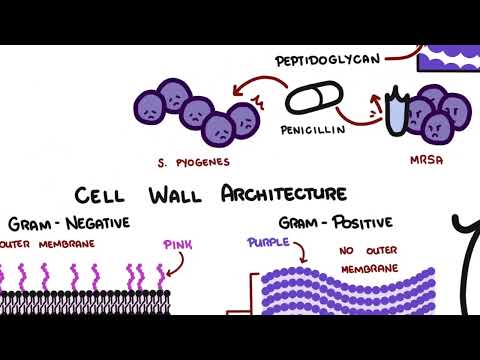
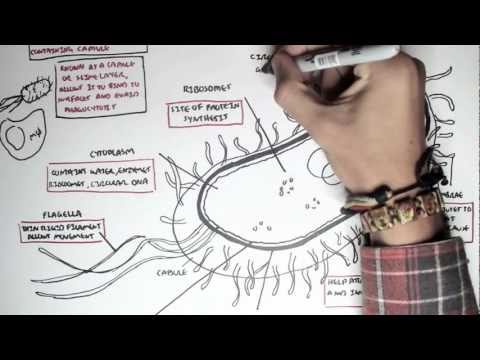
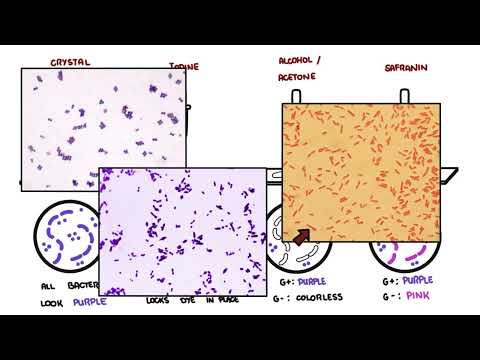
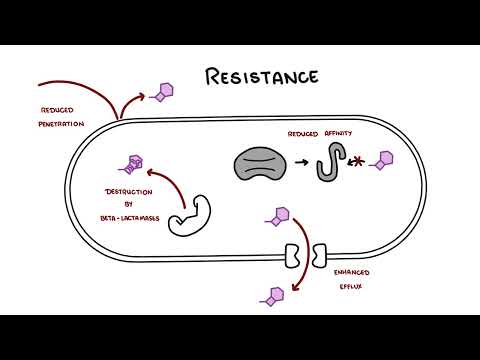
0:00 Arman Doha Surinan, Biology and Medicine videos, please make sure to subscribe, 0:05 join 0:06 the forming group for the latest videos, please visit Facebook, Arman Doha Sur 0:09 inan. 0:11 So in this video, we will look at investigate bacterial resistant to 0:18 antibiotics, basically 0:21 how some bacteria are resistant to antibiotics and how do they acquire such 0:28 resistance. 0:30 Let's start by looking at how bacteria can be grouped. 0:34 Well we have two broad categories of bacteria, these are gram-positive and gram 0:38 -negative. 0:39 They differ in their cell wall membrane composition. 0:44 See if this was a gram-positive bacteria, if this was the outside of the cell, 0:50 has an 0:51 inner lipid membrane here and a thick peptidoglycan layer. 0:56 Peptidoglycan is basically carbohydrates and proteins. 0:59 The peptidoglycans constitute the bacterial cell wall. 1:04 The gram-negative bacteria on the other hand has also an inner lipid membrane 1:09 but instead 1:10 has a thin peptidoglycan layer and then another outer lipid membrane. 1:16 So it has two lipid membranes. 1:20 These layers are what give gram-positive its purple color upon gram-staining 1:26 and the gram-negative 1:27 bacteria its pink color upon gram-staining. 1:33 What's interesting is that gram-negative bacteria already have some form of 1:37 resistance 1:38 to a famous antibiotic called penicillin. 1:44 Because you see penicillin targets proteins within the peptidoglycan layer. 1:51 Therefore penicillin would be very effective against gram-positive bacteria 1:56 because the 1:57 peptidoglycan layer is thick and it's the outermost layer. 2:02 However, the penicillin are not effective or not very effective against gram- 2:08 negative 2:09 bacteria because there is an outer lipid membrane in the way and also the pept 2:14 idoglycan layer 2:15 is quite thin over here. 2:19 So that's an important reason why some antibiotics such as penicillin is not 2:24 very effective against 2:26 gram-negative bacteria. 2:28 So what other types of antibiotic resistant mechanisms do bacteria have? 2:36 Well let's first go over some important parts of the bacteria. 2:41 Here we have a typical bacteria. 2:43 It is rod-shaped with a flagella. 2:46 We are looking inside the bacteria now. 2:51 One bacteria only has one chromosome which is one circular DNA basically. 3:00 Here the DNA is being synthesized because the bacteria is going to divide. 3:05 However, this circular DNA is not the only genetic material that the bacteria 3:11 carries. 3:12 You see the bacteria also have things called plasmids which are like super- 3:17 small circular 3:18 DNAs and it is these plasmids that usually carry the so-called resistant genes. 3:28 These that allow the bacteria to make things so that the bacteria becomes 3:33 resistant to 3:34 antibiotics, hence resistant genes. 3:40 For the plasmids to make these resistant things, it usually has to incorporate 3:45 itself into the 3:47 main DNA, the main circular DNA, but here I am showing that the plasmid is 3:51 synthesizing 3:53 RNA straight away. 3:55 In particular, mRNA. 3:58 So mRNA is being synthesized from the plasmid. 4:03 This mRNA will then be read by the ribosome to make polypeptides, to make 4:11 proteins. 4:12 And these proteins are what will become structures or enzymes that will help 4:19 the bacteria become 4:21 resistant to antibiotics. 4:23 So let's have a closer look by zooming in. 4:26 Now we will look at some examples that are not specific to one type of bacteria 4:31 because 4:32 each bacteria has its own unique resistance gene, you can say. 4:39 Now the antibiotic resistant genes, which is usually found on the plasmid, will 4:44 result 4:45 in the synthesis as I mentioned of proteins, polypeptides, that can form and 4:51 become maybe 4:52 an antibiotic degrading enzyme, for example. 4:57 So an antibiotic degrading enzyme, a good example of this are beta lactamases, 5:03 which 5:04 essentially breaks beta lactam rings. 5:09 What are beta lactams, and what are the beta lactams rings? 5:12 Well, this is a beta lactam ring, and beta lactam rings are found in penicillin 5:20 . 5:20 So penicillin is a beta lactam antibiotic. 5:26 And this penicillin is active because the beta lactam is a ring, it's closed, 5:31 the ring 5:32 is closed. 5:33 However, when penicillin encounters a beta lactamase in the bacteria, the beta 5:40 lactamase 5:41 will break the beta lactam ring, causing the penicillin to become inactive. 5:47 And thus penicillin will have no effect on the bacteria. 5:52 There are many types of beta lactamases, and they are found in many types of 5:56 bacteria, 5:57 such as E. coli. 6:01 The antibiotic resistant gene of a bacteria may also produce what's called an 6:07 efflux pump. 6:09 So what is an efflux pump? 6:11 Well imagine this is your bacteria with its cell wall, and you have the 6:16 circular DNA of 6:17 the bacteria. 6:18 Well some bacteria can produce these efflux pump, which are found on the 6:23 membrane. 6:24 So when some types of antibiotics, such as tetracycline, which normally interfe 6:29 res with 6:30 bacterial protein synthesis is used, the bacteria can use the efflux pump to 6:38 pump out the antibiotic. 6:40 And so the antibiotic tetracycline will have no effect on the bacteria because 6:44 it is pumped 6:45 out. 6:47 So we have looked at two mechanisms of antibiotic resistance so far, the 6:50 production of antibiotic 6:52 degrading enzymes and the production of the efflux pump. 6:56 Some other bacteria also have the resistant genes to modify the antibiotic 7:03 binding target. 7:05 For example, penicillin, which is a beta lactam, remember, targets penicillin 7:12 binding proteins, 7:14 which are found in the peptidoglycan layer of the bacteria. 7:19 However, if the bacteria has the genes to modify the penicillin binding 7:25 proteins, basically 7:26 changing the structure of the protein, the penicillin is unable to bind to the 7:32 protein 7:33 anymore because the protein has changed. 7:35 A great example of this type of resistance is found in the bacteria methicillin 7:40 -resistant 7:40 steplococcus iris, or MRSA, which is essentially a bacteria that is resistant 7:47 to the antibiotic 7:49 methicillin. 7:52 Methicillin does not work because the protein that methicillin binds onto is 7:57 modified within 7:58 the bacteria. 7:59 And so methicillin has no effect. 8:03 So those are some examples of how bacteria are resistant to antibiotics. 8:10 But how do the bacteria acquire such resistant genes? 8:16 Is it through evolution or how? 8:19 Well, there are two ways they can acquire the resistant genes. 8:24 One is through vertical gene transfer and the other is through horizontal gene 8:32 transfer. 8:34 Vertical gene transfer is where the resistant gene is passed through bacterial 8:39 replication. 8:40 So basically the bacteria actually acquires the gene throughout evolution, you 8:46 can say. 8:47 For example, spontaneous mutations can occur for a resistant gene or something 8:53 like that. 8:54 But of course, this is rare and does take some time. 8:58 The other way resistant gene are acquired is through horizontal gene transfer, 9:05 where 9:05 the resistant gene is actually transferred to a bacteria through three 9:13 different means. 9:15 The first is conjugation or it can be through transduction or through a process 9:21 called transformation. 9:24 These are important to know because they usually come up in exams. 9:28 So let's take a look at each of them. 9:32 Well let's just say first we have a bacteria here with its circular DNA and it 9:38 actually 9:39 has a plasma that contains the resistant gene for a particular type of 9:44 antibiotic. 9:45 The bacteria can actually form what's called a pillus that will attach to the 9:49 other bacteria. 9:50 It's kind of like sex and then the plasmid containing the resistant gene can be 9:57 replicated 9:58 and then passed on to the other bacteria. 10:02 This process of horizontal gene transfer is called conjugation. 10:09 Another form of horizontal gene transfer is through a virus called a bacterioph 10:15 age. 10:15 So here is a bacteria with its bacterial circular DNA. 10:21 I should point out that this particular bacteria I am drawing has a resistance 10:26 gene within it 10:27 already. 10:29 A bacteriophage here is a virus that only attacks bacteria, hence the name. 10:36 The bacteriophage will inject its DNA, which is simply called a phage DNA, into 10:42 the bacteria. 10:43 The phage DNA can then incorporate itself into the bacterial DNA. 10:48 And then after some time has passed, when the time is right, the phage DNA will 10:54 leave 10:55 the bacterial DNA and then will begin replicating, destroying the bacterial DNA 11:03 in the process. 11:05 So the resistant gene that was part of the bacterial DNA will then be floating 11:11 around 11:11 inside the damaged bacteria. 11:14 So the viral DNA is being replicated and new bacteriophages are being formed 11:20 within the 11:21 bacteria. 11:23 The new viruses being formed will pack up the viral DNA that was replicated. 11:32 The viral replication will cause the bacteria to lice, releasing the virus, the 11:38 bacteriophages, 11:40 containing the phage DNA out. 11:43 However, there can be a bacteriophage that will actually contain a resistant 11:49 gene from 11:50 the bacteria, because it accidentally packed the resistant gene of the bacteria 11:56 instead 11:56 of its own viral DNA. 11:59 I hope that makes sense. 12:01 And so the bacteriophage containing the resistant gene can then go attack 12:06 another bacteria. 12:08 But instead it will actually give a resistant gene to it. 12:13 Now this process of horizontal gene transfer with the help of the bacteriophage 12:17 is called 12:17 transduction. 12:20 The last type of horizontal gene transfer is called transformation, which is 12:24 basically 12:25 when another bacteria containing a resistant gene dies or lices. 12:31 It will then release the resistant gene. 12:33 The resistant gene can then be picked up by another bacteria. 12:38 The other bacteria will then incorporate it into its genome, allowing it to 12:42 become resistant 12:43 to some form of antibiotic. 12:47 So those were important ways that bacteria acquires resistant genes for 12:51 antibiotics. 12:53 Education, transduction and transformation. 12:56 I hope you enjoyed this video. 12:57 Thank you.