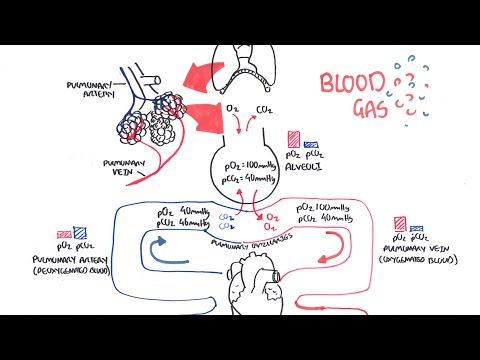
0:00 Armando Hasiriguan Biology and Medicine videos, please make sure to subscribe, 0:04 join the forum 0:04 and group for the latest videos, please visit Facebook, Armando Hasiriguan, 0:07 please like, 0:08 and here you can also ask questions, answer questions, and post some 0:10 interesting things 0:11 including our works that you can send them to me. 0:13 And you can also change the quality settings of this video to the highest one 0:16 for better 0:17 graphics. 0:18 In this video, we're going to look at an overall picture of the respiratory 0:21 system. 0:22 So we're talking about the lungs. 0:24 The respiratory system is very important because this is essentially what gives 0:29 us oxygen so 0:29 that we can live. 0:31 And during this process, we also release carbon dioxide. 0:34 So we inhale oxygen, release carbon dioxide, and it's essential for life. 0:39 Now to learn about the respiratory system, we actually have to learn about the 0:42 circulatory 0:43 system, about the heart, and how it pumps blood throughout our body. 0:48 And it's important to know about the circulatory system because of the 0:51 respiratory system and 0:52 the circulatory system coincide together. 0:54 They work together. 0:56 So funny enough, we begin learning about the respiratory system by learning 0:59 about the heart. 1:00 Here is the heart. 1:01 The heart consists of four chambers, chamber chambers. 1:06 Blood vessels enter and leave the heart. 1:09 The blood vessel in blue here represents deoxygenated blood, which means that 1:13 it contains low amounts 1:14 of oxygen. 1:15 Typically, it contains much higher levels of carbon dioxide. 1:21 This blood vessel in red represents oxygenated blood, which means that it 1:25 contains oxygen. 1:26 Now this oxygenated blood supply gets the oxygen from the lungs. 1:32 In this picture here, I represent as the lungs. 1:35 Now outside in the air, in our atmosphere, we have many types of gases, 1:40 including oxygen 1:42 gas, O2. 1:44 Now we breathe in oxygen gas. 1:46 It comes into our lungs. 1:49 And as we breathe in oxygen gas, we also breathe out carbon dioxide from our de 1:54 oxygenated blood 1:56 supply. 1:57 So carbon dioxide leaves into the atmosphere and we breathe in oxygen gas. 2:03 So now as oxygen enters our blood supply, it reoxidizes our blood supply. 2:08 So now we have an oxygenated blood supply here in red. 2:13 Then we'll then travel through our body, enter our heart, the heart will then 2:17 pop out the 2:18 oxygen and transport it throughout to different organs to different tissues. 2:23 The different tissues will take in oxygen and use it to make energy in the 2:28 forms of ATP. 2:30 And as a byproduct, it will create carbon dioxide. 2:35 So the tissues will then release carbon dioxide. 2:38 The blood vessel then transports the carbon dioxide back to the heart so that 2:41 the heart 2:42 can pump it up to the lungs to be exchanged for oxygen. 2:49 Now this overall picture is very important to understand. 2:54 On the side note, you might ask what happens to the carbon dioxide then? 2:57 Well, the plants actually use carbon dioxide and through photosynthesis uses 3:01 together with 3:02 water and sunlight. 3:04 It makes carbohydrates and also oxygen as a byproduct. 3:09 And so it's sort of like a cycle. 3:11 We breathe out carbon dioxide, the plants use carbon dioxide to make oxygen and 3:14 then 3:15 we use the oxygen and make carbon dioxide as a byproduct. 3:19 And so we can appreciate how this cycle works. 3:22 Now the respiratory system or respiration can be divided into four major parts. 3:32 One is known as the pulmonary ventilation. 3:36 And this is the movement of air in and out of the lungs. 3:40 So the movement of oxygen into the lungs and the movement of carbon dioxide out 3:44 of the 3:44 lungs, for example. 3:46 Two is known as external respiration. 3:51 External respiration is the movement of oxygen from the lungs into the blood 3:56 and the movement 3:57 of carbon dioxide from the blood into the lungs. 4:02 The three is a transport of respiratory gases. 4:05 So how the oxygen basically gets transported to different tissues and different 4:10 organs. 4:11 And then we come to our last one, four. 4:14 And this is known as internal respiration. 4:17 Internal respiration is where we have the movement of oxygen from the blood to 4:24 the tissues 4:26 and the movement of carbon dioxide from the tissues into the blood. 4:33 So hope you can understand the difference between internal and external resp 4:37 iration. 4:38 Most importantly. 4:40 Now that we hopefully understood a bit of an overall picture of the respiratory 4:44 system 4:45 and how it interacts with the circulatory system, let's look at the anatomy. 4:49 Let's look at the lungs in particular in the respiratory tract. 4:53 Okay, so here we have the atmosphere again. 4:57 It contains many types of gases, including oxygen gas over two. 5:01 Here we have a human body, I'm just going to shade some areas here so you can 5:06 see the 5:07 different parts of the respiratory tract more easily. 5:11 So let's start learning about the anatomy. 5:13 Here we have our nasal cavity, the nose cavity, the oral cavity, the mouth 5:18 cavity, the pharynx. 5:21 And then we have the esophagus here at the back, which leads towards the 5:26 stomach. 5:27 This is part of the digestive system. 5:29 And then in front of it we have the larynx, which actually leads to the 5:33 respiratory tract. 5:36 And so what divides the esophagus and the larynx? 5:42 Well, it's the epiglottis. 5:44 The epiglottis can cover the larynx when we are eating. 5:51 So just to understand what is happening, we're breathing in oxygen gas into our 5:54 nasal cavity 5:55 or through our oral cavity. 5:57 And it goes down towards our larynx. 6:00 And we breathe our out carbon dioxide. 6:04 When we breathe in oxygen gas, it will proceed down here and travel to the l 6:09 arynx. 6:10 And then it will go through a cartilage area known as a trachea. 6:15 The trachea will then divide into many types of branches. 6:19 The point of division is known as a careen of the trachea. 6:22 And these many divisions are what make up the lungs essentially. 6:26 So here we have the right lung and here we have the left lung. 6:30 And below the lungs we have the diaphragm. 6:32 This is the muscle, which helps in our breathing process. 6:37 So let's take a closer look at the lungs and let's look closer at the anatomy 6:42 of the lungs. 6:45 So here we have the lungs. 6:48 We breathe in oxygen gas and it comes into the lungs. 6:52 We also breathe out carbon dioxide and it leaves the lungs. 6:56 So here we have the trachea, the cartilage area, full of cartilage rings. 7:00 Now the trachea will divide into what's called the primary bronchosis. 7:04 There's two. And then the primary bronchosis will then further divide into the 7:09 secondary 7:09 bronchitis. There are many of them. 7:12 And then the secondary bronchi will then divide further into the segmental bron 7:16 chi. 7:17 And it still keeps dividing smaller and smaller. 7:20 Now let's stop there for a second and look at this area here on the left lung. 7:25 As you can see, the left lung has a bit of space here. 7:29 The space is known as a cardiac notch. 7:32 And if you know what cardiac means, it has to relate to the heart. 7:36 And so this is actually where the heart is positioned in our body. 7:43 Another thing to note is that the left lung and the right lung consists of 7:46 different number 7:47 of lobes making up the lungs, such as the right lung consists of a right 7:51 superior lobe, 7:52 a middle lobe, and an inferior lobe. 7:56 So the right lung has three lobes, whereas the left lung only has two. 8:01 It has a superior lobe and it has an inferior lobe. 8:04 So that's the other difference. 8:07 And now also going back to the trachea, which then branches off to the primary 8:11 bronchus, 8:12 the secondary bronchus, then the segmental bronchus, bronchi, sorry. 8:16 What comes after this? 8:18 Well, the last point of division, we have this sort of sack looking thing. 8:25 And this is known as alveolus, the alveolar ducts. 8:31 So let's just zoom into this alveolar duct-looking thing and look at it in a 8:38 bit more detail. 8:40 Of course, to each of these alveoli sacks, we have blood vessels coming in and 8:48 out. 8:49 The blue coming in and the red going out. 8:54 Now, let's learn some bit of anatomy. 8:56 Here we have what's called the bronchiol. 8:59 And wrapping around the bronchioles, we have smooth muscles, which are 9:04 necessary in order 9:05 for these to contract. 9:07 Then the bronchioles will go further to where they end, known as a terminal 9:13 bronchiol. 9:14 Then this terminal bronchiol will essentially go into what's called the sack 9:18 consisting 9:19 of many alveoluses. 9:22 So I hope this makes sense. 9:25 An important terminology is that one of these bowls, these bowl looking things, 9:31 are known 9:32 as an alveolus. 9:34 Many of these bowls looking things are known as an alveoli. 9:38 So one alveolus, many alveoli. 9:42 And they make up the alveolar sack or duct. 9:46 Hope this makes sense. 9:48 So here we have the alveolar sack, which contains many alveoli. 9:55 And then we have the alveolar duct, which basically is the area which connects 10:00 to the 10:00 terminal bronchiol, you can say. 10:03 Okay, this part might sound very confusing, but bear with me. 10:08 Now the question is, the pulmonary artery leaves the heart with deoxygenated 10:15 blood and 10:16 it contains mainly carbon dioxide, if you remember. 10:19 The pulmonary artery will enter the lungs and will basically branch into the al 10:25 veolar 10:26 sacks. 10:27 The pulmonary artery will give CO22 to the alveoluses, the alveoli, and the al 10:33 veoli will 10:33 give the pulmonary artery oxygen. 10:37 And so now it is reoxygenated, it contains new oxygen. 10:41 And then as the blood vessel leaves the alveolar sack and goes back towards the 10:46 heart, it is 10:47 now known as the pulmonary vein, because vein always goes back to the heart. 10:55 And we'll get back to that again if you don't quite understand it. 10:59 But another two concepts you should understand is that the pathway from nose to 11:04 the bronchioles, 11:05 which is there, is called the conducting zone of respiration. 11:09 From the bronchioles to the alveoluses, the one meaning alveolus is known as 11:14 the respiratory 11:15 zone. 11:16 And this is where the exchange of oxygen and carbon dioxide happens. 11:21 So let's go back to this pulmonary artery, pulmonary vein and look at it again. 11:25 So remember, one of these balls is an alveolus, we have an alveolus. 11:30 Now we have the pulmonary artery coming from the heart with deoxygenated blood, 11:34 with carbon 11:35 dioxide, and it branches into small pulmonary arterioles and then capillaries, 11:40 where it 11:41 will give carbon dioxide to the alveolus. 11:44 The alveolus will give the blood vessel or the capillaries new oxygen. 11:50 So it will reoxygenate the blood supply. 11:54 This new oxygen will then leave the alveolus as a pulmonary vein, because the 11:58 pulmonary 11:59 vein will go back towards the heart. 12:02 And this pulmonary vein contains new oxygen, so it's oxygenated. 12:07 Now that's a very important concept to understand. 12:10 Let's go back and look at the alveolus sacs, the many alveoluses, and look at 12:15 what components 12:16 it has by looking at a cross-sectional diagram of it. 12:20 So here we have a cross-section of alveolis. 12:25 One of course being an alveolus, we also have blood vessels surrounding this 12:29 area consisting 12:30 of red blood cells, and red blood cells play an important role, which we will 12:34 soon see. 12:35 From the blood vessel to one alveolus is about 0.5 micrometers, which is very 12:40 small. 12:41 Also around this area, we have white blood cells. 12:44 And within the alveoluses, we have macrophages. 12:48 So why do we have macrophages and white blood cells within our lungs? 12:53 Well, it is important to have white blood cells, such as macrophages, within 12:58 our lungs. 12:59 And this is because our lungs is continuously exposed to the outside. 13:06 So pathogens, bacteria, small things, dusts, particles can enter our lungs and 13:13 can potentially 13:14 damage it. 13:15 And this is where the white blood cells play a role in that it basically stops 13:21 these invading 13:22 things from damaging our body. 13:26 The alveolus itself consists of two main types of cells, the Type I alveolus 13:31 cell, which 13:32 is basically a simple squamous epithelial cell. 13:35 It is thin, which allows for easy exchange of gas, easy exchange of oxygen and 13:40 carbon 13:40 dioxide. 13:41 The second type of cell is known as the Type II alveolus cell, or the surfact 13:49 ant cell. 13:50 Surfactant cells secrete surfactant, and they reduce surface tension in the al 13:55 veolus, 13:55 which means that the membranes can separate more easily, allowing for easier 14:01 gas exchange. 14:03 Now let's look at the interaction between an alveolus and a blood vessel, or 14:06 the capillary. 14:07 Let's zoom into this section here and see how gas exchange occurs, an overall 14:11 picture. 14:12 So here we have the Type I alveolus cell of the alveolus, and then here we have 14:17 the epithelial 14:17 cell of the capillary. 14:22 Now this is where red blood cells play a critical role, because respiratory 14:26 gases such as oxygen 14:27 travel throughout the body by binding onto hemoglobin within a red blood cell. 14:34 Carbon dioxide also requires red blood cells in order to travel around the body 14:39 , but carbon 14:40 dioxide only require red blood cells so that the red blood cells can convert 14:44 carbon dioxide 14:46 into what's called bicarbonate, and carbon dioxide therefore travel throughout 14:50 the body 14:51 through a chemical known as bicarbonate. 14:57 So when the red blood cells reach the alveolus, the red blood cells will 15:02 convert the bicarbonate 15:04 back to carbon dioxide, and give it to the alveolus. 15:08 The alveolus will then give oxygen gas to the red blood cell. 15:12 The oxygen gas will bind onto the hemoglobin component of the red blood cell, 15:16 and then 15:17 will travel around the blood. 15:20 The carbon dioxide will obviously be exhaled out. 15:24 So that's where we'll end in this overall video on the respiratory system. 15:29 We will look into the red blood cell and how oxygen and carbon dioxide does all 15:35 these 15:35 things with it in the next video, hopefully, which will come out soon. 15:40 I hope you enjoyed this video. 15:41 Please like, share, and comment, and leave some feedback, please. 15:44 Thank you.