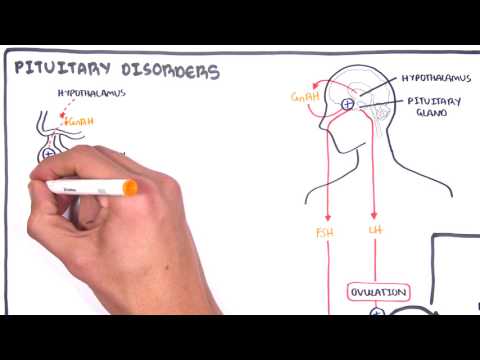
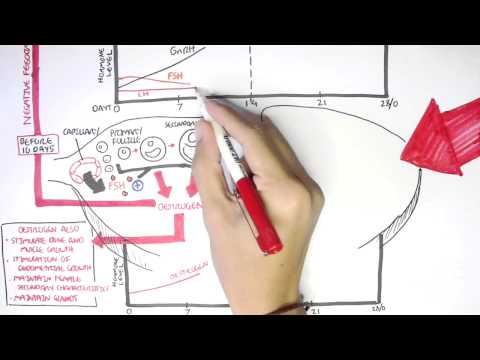
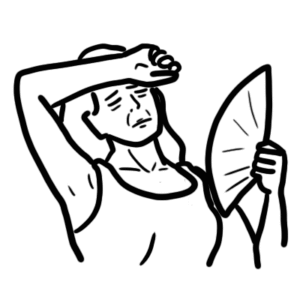
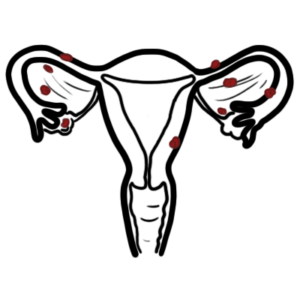
0:00 Armando Hasugan biology and medicine videos, please make sure to subscribe, 0:06 join the forum 0:07 and group for the latest videos, please visit Facebook Armando Hasugan. 0:11 In this video, we're going to talk about menopause. 0:15 Menopause is defined as amenorrhea occurring more than 12 months. 0:20 Amenorrhea means absence of menstruation. 0:25 The biochemical sign is a decrease in estrogen, which relates to the depletion 0:31 of follicles 0:32 in the ovaries. 0:34 I think it is important to look at the changes of estrogen levels throughout 0:39 the female 0:40 life cycle to see how menopause occurs. 0:45 So here I am drawing a graph, the estrogen concentration on the y-axis and age 0:51 on the 0:51 x-axis, so 10 years, 20, 30, 40, 50, 60 years. 0:57 During puberty, estrogen concentration increases. 1:01 This is when adolescents develop secondary sex characteristics. 1:06 And then during adolescence, they begin having their menstrual cycle. 1:11 And during the menstrual cycle, the estrogen concentration fluctuates. 1:17 But it still remains relatively high. 1:20 Now during pregnancy, estrogen levels rise. 1:23 This is in order to prepare the female for parturition and breastfeeding. 1:31 Then again, there is normal menstrual cycle with estrogen concentrations fluct 1:36 uating till 1:37 about 40 years old, when women attempt to hit menopause. 1:44 Now menopause usually occurs between mid to late 40s and lasts for about four 1:51 years. 1:51 In early menopause, the estrogen concentration are relatively stable. 1:56 However, towards the end of menopause, you have a drop of estrogen 2:02 concentration. 2:03 So after the four years of menopause, you have post-menopause, where estrogen 2:08 concentrations 2:09 are very low, and there is no more menstruation, no more menstrual cycle, so- 2:15 called amenorrhea. 2:17 And we will have a look at why there is no menstruation in menopause and why 2:22 there is 2:23 low estrogens. 2:25 So we can say that before menopause, when estrogen levels are rising and 2:31 relatively stable, this 2:33 is the pre-menopause stage. 2:36 So let's have a closer look at the two stages of menopause, the early and late 2:41 stage of 2:42 menopause. 2:44 Now hopefully this won't sound too confusing, but in early menopause, as I 2:48 mentioned, there 2:49 is normal estrogen levels. 2:51 And because there is normal estrogen levels, there is normal FSH levels, 2:55 another important 2:57 hormone that is responsible for actually stimulating estrogen production. 3:03 However, in late menopause, you have a decrease in estrogen levels. 3:09 And because you have a decrease in estrogen, you have an increase in FSH. 3:15 And that is because FSH wants to try to produce or wants to try to stimulate 3:20 more estrogen 3:21 production. 3:23 Unfortunately, estrogen cannot be produced despite the increase in FSH. 3:29 So I hope that was not too confusing, let us look at these hormones in a bit 3:33 more detail 3:33 and how they are related. 3:36 So here is the hypothalamus, an important endocrine tissue in the brain. 3:41 And below is the pituitary gland, another important endocrine tissue made up of 3:46 the 3:47 anterior and posterior lobes. 3:50 During a female's new cycle for menstruation, so just after a woman experiences 3:57 her period, 3:59 the hypothalamus produces a hormone called GNRH, which stimulates the anterior 4:05 pituitary 4:06 here to produce and release follicle stimulating hormone, or FSH. 4:14 Now FSH, follicle stimulating hormone, travels to the ovaries, which are the 4:21 female gonads. 4:22 The tissue that makes the female eggs. 4:27 Your follicle stimulating hormone aims to do is to stimulate the maturation of 4:34 follicles, 4:35 of primordial follicles in the ovaries here. 4:39 In the ovaries, you have thousands heaps of primordial follicles ready to 4:45 mature. 4:46 These primordial follicles have follicle stimulating hormone receptors. 4:50 They have FSH receptors. 4:53 And so, when FSH is being produced, some of these follicles will mature. 5:00 And as these follicles mature, they begin producing estrogen. 5:04 So we can say that FSH's role is for follicle maturation, as well as estrogen 5:10 production 5:12 indirectly. 5:14 However, only one follicle will mature faster than the rest. 5:19 This is because it has the most FSH receptor, or it has a higher affinity for F 5:26 SH. 5:26 And it is this follicle that will ovulate and release the egg. 5:34 When ovulation occurs, when the follicle releases the egg, no more follicles 5:40 mature. 5:41 And the follicle that ovulates become the corpus luteum. 5:45 The corpus luteum is essentially a dead follicle that will degenerate, but also 5:49 as it degenerates, 5:50 it will secrete estrogen. 5:53 Okay, so that was a normal menstrual cycle in that this occurs each month. 6:01 There's ovulation each month. 6:02 There's a corpus luteum that degenerates each month. 6:06 Now, an important concept to understand that relates estrogen to follicle 6:11 stimulating hormone 6:13 is that when you have an increase in estrogen, when you have high 6:19 concentrations of estrogen 6:22 in the blood, they will inhibit the release of follicle stimulating hormone 6:27 because you 6:27 already have high amounts of estrogen. 6:29 However, if you have low amounts of estrogen, this will actually trigger the 6:34 release of follicle 6:35 stimulating hormone because you want more estrogen to be produced. 6:42 So now, let's see how all this relates to menopause. 6:48 So what happens is, when a woman hits menopause, this is where there is an 6:53 exhaustion of follicles 6:55 when the follicles are depleted, when there's little to no follicles left. 7:00 However, in early menopause, there's still some follicles maturing. 7:08 And so you do get the estrogen concentrations are still there. 7:15 However, if this happens each month after each month and there's less and less 7:20 follicles 7:21 maturing, you have less and less estrogen being produced. 7:27 So when you have less and less estrogen being produced, this will actually 7:34 stimulate the 7:35 release of more FSH. 7:37 And because it will stimulate the release of more FSH, this will desensitize 7:44 the follicle 7:45 to FSH. 7:48 And so as a result, if there's because there's so much FSH, it just will not 7:53 work on the follicle. 7:54 And so you actually have no ovulation occurring. 7:59 And so this is where menopause occurs basically. 8:04 And when you slowly just, the follicles just stop maturing and the estrogen 8:09 concentrations 8:10 just drops. 8:12 Okay, so I hope that made sense. 8:15 So factors that can hasten the onset of menopause include smoking. 8:20 Smokers undergo menopause two years earlier than non-smokers. 8:24 Let us now look at some symptoms of menopause. 8:29 So some neurological sign and symptoms include depression, anxiety, memory loss 8:34 , labile mood 8:36 and headaches. 8:38 Menopause also triggers hot flushes, which is where one experiences a sudden 8:45 feeling 8:45 of warmth in the face, neck, and chest area for about four minutes. 8:51 And this can trigger night sweats. 8:54 Other symptoms include joint pain and weight gain. 8:58 Biological symptoms include urgency, frequency, dysuria, and incontinence. 9:06 Vaginal symptoms and signs include dryness, which de-increases the chance of 9:12 getting the 9:12 female of getting urinary tract infections as well as other infections. 9:17 There's also discomfort, itching, dysparnuria, and vaginal atrophy. 9:25 So there's no prevention for menopause. 9:28 It is a normal physiological process that occurs in females. 9:32 But the treatments are available to help with symptoms. 9:37 And these include hormone therapy, administration of estrogen. 9:43 You can also administer gabapentin and as well as moisturizers and topical 9:47 hormones to treat 9:49 the vaginal symptoms. 9:53 So I hope you enjoyed this video on menopause. 9:55 Thank you for watching. 9:58 [BLANK_AUDIO]