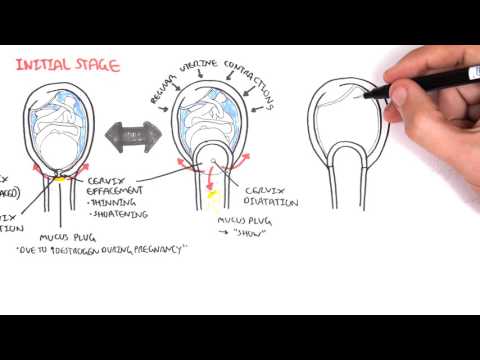
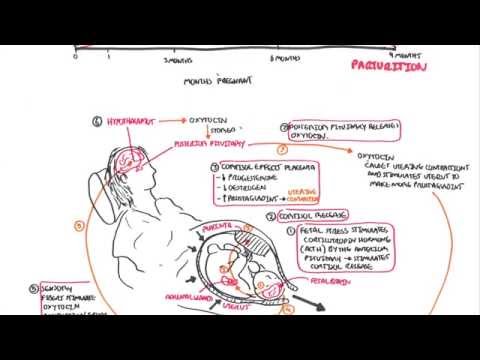
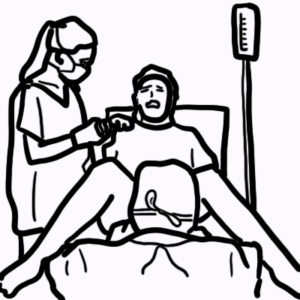
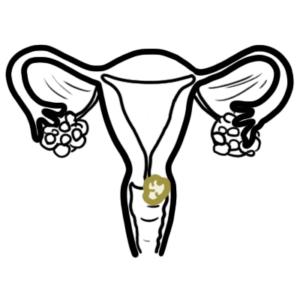
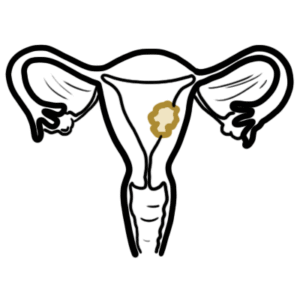
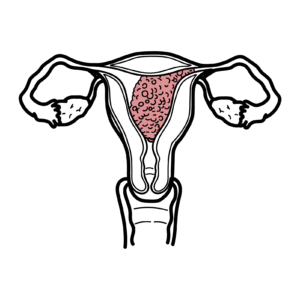
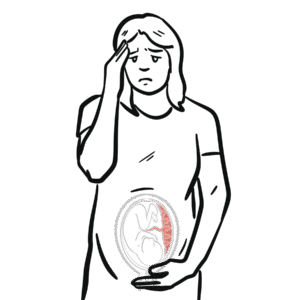
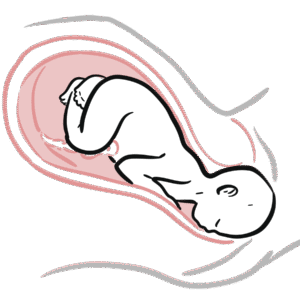
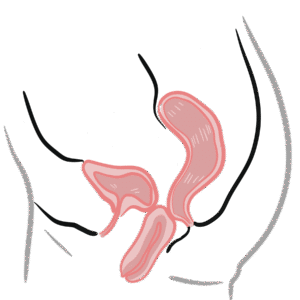
0:00 Hello, in this video we're going to talk about the stages of labour. 0:11 So labour can be divided into three stages. 0:15 First let us recap the physiology and some terminologies. 0:19 So normal labour usually occurs after 37 weeks. 0:25 A full term birth would refer to delivery occurring between 37 to 42 weeks 0:32 gestation. 0:33 But during certain situations, during certain circumstances, labour might occur 0:38 before 37 0:40 weeks. 0:41 If it's before 37 weeks, we call this premature labour. 0:45 Now remember, labour is divided into three stages, stage one, stage two and 0:53 stage three. 0:54 Now let's just say a woman is going into labour, she's about to deliver. 1:00 What is happening? 1:01 Well, she will enter stage one of labour. 1:05 Stage one of labour can be divided into two phases. 1:09 The latent, also known as the initial phase, and the active phase. 1:15 So when labour begins, the cervic is actually being stretched by the baby due 1:20 to release 1:20 of certain factors. 1:23 The stretching of the cervix will actually send signals to the brain. 1:28 It will send signals to the hypothalamus and the posterior pituitary gland to 1:33 release 1:33 a hormone called oxytocin. 1:37 Oxytocin will travel to the uterus via the blood and start stimulating uterine 1:43 contractions. 1:45 What's more, when the fetus or the baby is ready to go out, it will also 1:50 release things 1:52 from itself, which will also stimulate the placenta to secrete chemicals called 1:58 prostaglandins. 1:59 And these prostaglandins will stimulate uterine contraction as well. 2:04 So with all this uterine contraction by the oxytocin and by the prostaglandin, 2:09 the cervix 2:10 will actually slowly stretch out even more, and the cycle continues. 2:16 It's a positive feedback loop. 2:20 The contractions of the uterus are more constant. 2:23 They come in waves, regular rhythm. 2:27 The contractions during labour is actually defined as being regular, painful 2:32 contractions. 2:32 The cervix stretches slowly, and you begin to see thinning of the cervix, which 2:38 is effacement 2:39 of the cervix, which will progress to the final outcome cervix dilatation. 2:45 This particular cervix is now 3 centimetres dilated. 2:50 I am now drawing the cervix, looking at it from the front. 2:55 So the vaginal wall is at the bottom here. 2:58 And as you can see, the cervix is not dilated here, but as the labour 3:03 progresses, the cervix 3:04 will dilate. 3:07 Here the cervix is about 3 centimetres dilated. 3:12 As the cervix opens to about 3 centimetres in diameter, or some sources say 4 3:18 centimetres 3:19 in diameter, the latent or the initial phase of stage 1 of labour will then 3:26 enter the active 3:28 phase of stage 1 of labour. 3:32 In the active phase of stage 1 of labour, the cervix will just continue to dil 3:38 ate. 3:38 Your contractions are regular and more painful. 3:42 The cervix is said to be fully dilated when it is 10 centimetres. 3:48 This is where you can see crowning of the baby's head. 3:53 So looking at the cervix from the front again, here you can see the baby, the 3:59 placenta and 4:00 the uterus. 4:02 The uterus is where the baby is in. 4:05 And this is crowning, where the cervix is fully dilated and you can see the 4:08 head of the baby 4:09 coming down. 4:11 And this is the vaginal wall. 4:14 It is really important to know that babies usually are delivered head first. 4:20 But in some situations, the foot or the legs can come first. 4:23 This is called breach position. 4:26 Babies in a breach position can be delivered from the vagina, but often they 4:31 are delivered 4:32 via caesarean section because of the risks of complication it has for normal 4:38 delivery. 4:40 The uterus is contracting all this time, remember, because of the oxytocin and 4:44 the prostaglandins. 4:47 Recapping stage 1. 4:49 Stage 1 is divided into the latent and active phase. 4:54 Regular painful contractions with thinning, effacement of the cervix is what 5:00 happens in 5:00 stage 1, until the cervix reaches 10 centimetres dilatation or full dilatation 5:07 of the cervix. 5:09 After stage 1, the labour will progress to stage 2. 5:13 And stage 2 is from full cervix dilatation until the baby is born. 5:19 Basically, in stage 2 of labour, this is where the mother is delivered from the 5:26 baby. 5:27 Here is the umbilical cord. 5:28 Here is the placenta and here is the rectum of the mother. 5:32 And here you have a fully dilated cervix which is about 10 centimetres in 5:36 diameter. 5:37 During this time, the uterus is still having regular painful contractions. 5:42 Once the baby is born, the labour will then enter stage 3. 5:47 Stage 3 of labour is essentially the delivery of the placenta. 5:55 And here is the umbilical cord which is the connection between the baby and the 6:00 placenta. 6:01 In stage 3 of labour, the placenta is slowly detaching from the uterine lining. 6:07 The uterus is still contracting at this stage. 6:11 And actually, during this time, the mother is given an injection to stimulate 6:16 the delivery 6:16 of the placenta. 6:19 The placenta has to be carefully delivered because it can cause hemorrhage if 6:23 not delivered properly. 6:27 Once the baby is out, of course, clamps are put on either side of the umbilical 6:32 cord 6:32 and then the umbilical cord is cut. 6:35 It is also routine to get bloods from the umbilical cord for analysis of pH. 6:41 Blood is taken from the umbilical artery and the umbilical vein. 6:47 Thank you for watching. 6:49 I think I will have a video that goes into detail, specifically at stage 1 of 6:54 labour, 6:54 which is, again, the first stage of 3.