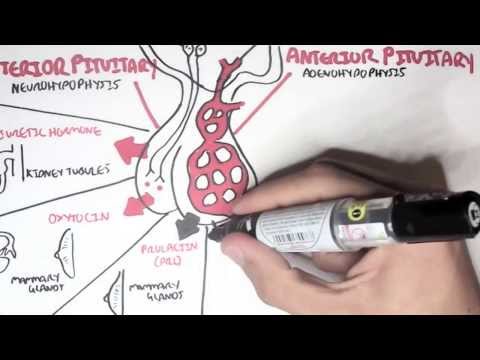
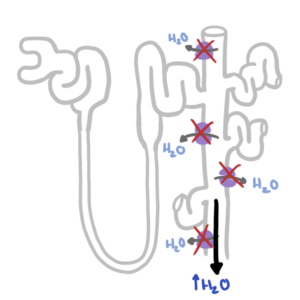
0:00 Hello, in this video, we're going to talk about the hormones of the posterior 0:10 pituitary 0:11 gland. 0:12 The hypothalamus is the region in the brain involved in maintaining homeostasis 0:17 , equilibrium 0:18 in the body. 0:20 Most of the hypothalamic responses are mediated through the pituitary glands. 0:24 The hypothalamus interacts with the anterior pituitary gland, telling it to 0:28 release or 0:29 inhibit the release of hormones from the anterior pituitary gland. 0:34 For the posterior pituitary gland, the hypothalamus actually has hypothalamic 0:40 neurons called 0:41 magnus cellular neurons running towards the posterior pituitary. 0:47 The magnus cellular neurons produces peptides and then secretes them into the 0:53 systemic 0:53 circulations within the posterior pituitary. 0:58 In this video, we will talk about the two hormones, the posterior pituitary 1:04 releases, 1:04 or more specifically, the hypothalamus releases. 1:07 These are oxytocin and antidiuretic hormone ADH, also known as arginine vasop 1:16 ressin. 1:18 The magnus cellular neurons produces neuropeptides ADH and oxytocin, which will 1:25 subsequently 1:26 be released from the posterior pituitary gland. 1:31 Oxytocin and ADH are closely related peptides, because they are both produced 1:37 by the magnus 1:38 cellular neurons running from the hypothalamus to the posterior pituitary. 1:45 Let's talk about oxytocin first. 1:47 So oxytocin is a hormone expressed mainly in females giving birth, labor, and 1:53 also during 1:54 lactation, feeding and infant with breast milk. 1:57 During labor, the baby is ready to come out from the mother's womb. 2:00 It will begin to stretch the cervix. 2:03 This stretching of the cervix during labor will send signals to the hypothal 2:08 amus, telling 2:09 it to secrete more oxytocin into circulation. 2:14 Oxytocin travels to the uterus, and here oxytocin will bind onto oxytocin 2:18 receptors in the 2:19 uterus, where it will cause rhythmic uterine contractions. 2:25 Utron contractions will further promote childbirth, further stretching the cerv 2:30 ix, which will 2:31 relay a positive feedback loop back to the hypothalamus to secrete even more 2:37 oxytocin. 2:39 This continues until childbirth is complete, and so it makes sense that oxytoc 2:45 in analogues 2:46 are sometimes used clinically during labor and delivery to promote the uterine 2:53 contractions. 2:55 During pregnancy, the female breast increases in size, preparing itself to feed 3:00 the hungry 3:01 baby when it's born. 3:03 The lobules of the breast becomes hypertrophyid, and adipose tissue increase in 3:09 this area, 3:10 making the breasts large. 3:12 The breast lobules produces breast milk. 3:15 The myoepithelium surrounds the lobules, and its role is to contract and to 3:22 help eject milk 3:24 out from the nipple. 3:27 Suckling of a lactating breast will send signals to the hypothalamus to secrete 3:34 oxytocin. 3:35 Oxytocin stimulates milk ejection by inducing contractions of the myoepithelial 3:42 cells that 3:42 line the lobules here. 3:46 And this is the positive feedback loop. 3:48 More sucking increases more oxytocin and again more milk ejection. 3:55 The next hormone of the posterior pituitary is anti-diuretic hormone, ADH, also 4:01 known 4:01 as arginine vasopressin. 4:03 ADH, also known as vasopressin, is the other neuropeptide produced by magnocell 4:08 ular neurons 4:09 of the hypothalamus and is released from the posterior pituitary. 4:14 The main function of ADH is increasing water reabsorption from the distal part 4:18 of the nephron. 4:19 ADH also has a role in vasoconstriction. 4:27 Kidneys are important in maintaining electrolyte and fluid homeostasis. 4:31 The functional units of the kidneys are the nephrons. 4:35 Blood gets filtered through the nephron. 4:37 The nephrons get reabsorbed back into the body and things get secreted into the 4:41 nephron. 4:42 The nephron is made up of the bone meds capsule, the head, where filtration 4:47 begins, the proximal 4:48 conflated tubules, the loop of Henley, the distal conflated tubules and then 4:53 the collecting 4:54 duct. 4:56 The proximal conflated tubule is responsible for reabsorbing 90% of filtered 5:00 water through 5:01 aqua pore and one channels. 5:06 Reabsorption of the remaining 10% of filtered water occurs in the distal conf 5:11 lated tubules 5:12 and the collecting ducts and is primarily driven by antidiuretic hormone. 5:19 ADH works principally on the principal cells. 5:24 Did you see what I did there? 5:27 The principal cells are found in the distal part of the nephrons, typically at 5:32 the collecting 5:33 ducts. 5:34 Let's see what stimulates ADH release first. 5:38 So ADH is released either in response to an increase in plasma osmolarity or a 5:45 decrease 5:46 in blood volume. 5:48 The hypothalamus is more sensitive to small changes in plasma osmolarity rather 5:54 than blood 5:54 volume. 5:56 Plasma osmolarity is basically sodium levels you can think about. 6:00 So if you have an increase in plasma osmolarity, it means you have high levels 6:06 of sodium in 6:07 the blood. 6:08 As we know, water follows sodium so the body will try to make this happen. 6:16 When there is an increase in plasma osmolarity or a decrease in blood volume of 6:22 10%, this 6:23 will stimulate the hypothalamus to secrete antidiuretic hormone. 6:29 Acrytic hormone ADH will travel in blood and will target the principal cells of 6:33 the nephron, 6:35 increasing the expression of aquaporin type 2 channels in the collecting duct 6:40 and the 6:40 distal convoluted chugles here. 6:43 And this will account for roughly 10% of the water reabsorption. 6:48 Let's take a closer look at the principal cells and see how ADH asserts its 6:55 mechanism. 6:55 ADH binds onto ADH2 receptors, where it will stimulate the insertion of aquapor 7:04 in 2 channels 7:05 on the apical surface of the principal cells. 7:09 The insertion of water channels into the membrane here increase the perme 7:14 ability of water in 7:16 the area. 7:18 Water reabsorbed in the cells leave the cells through the basal aspect through 7:22 aquaporin 7:23 3 and 4 channels. 7:26 Increase in water reabsorption means increase in blood volume and blood 7:30 pressure, and also 7:32 decreases plasma osmolarity, maintaining body homeostasis. 7:37 In addition to increasing water permeability in the nephron, ADH also increases 7:42 vascular 7:43 resistance. 7:44 This usually occurs only during severe blood loss or infection. 7:49 ADH binds to ADH1 receptors expressed on vascular smooth muscles, producing 7:55 contraction and 7:55 increasing peripheral vascular resistance, which will also increase blood 8:01 pressure. 8:02 And that concludes the video on hormones of the posterior pituitary gland, 8:06 which are octatosing 8:08 and antidertic hormone, also known as arginine vasopressin.