

Schizophrenia

Overview
Schizophrenia is a complex syndrome often presenting in late teens/early 20s with positive, negative and cognitive symptoms. Positive symptoms include behaviours and thoughts that are not normally present (psychosis). Negative symptoms include social withdrawal and affective flattening. Finally, cognitive symptoms are expressed as a broad set of cognitive dysfunction. The average lifetime prevalence of narrowly defined schizophrenia is just under 1%, but only about half of those affected ever obtain treatment. Schizophrenia on average has a shorter life than the rest of the population. Primary management are 1st and 2nd generation antipsychotics.
Definition
Pscyhosis: “Loss of contact with reality”
Delusion: strongly held false belief that are not typical of patient background and culture
Bizarre Delusions: Delusions that are totally implausible (eg, having been captured by aliens).
Non-Bizzare Delusions: Delusions that are plausible (eg, wife cheating on me).
Hallucination: Wakeful sensory experiences of content that is not actually present
Illusions: Distortion or misinterpretation of real sensory stimuli

Risk Factors
- Prenatal and perinatal events – complication in fetal life and born in late winter, early spring increases risk
- Paternal age – older fathering increased risk of child
- Urban environment – more common in disadvantaged areas (less support)
- Migration status – increased rates amongst migrants
- Drug abuse – persistant abuse of amphetamine, methamphetamine and cocaine. Cannabis increases rates of psychotic episodes.
- Social adversity – physical abuse, sexual abuse, maltreatment and bullying
Stages of Schizophrenia
| Stages of Schizophrenia and its features | ||
| Stage | Description | Features |
| I | Risk (Premorbid) | Genetic and environmental riskAsymptomatic |
| II | Prodrome | Cognitive and social deficitsHelp seeking |
| III | Acute psychosis | Relapse and remittingSuicide risk |
| IV | Chronic psychosis (Residual) | Medical complicationsDisability |
Clinical Manifestations
There are two categories of symptoms: positive and negative. The symptoms of schizophrenia usually begin between late adolescence and the mid-30s.
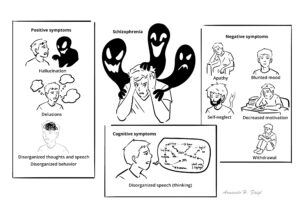
Positive symptoms
- Hallucination
- Delusions
- Disorganised thoughts and speech
- Disorganised behaviour
Negative Symptoms
- Apathy
- Self-neglect
- Blunted mood
- Decreased motivation
- Withdrawal
Cognitive Symptoms
- Attention and processing-speed impairment
- Working memory and learning difficulties
- Executive dysfunction, including impaired planning, problem-solving and judgement
Before diagnosing schizophrenia, remember to rule out any substance abuse, medications, or medical conditions that could be causing the psychotic symptoms.
| CHARACTERISTICS OF SCHIZOPHRENIA AND MOOD DISORDERS | ||
| Diagnosis | Psychotic symptoms | Mood Disorder |
| Schizophrenia | Present | Brief duration of mood symptoms |
| Shizoaffective disorder | Present along with and in the absence of mood disorder | Present only with psychotic symptoms |
| Mood disorder | Present only during mood disorder | Present in the absence of psychotic symptoms |
Diagnosis & Investigations
For schizophrenia, diagnosis is clinical—there is no single blood test, scan, or biomarker that confirms it. Investigations are mainly used to exclude medical, neurological, and substance-related causes of psychosis and to establish a baseline before treatment.
Diagnosis
Using DSM-5-TR criteria, schizophrenia requires ≥2 of the following symptoms for a significant portion of at least 1 month, with at least one of the first three present:
- Delusions
- Hallucinations
- Disorganised speech
- Grossly disorganised or catatonic behaviour
- Negative symptoms such as reduced emotional expression, avolition, alogia, anhedonia, or social withdrawal
There must also be:
- Significant decline in work, interpersonal relationships, or self-care
- Continuous disturbance for ≥6 months, including prodromal or residual symptoms
- Symptoms not better explained by schizoaffective disorder, bipolar disorder, major depressive disorder with psychotic features, substances, medications, or another medical condition
Important differentials include substance-induced psychosis, bipolar disorder, severe depression with psychotic features, schizoaffective disorder, delirium, dementia, epilepsy, autoimmune encephalitis, endocrine/metabolic disorders, and medication-related psychosis.
Investigations
Typical first-episode psychosis investigations include:
| Investigation | Purpose |
|---|---|
| FBC | Anaemia, infection, haematological disease |
| UEC/creatinine | Electrolyte or renal abnormalities |
| LFTs | Hepatic disease and treatment baseline |
| Calcium | Hypercalcaemia/hypocalcaemia |
| Glucose/HbA1c | Metabolic disease and antipsychotic baseline |
| Lipid profile | Antipsychotic metabolic baseline |
| TSH | Thyroid dysfunction |
| B12/folate | Nutritional or neurological causes |
| Urine drug screen | Substance-induced psychosis |
| Pregnancy test where relevant | Medication and imaging implications |
Depending on the clinical presentation, consider HIV and syphilis serology, inflammatory/autoimmune testing, cortisol or other endocrine investigations.
CT/MRI brain is not routinely diagnostic for schizophrenia but should be considered when there is atypical presentation, focal neurological signs, seizures, cognitive deterioration, head trauma, later-age onset, or concern for an intracranial cause.
EEG may be appropriate if epilepsy or episodic altered awareness is suspected.
Lumbar puncture and autoimmune encephalitis testing, including anti-NMDA receptor antibodies, should be considered when psychosis is accompanied by features such as seizures, abnormal movements, autonomic instability, fluctuating consciousness, catatonia, rapid deterioration, or other neurological abnormalities.
Treatment
Non-pharmacological
- Cognitive behavioral therapy (commence at risk groups)
- Medication review
- Regular review
- Motivational interviewing, social skills training
- Electroconculsive therapy
Pharmacological
First Generation (typical) antipsychotics
- Haloperidol
Second Generation (atypical) antipsychotics (fewer side effects)
- Risperidone
- Olanzapine (not first-line)
- Closzapine (not first-line)
Pharmacology
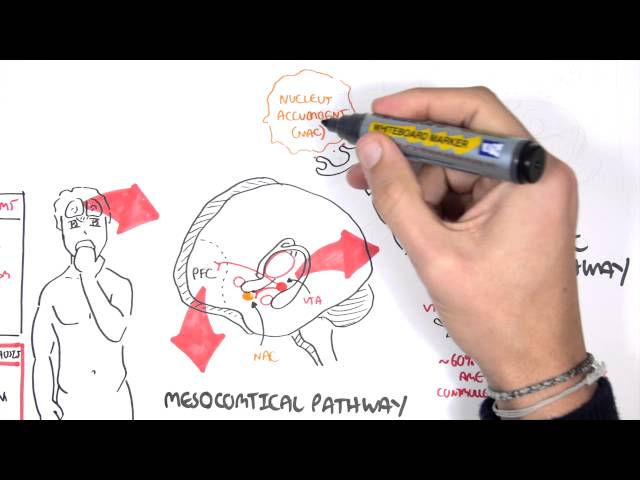
First Generation (Typical) Antipsychotics – D2 receptor antagonist in mesolimbic and mesocortical pathways. Side effects: extrapyramidal symptoms (dystonias, Parkinsonan symptos, and akathisia), prolactinemia (impotence, amenorrhea, hynecomastia), and tardive dyskinesia.
Second generation (Atypical) Antipsychotics – D2 receptor antagonist and serotonin 2A receptor antagonist. Side effects: metabolic syndrome, obestiy.
Serious Side-effects of Anti-psychotics
- Unfortunately, tardive dyskinesia is usually a permanent condition and can be both disfiguring and disabling.
- Neuroleptic malignant syndrome (NMS) is the most severe potential side effect and can occur with any antipsychotic at any time during treatment
- Clozapine is beneficial, especially in treatment-resistant schizophrenia, but has a significant adverse effect in that it can cause agranulocytosis.
Complications & Prognosis
Consequences/Complications
- Psychological – depression (70%), suicide (10%), substance abuse
- Social – isolation, relationship loss, interpersonal issues, poor social function
- Financial – poor academic / work attendance & performance, cost of treatment
- Family – guilt, worry, shame, stigma
- Community – discrimination, social disruption, burden on healthcare system
Prognosis
- 20% -> full recovery
- 30% -> multiple episodes with reasonable inter-morbid function
- 50% -> significant ongoing impairment
| Good prognostic factors | Poor prognostic factor |
| Acute onset | Poor premorbid functioning (most important) |
| Later age at onset | Early onset |
| Shorter duration | Negative symptoms |
| Female gender | Single, divorced, or widowed status |
| Good cognitive function | Poor support system |
| Good premorbid function | |
| No family history | Family history of schizophrenia |
| Presence of affective symptoms | |
| Absence of structural brain abnormalities | |
| Good response | |
| Good support systems |
Chronic Schizophrenia
Chronic schizophrenia is an enduring syndrome of delusions, hallucinations, flatness of affect, poverty of speech or incoherence of speech. Other symptoms may occur, including mood symptoms, cognitive problems and movement disorders.
- Symptoms of schizophrenia may be episodic or continuous.
- Up to 90% of people with schizophrenia have a chronic physical illness.
- There is a two-to-three-fold increase in mortality from suicide, accidents and medical disease
- Increase risk of cardiovascular disease
Ideally, people with chronic schizophrenia should have ongoing access to specialist services, such as a private psychiatrist or public mental health services. Some people with chronic schizophrenia are managed solely by their GP. Many patients struggle to find specialist services that are available, accessible, affordable and acceptable.
Metabolic syndrome has become more prevalent due to the use of newer antipsychotics, which have been associated with greater weight gain and higher fasting glucose, cholesterol and lipid levels.
References
- Holder SD, Wayhs A. Schizophrenia. Am Fam Physician. 2014;90(11):775-82.
- Owen MJ, Sawa A, Mortensen PB. Schizophrenia. Lancet. 2016;388(10039):86-97. doi:10.1016/S0140-6736(15)01121-6.
- American Psychiatric Association. Diagnostic and statistical manual of mental disorders. 5th ed., text rev. Washington (DC): American Psychiatric Association Publishing; 2022. doi:10.1176/appi.books.9780890425787.
- Keepers GA, Fochtmann LJ, Anzia JM, Benjamin S, Lyness JM, Mojtabai R, et al. The American Psychiatric Association practice guideline for the treatment of patients with schizophrenia. Am J Psychiatry. 2020;177(9):868-72. doi:10.1176/appi.ajp.2020.177901.
- Huhn M, Nikolakopoulou A, Schneider-Thoma J, Krause M, Samara M, Peter N, et al. Comparative efficacy and tolerability of 32 oral antipsychotics for the acute treatment of adults with multi-episode schizophrenia: a systematic review and network meta-analysis. Lancet. 2019;394(10202):939-51. doi:10.1016/S0140-6736(19)31135-3.
- Hope J, Keks N. Chronic schizophrenia and the role of the general practitioner. Aust Fam Physician. 2015;44(11):802-8.





Members only discussions coming soon…