Ruptured Abdominal Aortic Aneurysm
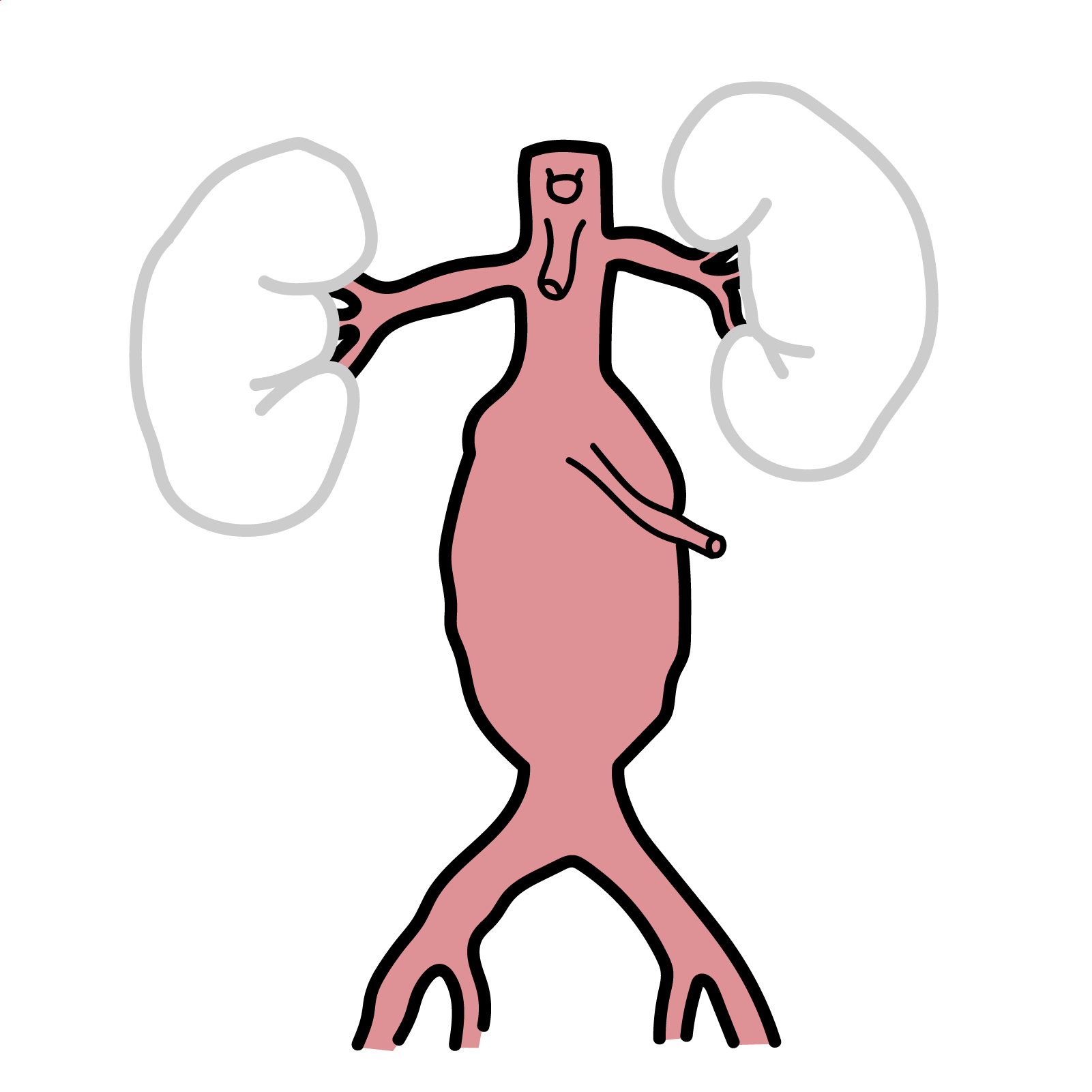


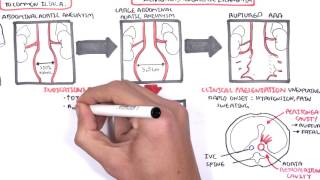
Abdominal Aortic Aneurysm, also known as AAA, is a permanent dilation of the abdominal aorta with a diameter of >1.5 times of the expected diameter. The adopted diameter that indicates AAA is 3cm or more. AAA is strongly associated with smoking and increasing age. Most of these aneurysms are fusiform and originate below the renal arteries. Rupture is associated with an overall mortality rate of 90% and 50% for those reaching hospital. Screening men over 65 reduces AAA-related mortality. Patients diagnosed with small AAA are managed with ultrasound surveillance and cardiovascular risk reduction. Patients with indications for AAA repair should be referred promptly to a vascular surgeon.1 2
Aneurysm: an artery that has enlarged to greater than 1.5 times the expected diameter.
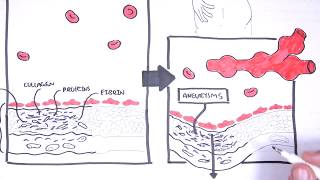
True Aneurysm: The aneurysm is bound by all three layers of the vessel wall (intima, media and adventitia). The wall may be attenuated.
False Aneurysm: Occurs when a blood vessel wall is injured, and the blood is contained by the surrounding tissues creating an apparent dilatation of vessel.
Aortic dissection: occurs when a tear in the tunica intima of the aorta causes blood to flow between the layers of the wall of the aorta, forcing the layers apart.
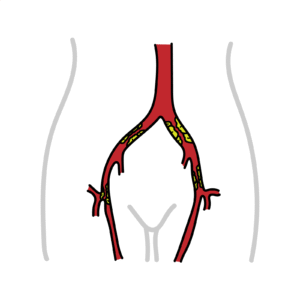
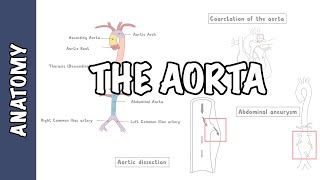
Abdominal aorta originates at T12 as it passes through the diaphragm
It bifurcates into the right and left common iliac arteries at L4
Branches of the descending abdominal aorta:
| Branch | Vertebral level of origin | Region of supply |
| Inferior phrenic | T12 | Inferior diaphragm, adrenal glands |
| Coeliac trunk | T12/L1 | Foregut |
| Superior mesenteric | L1 | Midgut |
| Middle suprarenal | L1 | Adrenal glands |
| Renal | L1/L2 | Kidneys, adrenal glands |
| Gonadal | L2 | Gonads (testes/ovaries) |
| Inferior mesenteric | L3 | Hindgut |
| Median sacral | Superior to bifurcation (L4) | Lumbar vertebrae, sacrum |
| Lumbar arteries | L1-L4 | Posterior abdominal wall, spinal cord |
↓
Chronic aortic wall inflammation
↓
Proteolytic imbalance – Increased Matrix metalloproteinases
↓
Elastin and collagen breakdown + smooth muscle apoptosis
↓
Aortic wall weakening
↓
Progressive dilation
↓
Eventually wall stress exceeds vessel strength and causes rupture
Anatomical:
Most AAA are located infrarenally due to less elastin in the aortic wall and lack of vasa vasorum, which makes tunica media more susceptible to ischaemia.
Diameter:
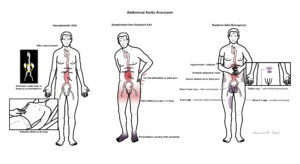
Asymptomatic AAA:
Symptomatic non-ruptured AAA:
Ruptured AAA – triad:
Investigation
Aortic ultrasound – used for screening asymptomatic patients and symptomatic patients who are haemodynamically unstable; cannot definitively rule out ruptured AAA
CT angiogram – used for pre-op planning and patients with symptomatic AAA who are haemodynamically stable
Patients with known history of AAA and symptoms of rupture can be diagnosed based on clinical examination alone 1 4
Do not delay diagnosis and management of a ruptured AAA while waiting for imaging results.
Classic triad of ruptured AAA: hypotension/collapse, back/abdominal pain, palpable/pulsatile mass.
Asymptomatic AAA:
| AAA diameter (cm) | Surveillance interval |
| >2.5 but <3.0 | 10 years |
| 3.0 – 3.9 | 3 years |
| 4.0 – 4.9 | 12 months |
| 5.0 – 5.4 | 6 months |
Indications for AAA repair:
Risk of rupture based on aortic diameter: 6
| Baseline aortic diameter (cm) | 12-month rupture risk |
| 3.0 – 3.9 | <1% |
| 4.0 – 4.9 | 1% |
| 5.0 – 5.9 | 1.7 – 11% |
| 6.0 – 7.0 | 5.1 – 22% |
| >7.0 | 19 – 33% |
Ruptured and symptomatic non-ruptured AAA – urgent surgical management:
Ruptured AAA resuscitation – restrictive resuscitation with blood products aiming for permissive hypotension – prevents worsening of bleed: higher BP would lead to higher pressure on aortic wall and disruption of temporary clot, and increase in fluid level may cause dilutional coagulopathy.
Rupture into the peritoneal cavity is usually rapidly fatal due to blood having more space to spread. In a retroperitoneal rupture, the blood has limited space to spread and bleeding is reduced, which may cause the rupture to transiently stabilise, providing a window of opportunity for lifesaving intervention.
Complications of AAA:
Repair-related complications:




Please confirm you want to block this member.
You will no longer be able to:
Please allow a few minutes for this process to complete.
Discussion