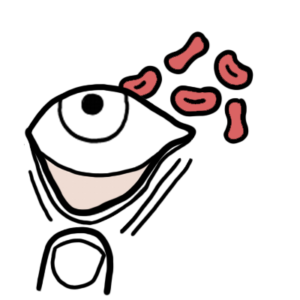
0:00 Hello, in this video, we're going to talk about hamato poasis. 0:10 Hamato poasis, as the name suggests, hamato refers to the blood and poasis is 0:16 essentially 0:17 I guess formation of. 0:19 And hamato poasis refers to the commitment and differentiation process of a 0:26 stem cell 0:27 to the different types of cells we found in the blood, for example our red 0:32 blood cells. 0:34 Now hamato poasis, which is the making of these different cells, they occur 0:41 mainly in 0:42 the bone marrow and this is particularly in adults. 0:47 This is referred to as medullary hamato poasis. 0:51 But hamato poasis can also occur in other tissues such as the liver, thymus and 0:56 spleen 0:56 and this is called extra medullary hamato poasis. 1:00 And we'll learn about that in this video. 1:03 So let's begin by zooming into the bone marrow. 1:06 And in the bone marrow we can find hamato poetics stem cells. 1:10 Hamato poetics stem cells can first of all differentiate into either what's 1:15 called a 1:15 common lymphoid progenitor cell or a common myeloid progenitor cell. 1:21 The common lymphoid progenitor cell then further differentiates into different 1:26 lymphoblasts 1:27 with different genetic profiles. 1:30 And this will allow them to form and mature into different types of lymphocytes 1:36 . 1:36 So here I'm just drawing the bloodstream because as cells exit the bone marrow 1:41 they 1:41 will enter the blood. 1:43 So these different lymphoblasts with the different genetic profiles will become 1:51 either naive 1:51 B cells, pre T cells or natural killer cells. 1:57 Now also common lymphoid progenitor cells can differentiate into certain types 2:02 of dendritic 2:03 cells. 2:04 The dendritic cells when it's formed will move into tissues and becomes what's 2:10 known as 2:10 a lymphoid dendritic cells. 2:13 Dendritic cells are peripheral antigen presenting cells that are actually very 2:18 important in 2:19 the connection between the innate immune system and the adaptive immune system. 2:27 So that was the lymphoid progenitor cell lineage. 2:32 Now let's look at the common myeloid progenitor cell lineage. 2:36 And it's important to know that the outcome of these lineage are cells that can 2:44 circulate 2:44 in the blood, hence hematopoietic. 2:48 So again from the hematopoietic stem cell it can become a common myeloid progen 2:55 itor cell. 2:57 And there are different maps of hematopoiesis that depict common myeloid progen 3:03 itor cell 3:03 differentiation. 3:05 But how I'm going to show you is what I think is the easiest. 3:09 Anyway, the common myeloid progenitor cell can become myeloblasts and 3:15 eventually become 3:17 granulocytes. 3:18 These granulocytes are cells containing granules. 3:22 And they can either be banned neutrophils, banned basophils, and banned isinoph 3:31 ils. 3:31 So neutrophils, basophils, isinophils. 3:34 And these granulocytes are banned cells because they are immature. 3:40 But once they enter the circulation they mature and become what we know as neut 3:45 rophils, basophils 3:46 and isinophils respectively. 3:50 Neutrophils are important in the acute response to infection and inflammation. 3:54 Basophils are important in allergy and parasitic infections. 3:59 Like isinophils are also important in allergies and sensitivity. 4:06 The common myeloid progenitor cells can differentiate and become promonocytes 4:12 and mast cell precursors. 4:14 The promonocytes then mature and become what we know as monocytes. 4:21 Monocytes are essentially circulating macrophages. 4:25 And so once they move into a tissue such as the skin they become tissue macroph 4:32 ages. 4:33 And macrophages are antigen presenting cells which again are important in the 4:38 connection 4:38 between the innate immune system and the adaptive immune system. 4:45 The monocytes or promonocytes can also become dendritic cells. 4:52 And if they become dendritic cells in the tissue they are referred to as the my 4:57 eloid 4:57 dendritic cells. 5:00 So again we have two important antigen presenting cells, the macrophage and the 5:06 dendritic cell. 5:08 The muscle precursor can become mature muscles once they enter circulation and 5:15 move into 5:16 tissues. 5:18 Smiles are very important cells in allergy, the inflammatory response and 5:23 hypersensitivity. 5:25 Finally, the common myeloid progenitor cell can differentiate and become mega k 5:32 aryocytes 5:32 with stimulation of thrombopoietin, a hormone produced by the liver and the 5:40 kidneys. 5:41 Or the myeloid progenitor cell can become erythroblasts through stimulation of 5:47 erythropoietin 5:48 a hormone released by the kidneys. 5:52 Let's look at mega karyocytes first. 5:55 Mega karyocytes are normally present in the bone marrow, not in the circulating 6:00 blood, 6:01 but these guys give rise to the platelets we find in the blood. 6:06 Mega karyocytes rupture releasing platelets into circulation and platelets are 6:11 very important 6:12 in clotting. 6:15 Erithroblasts are still nucleated red blood cells, meaning that they have a 6:22 nucleus. 6:23 But once these erythroblasts enter circulation and mature, they become erythro 6:29 cytes which 6:31 are A nucleated. 6:33 Erithrocytes are our red blood cells. 6:38 In adults, healthy adults, hematopoasis occurs in the bone marrow, particularly 6:45 in 6:45 the pelvis, the vertebrae, and sternum. 6:49 However, hematopoasis can occur in other organs, and this is called extramadol 6:55 ary hematopoasis. 6:57 And let us look at a graph with X being the timeline. 7:02 Here is birth and down the X-axis to 70 years old. 7:07 And on the Y-axis is hematopoasis, where the blood cells, the different blood 7:12 cells 7:12 are made. 7:13 So before birth, so when you are a fetus in the uterus, hematopoasis occurs 7:21 predominantly 7:22 in the liver and the spleen. 7:24 And this is the fetus we're talking about. 7:25 So in the fetus, hematopoasis occurs in the liver and spleen. 7:29 But then it drops off by birth. 7:33 And this is because slowly the bone marrow will take over the role. 7:40 And by adulthood, the bone marrow has the main role in hematopoasis, 7:45 particularly the 7:46 vertebrae bone marrow and the pelvis and sternum. 7:50 Hematopoasis occurring in the bone marrow is termed medallory hematopoasis. 7:57 It's interesting to note that hematopoasis also occurs in the lymph nodes 8:01 during adulthood, 8:02 but at a much lower concentration and usually occur more often during periods 8:10 of infections. 8:12 So what is very interesting is that the liver and spleen, as one might suspect, 8:17 has no to 8:19 minimal role in hematopoasis after birth. 8:22 However, they actually do have a role, particularly during periods of 8:28 infections or during pathological 8:31 changes, such as in certain diseases. 8:37 When other organs perform hematopoasis aside the bone marrow, such as if it 8:42 happens in 8:43 the lymph nodes spleen or liver, this is called extramadolary hematopoasis. 8:52 When you think about it, a child with an infection, their liver or spleen can 8:57 sometimes 8:57 enlarge, and this is because the spleen or the liver is working harder to make 9:02 more blood 9:02 cells, but this is usually self-limiting and goes away.