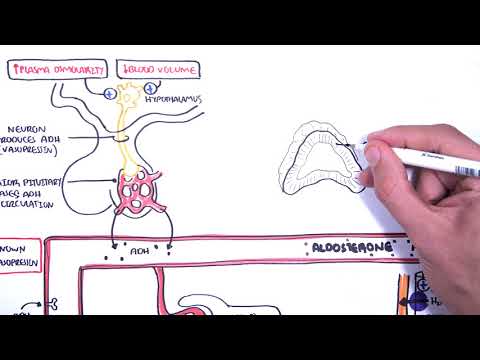
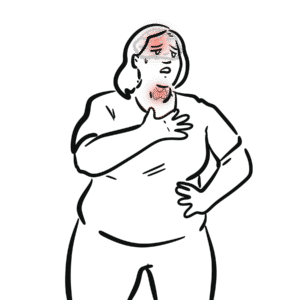
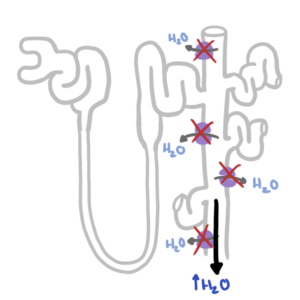
0:00 In this endocrinology video, we will talk about the hypothalamic paturgyaxis of 0:11 the adrenal 0:12 corticotropic hormones, so the hormones of the adrenal cortex actually. 0:18 The brain consists of structures that are very important in regulating the 0:22 hormones in 0:23 our body. 0:24 The hypothalamus is actually the main regulator. 0:28 The pituitary gland, which sits below the hypothalamus, is made up of the 0:33 anterior and 0:34 posterior lobes, and these are also important endocrine glands. 0:40 But here we will mainly focus on the anterior pituitary gland. 0:46 We're only going to talk about the anterior pituitary because we're talking 0:49 about the 0:50 adrenal gland and its hormones. 0:53 So the adrenal glands sit above our kidneys, and we have two kidneys, and so we 0:59 have two 0:59 adrenal glands. 1:02 Here is a cross section of an adrenal gland. 1:05 It is made up of an adrenal medulla in the center and the adrenal cortex on the 1:10 outside 1:11 or periphery. 1:13 The adrenal cortex and adrenal medulla produces very different hormones, but in 1:18 a way they 1:19 are similar. 1:22 Unlike the adrenal cortex, the adrenal medulla is stimulated by nerves. 1:28 The brain sends signals down the spinal cord, and the nerves, which are leaving 1:33 the spinal 1:34 cord, are sympathetic nerves that will target the adrenal medulla to secrete 1:40 adrenaline 1:40 and noradrenaline, or epinephrine and norepinephrine. 1:45 An increase in noradrenaline or adrenaline in our blood essentially will 1:50 trigger the 1:51 fight or flight response, and so it will increase the sympathetic activity. 1:58 And this is what we will see when there is an acute stress, when we are nervous 2:02 , when 2:03 we are running away in fear, or get a sudden jolt of horror. 2:08 But what about the adrenal cortex? 2:10 Well, the adrenal cortex is responsible for long-term stress response, you can 2:16 say. 2:16 The adrenal cortex has actually three main layers, which can be remembered from 2:22 the top 2:23 as GFR, such as the GFR of the kidneys. 2:30 So the very outer layer is the zona glomerulosa. 2:35 F is for zona fasciculata, and R is for zona reticulares. 2:41 Again, the adrenal medulla produces hormones for acute stress, however, in the 2:47 long-term 2:48 stress response, the adrenal cortex has a bigger role. 2:53 Long-term stresses will actually just essentially cause the hypothalamus in the 2:58 brain to release 2:59 corticotropin-releasing hormone, which then will target cells in the anterior 3:05 pituitary 3:06 gland to release another hormone called adrenocorticotropic hormone, or ACTH 3:13 for short. 3:15 ACTH will enter circulation of the blood and target cells within the adrenal 3:23 gland, specifically 3:24 the adrenal cortex. 3:27 It will stimulate the cells within the glomerulosa, zona glomerulosa, to 3:32 release mineral corticoids, 3:34 mainly aldosterone. 3:36 ACTH will stimulate cells in the zona fasciculata to release glucocorticoids, 3:42 mainly cortisol. 3:44 ACTH will stimulate cells in the zona reticulares to release androgens. 3:51 Out of these three hormones, the glucocorticoids has the very important role in 3:56 providing a 3:57 negative feedback to the brain. 3:59 What I mean by negative feedback is that if there is an increase in glucocortic 4:03 oids 4:03 in circulation, this will send a negative feedback signal to the hypothalamus, 4:09 telling 4:10 it to reduce the production of corticotropic-releasing hormone, and thus 4:15 reducing the whole cascade 4:16 from there. 4:18 Alright, let us focus on each of these three adrenal cortex hormones and see 4:23 what they 4:24 do, beginning with mineral corticoids. 4:28 To understand mineral corticoids, we need to know about the kidneys and their 4:34 functional 4:34 units called the nephrons. 4:36 So nephrons are the functional units of the kidneys, there are millions of 4:41 these. 4:41 And these guys are responsible for filtering, reabsorbing and secreting things 4:46 from our 4:46 body, and thus also has a major role in controlling our blood pressure. 4:54 So kidneys, the nephrons, have a main role as a big role in controlling blood 4:59 pressure. 5:00 When there is a decrease in blood pressure, the kidneys will reabsorb water and 5:06 sodium 5:06 in back into the blood, and either reabsorb or secrete potassium in exchange. 5:15 The increase in water and sodium in the blood will then increase blood pressure 5:20 back to 5:21 normal. 5:22 Aldosterone, secreted by the zona glomerulosa of the adrenal cortex, will 5:28 actually stimulate 5:30 this process, thereby increasing blood pressure. 5:36 Aldosterone primarily works at the distal part of the nephron, known as the 5:41 distal convoluted 5:42 tubule and the collecting duct. 5:46 So Aldosterone stimulates water and sodium retention, thereby increasing blood 5:54 pressure. 5:55 It also actually tells potassium to be secreted out, thus can lead to hypochle 6:02 mia. 6:02 Anyway, let's talk about glucocorticoids. 6:07 Glucocorticoids, primarily cortisol, is secreted by the zona fasciculata, and 6:13 has many functions. 6:15 You mentioned it has a responsibility for negative feedback to the brain, 6:19 telling the 6:20 brain to reduce the secretion of ACTH. 6:24 Glucocorticoids have other functions, such as causing hyperglycemia. 6:31 It does this by stimulating the liver, or telling the liver to make more glyc 6:35 ogen stores, 6:37 which will eventually fill up. 6:38 It tells the liver to make more glucose, gluconeogenesis, tells the liver to 6:43 increase protein breakdown, 6:45 and actually induces insulin resistance, as well as increasing fat deposition. 6:52 All this will either result in too much glucose in the liver, which will 6:56 eventually be shunted 6:57 into circulation, or because of the insulin resistance, this will cause the 7:03 inability of 7:04 glucose to be taken up by cells, thus leading to hyperglycemia. 7:11 Glucocorticoids also increase blood pressure, and suppresses the immune system. 7:17 It suppresses the immune system, which helps decrease pain, sensation, but at 7:21 the same 7:22 time it will increase the risk of infection. 7:26 And this is because the immune cells are being suppressed, and thus are unable 7:30 to defend 7:30 our body. 7:32 Finally, glucocorticoids also stimulate osteoclastic activity in the bone, 7:37 leading to osteopenia, 7:40 and increasing the risk of osteoporosis, thus increasing the risk of bone 7:46 fractures. 7:47 The final hormone secreted by the adrenal cortex comes from the zona reticula, 7:51 which 7:52 is the area of the adrenal cortex, which releases androgens. 7:57 It's important to know that unlike aldosterone and glucocorticoids, androgens 8:01 have minimal 8:02 role in stress. 8:05 Androgens actually promote prostate growth in men, and help with the 8:08 development of masculine 8:09 characteristics, such as a deep voice and hair growth. 8:14 In females, androgens, adrenal androgens are important in libido, and thus a 8:21 decrease 8:22 in androgen production will result in a decrease in libido, decrease in sexual 8:27 drive in females. 8:30 Those were the general effects and functions of the three hormones produced by 8:35 the adrenal 8:35 cortex, in response to long-term stress, amongst many other things. 8:41 It is important to learn about another factor, which actually affects the 8:46 release of aldosterone, 8:47 not really related to stress. 8:50 This other factor is a molecule called angiotensin2, which is part of the renin 8:54 angiotensin-aldosterone 8:56 system. 8:58 To understand this topic, we need to go back to the nephron, the functional 9:03 units of the 9:04 kidneys. 9:06 As mentioned, the nephron filters things from our blood. 9:10 The afferent arterial are the vessels that enter the head of the nephron for 9:16 filtration, 9:17 and the efferent will leave the head of the nephron. 9:22 The things filtered will go through the nephron tubes and essentially come out 9:28 as urine. 9:29 Now, when there is low blood pressure, it will decrease the filtration rate, 9:38 and it will 9:39 also decrease the pressure in the afferent arterial coming into the head of the 9:44 nephron. 9:45 This decrease in pressure essentially will stimulate the release of renin from 9:50 the juxter 9:52 glomerular cells, and renin will essentially start the renin angiotensin-ald 9:57 osterone system 9:58 cascade, which eventually the final outcome will be activation of the final 10:03 product called 10:04 angiotensin2. 10:07 Angiotensin2 will stimulate zona glomerulosa to secrete aldosterone in the 10:13 attempt to increase 10:15 blood pressure by targeting the nephron to remember that aldosterone will 10:20 target the 10:21 nephron to retain and reabsorb sodium and thus water into the vasculature, 10:27 leading to 10:28 an increase in blood pressure. 10:31 I hope you enjoyed this video, thank you very much for watching.