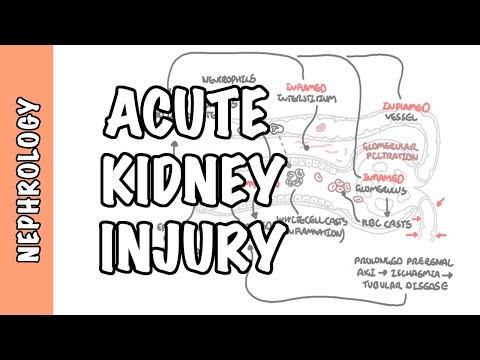
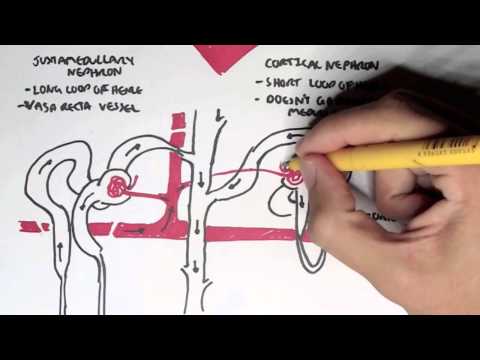
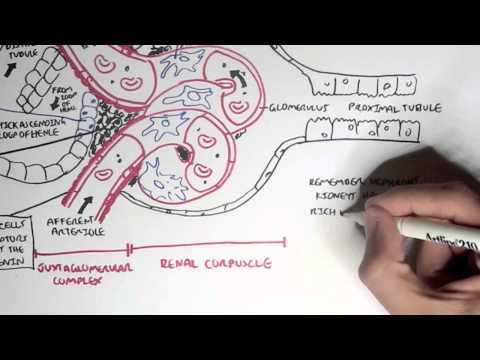
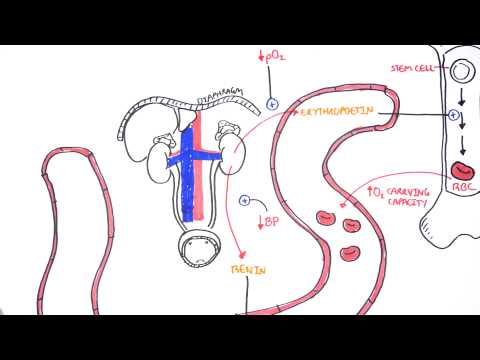
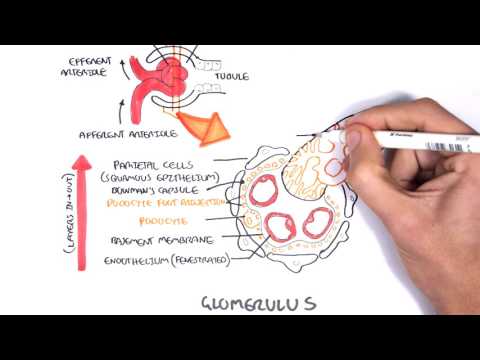
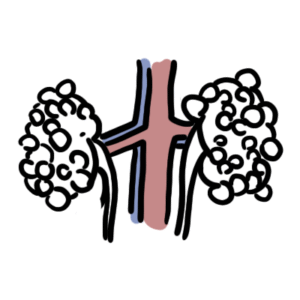
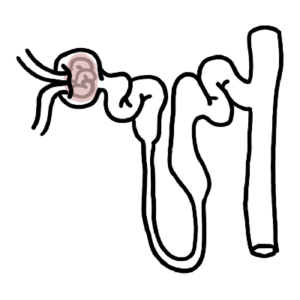
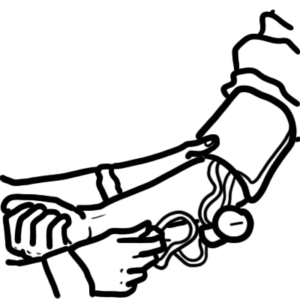
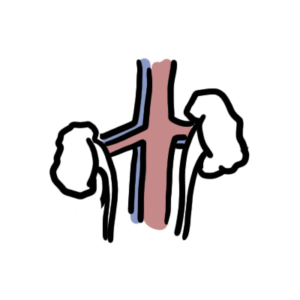
0:00 Armando has to do an biology and medicine videos. Please make sure to subscribe 0:05 , join 0:06 the four main group for the latest videos. Please visit Facebook Armando has to 0:09 do now. 0:10 Now in this video we're going to look at acute renal failure, which is defined 0:17 as a decrease 0:18 in glomerular filtration rate. And I put reversible because in quotations 0:24 because it may be reversible. 0:28 Essentially it's, you know, it's damage to the kidneys, which will cause a few 0:35 problems, 0:37 many problems actually. And so we will look at these problems and some causes 0:43 of acute 0:44 renal failure. So here I'm just drawing the anatomy. Here we have the kidneys, 0:51 the inferior 0:52 vena cava, where the renal veins drain into. And then we have the ribs here. 1:00 And here is 1:00 the diaphragm. And here we have the aorta, which will supply the kidneys 1:04 through the 1:05 renal artery. And here we have the pelvis. And now the kidneys, as we know, 1:12 produce urine, 1:13 which will travel through the ureter and go to the bladder. And urine is stored 1:17 in the 1:18 bladder. And when needed, the bladder will contract and expel urine through the 1:23 urethra. 1:24 Now above the kidneys, we have glands known as adrenal glands, which are 1:30 important because 1:31 they produce some important hormones. Okay, now I want to talk about the main 1:39 causes 1:39 of acute renal failure. And there's three main ones. It can either be pre-renal 1:46 before 1:46 the kidneys, intra-renal within the kidneys, or post-renal after the kidneys. 1:52 So these 1:53 are the main causes. But now we will focus on each one and look at these in a 1:58 bit more 1:59 detail. So pre-renal cause of acute renal failure can be due to a sudden or 2:07 severe decrease 2:08 in blood pressure. Or it can be due to a flow obstruction to the kidneys. And 2:15 this can 2:15 be due to atherosclerosis or some form of ischemia, so stenosis. 2:23 And then you have intra-renal cause. Now intra-renal causes include direct 2:28 damage to the kidneys 2:30 itself, inflammation within the kidneys, a form of infection, drugs, as well as 2:37 autoimmune 2:39 diseases, such as systemic lupus erythromytosis. I hope I pronounced that right 2:46 . 2:46 And then the third one, the post-renal cause of acute renal failure include 2:51 mainly an obstruction 2:52 of urine flow. So this can be due to a benign prosthetic hyperplasia, kidney 2:58 stones, as 2:58 well as some form of bladder injury or tuma. 3:04 Now we will mainly focus on intra-renal, which is the most common form of acute 3:10 renal failure. 3:12 So it's the most common cause. Now before we look into that we should just 3:16 quickly brush 3:16 over the anatomy. So here I'm drawing the right kidney, the ureter, the renal 3:23 pelvis, 3:24 the renal pyramids, which are within the renal medulla. And around this area 3:31 are the functional 3:33 units of the kidneys, which are called nephrons. So let's just zoom into one of 3:38 these nephrons. 3:39 So here I'm drawing one nephron, it has the head, which is the bowman's capsule 3:44 . And 3:45 then we have this convoluted part called the proximal convoluted tubules, which 3:50 then forms 3:51 a loop of Henley. And then we have the distal convoluted tubules and then the 3:56 collecting 3:56 ducts. 3:59 So let us briefly look at the function of the kidneys of the nephrons. So in 4:05 summary, an 4:06 afferent arterial will carry blood from the renal artery. This afferent arter 4:13 ial will come 4:14 down and it will be filtered in the glomerulus. And this occurs in the bowman's 4:21 capsule, 4:21 the head of the nephron. 4:24 A term to know is the glomerular filtration rate. And this is literally the 4:30 rate at which 4:31 the glomerulus filters the blood. When the blood is being filtered, filtrate is 4:39 produced 4:39 and this is what will go through the nephron. The remaining blood will leave 4:45 the glomerulus 4:47 and exit out through the afferent arterial. And this afferent arterial will 4:52 essentially 4:54 make its way around the nephron as the vasorecta. The vasorecta, the vasorecta 5:01 's role is to 5:02 reabsorb things from the filtrate that is within the nephron. As well, the vas 5:09 orecta 5:09 will secrete things that it doesn't need. It will secrete things from the blood 5:15 back 5:15 into the nephron as filtrate. The vasorecta will then leave and head towards 5:22 and join 5:24 with other veins and form essentially the renal vein. The filtrate, which is 5:30 inside 5:30 the nephron, is what we pee out. It's our urine output. 5:39 Okay, now let's just recap the three main causes of acute renal failure. We 5:45 have 5:45 pre-renal, intrarrenal and post-renal. We will mainly focus on intrarrenal. 5:51 Now, in intrarrenal causes, there's actually four main types. We can have acute 6:00 glomerular nephritis 6:02 and this is literally inflammation of the glomerulus. One of the main causes of 6:08 acute glomerular 6:09 nephritis is autoimmune condition known as systemic lupus erythmatosis. 6:13 The second type of intrarrenal cause of acute renal failure is acute chibular 6:22 necrosis. 6:22 And this is actually the main sort of sign we see in acute renal failure, 6:28 which is death of cells within the nephron. And 50% of acute renal failure 6:36 cases have this 6:38 feature. And then we have acute interstitial nephritis, which is literally sort 6:45 of inflammation of the 6:47 interstitial space in the kidneys. And we see this mostly in allergic reactions 6:54 as well as infection. 6:55 Now, before we look at the fourth sort of type of intrarrenal cause of acute 7:02 renal failure, 7:04 we have to understand that pre-renal, intrarrenal, and post-renal causes are 7:09 all connected. 7:10 For example, a pre-renal and post-renal can cause an intrarrenal problem. 7:19 And so this leads to the fourth main type of intrarrenal cause of acute renal 7:27 failure, which is vascular. 7:31 Okay, so we know that acute renal failure is characterized mainly by a decrease 7:37 in 7:38 the glomerular filtration rate, or GFR. So why do we have this characteristic 7:44 of a decrease in GFR? 7:45 Well, it can be basically caused by two main changes. The first is vascular 7:53 change, where we see 7:55 endothelial dysfunction, where we see vasoconstriction, particularly in the aff 8:01 erent arterial, 8:02 the arterial coming into the nephron, as well as we can see an increase in ad 8:07 hesion of inflammatory 8:09 cells, such as neutrophils. And this will cause and aggravate the problem. It 8:13 will cause inflammation. 8:15 The second change we see is ar tubular changes. 8:23 So in tubular change, for example, here is within the tube of the nephron. The 8:29 filtrate normally goes 8:30 this way. And we now see cell loss. We see damaged cell. And this can be due to 8:37 necrosis, or it can 8:39 later cause apoptosis. So now these can form necrotic bodies, which will 8:45 literally cause an 8:46 obstruction in the tube. And as a result, the filtrate will back leak. The 8:52 urine will back leak. 8:53 And this can lead to other complications. So these are the two main changes 9:01 that cause 9:03 a decrease in GFR in intra renal failure. 9:12 Okay, so now just quickly going over the characteristics of acute renal failure 9:17 . 9:17 Functionally, we have, remember, a decrease in GFR, the filtration. This will 9:24 lead to a decrease 9:25 in urine output. And we will have, as a result of some problems in the tube, 9:32 increase in nitrogenous 9:33 waste in the blood, such as urea and creatinine. And this is what we can use to 9:37 measure acute 9:38 renal failure, sort of the severity. Structurally, in acute renal failure, we 9:44 have cell death due to 9:45 apoptosis or necrosis, as well as loss of adhesion to intrinsic renal cells. 9:52 And this will, you know, 9:53 lead to obstruction and stuff like that. So that concludes the video on acute 9:58 renal failure. 9:59 I hope you enjoyed it. Thank you for watching. 10:08 [BLANK_AUDIO]